Time-of-Day Tariffs in India: What They Mean for Battery Storage
Solar has turned the cheap hours from night to midday. How ToD tariffs work for commercial and industrial consumers, how a battery shifts energy into the evening peak, and how to read your own bill.
Published: 11 October 2026
C&I storage · 5 min read
The same unit, priced by the hour
For most of the history of Indian electricity billing, a unit was a unit. A commercial or industrial consumer paid one energy rate whether the kilowatt-hour was drawn at 3 a.m. or at 7 p.m. Time-of-day tariffs change that. The day is cut into windows, and each window carries its own price — usually expressed as a rebate or a surcharge on the normal energy charge.
The logic is simple. Electricity costs the system more to supply at some hours than others, because the most expensive generators only run when demand is highest. A ToD tariff passes some of that signal through to the consumer, in the hope that the consumer moves load away from the expensive hours.
For a factory that cannot move its production shift, a battery is one of the few ways to respond to that signal without changing how the plant runs. This article explains how the windows work, why they have moved, and how to read your own bill to see whether storage has anything to work with.
How a ToD tariff is built
The structure varies by state, and each state electricity regulatory commission sets its own windows and rates in its tariff order. The common pattern has three kinds of period:
- •Peak hours. Usually the evening, when household lighting, cooling and cooking load arrive on top of commercial load, and often a morning block as well. Energy here carries a surcharge.
- •Normal hours. Billed at the base energy charge.
- •Off-peak or rebate hours. Historically the night. Increasingly, in many states, the middle of the day. Energy here carries a rebate.
The surcharge and rebate are usually set as a percentage of the normal energy charge, which means the spread between the cheapest and dearest unit moves whenever the base tariff is revised. Applicability also differs: some states apply ToD only above a connected-load or contract-demand threshold, some make it mandatory for HT industrial consumers, and some offer it as an option.
We deliberately do not quote rates or windows here. They are revised in tariff orders, and a figure that was right last year is not a safe basis for a capital decision. Your discom’s current tariff schedule is the only number that matters.
Why the solar hours flipped the cheap period
The old assumption was that night was cheap: demand was low and coal plants kept running because they cannot easily switch off. That assumption has been overturned by solar.
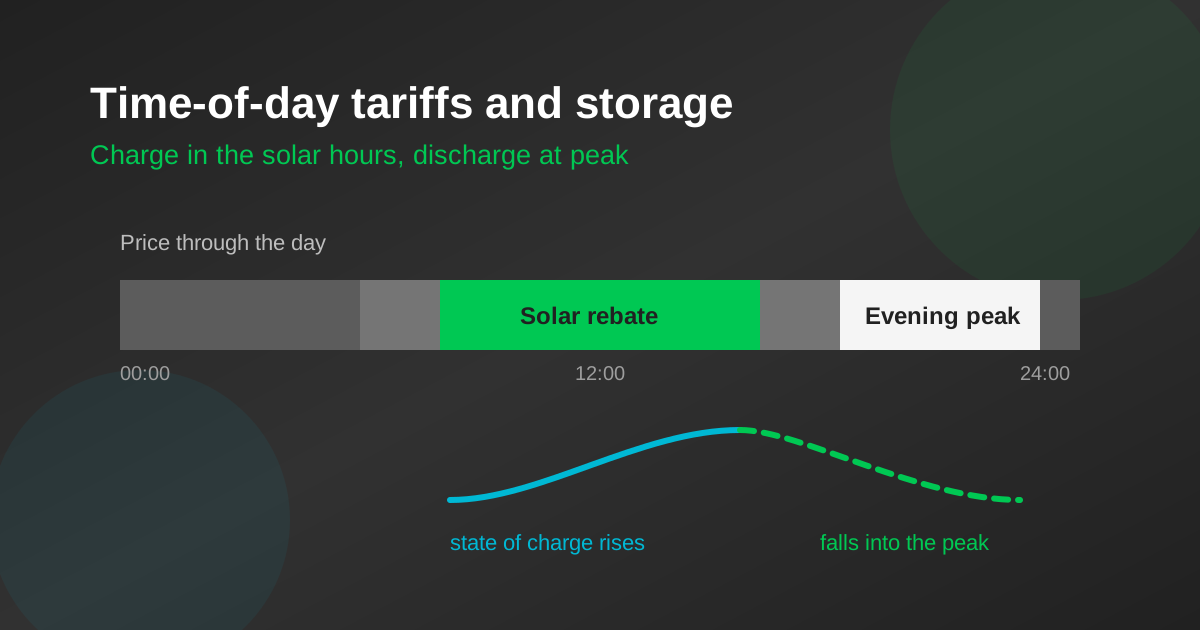
As large amounts of solar capacity have connected, the grid now has a surplus of low-cost energy around midday and a steep ramp as the sun sets, just as evening demand arrives. The expensive hours are now the hours after sunset, when solar has gone and thermal and hydro have to cover a rising load. National guidance has pushed states in the same direction: solar hours priced lower, evening hours priced higher.
The practical consequence for storage is significant. Under the old pattern, a battery charged at night and discharged in the day. Under the new one, it charges in the solar window — from the grid at a rebate, or from your own rooftop — and discharges into the evening peak. That fits a two-to-four-hour battery and a factory that runs a second shift very naturally.
How a battery turns the spread into a saving
The mechanism is energy shifting. The battery buys units in the rebate window and releases them in the surcharge window, so the meter records less consumption at the expensive rate and more at the cheap rate. The headline value per cycle is roughly the spread between the two rates multiplied by the energy shifted.
Three things reduce that headline before it reaches your bank account:
- •Round-trip losses. A lithium iron phosphate system typically returns 85 to 90 per cent of the energy put in at the AC side, so you buy more units than you sell back
- •Degradation. Each cycle consumes a little of the battery’s life, and that cost belongs in the arithmetic
- •Usable window length. If the peak window is shorter than the battery’s duration, part of the stored energy spills into normal hours where the spread is smaller
The result is that ToD arbitrage on its own is often a thin margin. It becomes worthwhile when it is stacked with something else that the same battery is already doing.
The interaction with demand charges
Most C&I tariffs bill twice: once for energy, once for the maximum demand you recorded or contracted. ToD affects the energy line. Demand charges affect the capacity line. A battery can work on both, but the two duties compete for the same stored energy.
The evening peak window is often when a two-shift factory’s demand is also highest, which is helpful — discharging there serves both. The conflict arrives when a demand spike occurs after the battery has already emptied itself into the ToD window. The meter records the spike, and the month’s demand charge is set by it.
A sensible control strategy therefore holds a reserve for peak shaving and only arbitrages with the remainder. We cover the demand side in detail in peak shaving and demand charges, and the other ways a site battery earns its keep in where the savings actually come from.
Reading your own bill
You can establish most of what matters from a year of bills and the current tariff order. Look for:
- •Whether ToD applies to your category at all, and whether it is mandatory or opted into
- •Consumption split by period — most HT bills show units recorded in each ToD slot
- •The surcharge and rebate percentages, and the base energy charge they are applied to
- •The exact hours of each window, including any seasonal variation between summer and winter
- •Recorded maximum demand, contract demand, and the rate per kVA or kW
- •Whether demand is measured over a 15-minute or 30-minute interval
If your bill shows a large share of units in the peak slot, and the spread between peak and solar-hour rates is meaningful, there is something for a battery to work with. If almost all your consumption is already in normal or rebate hours, ToD alone will not justify storage.
What this means for a buying decision
ToD tariffs are a reason to look at storage, not a reason to buy it. The spread is set by a regulator and can move in either direction at the next tariff order. A case that depends entirely on today’s spread carries regulatory risk for the whole life of the asset.
The more robust case combines ToD shifting with demand-charge reduction and, where you have it, rooftop solar that would otherwise be exported cheaply. Put your own peak-slot consumption and current rates into the BESS savings calculator and test what happens if the spread narrows. If the numbers still work at a smaller spread, the case is sound. If they only work at today’s, treat it as a bet on the next tariff order.
Terms in this article
Frequently asked questions
What is a time-of-day electricity tariff?+
A tariff that prices electricity differently depending on when it is used. The day is divided into peak, normal and off-peak windows, and energy in each carries a surcharge, the base rate or a rebate. The windows and rates are set by each state regulator in its tariff order.
Why are solar hours now cheaper than night in many ToD tariffs?+
Large amounts of solar generation now reach the grid around midday, creating a surplus of low-cost energy, while the expensive hours have moved to the evening when solar output falls and demand rises. Many states have redrawn their windows to reflect this, pricing solar hours lower and evening hours higher.
Can a battery save money under a ToD tariff on its own?+
It can, but the margin is often thin once round-trip losses and battery wear are counted. The case is usually stronger when time-of-day shifting is combined with demand-charge reduction and storing on-site solar. Check the current spread in your discom’s tariff schedule rather than relying on a generic figure.
Is storage right for your site?
Send us a month of electricity bills and your load profile, and we will tell you what a battery would save — including when it would not pay.