AC-Coupled vs DC-Coupled Solar-Plus-Storage: Which Architecture Fits Your Site
Whether a battery joins a solar system on the AC side or the DC side shapes its efficiency, its ability to capture clipped solar, and how easily it can be added later.
Published: 11 October 2026
C&I storage · 5 min read
Where the battery joins the circuit
Solar panels produce direct current. Batteries store direct current. The grid and almost every load in a building run on alternating current. Put solar and storage on the same site and there is an unavoidable design question: at which point does the battery join the electrical system?
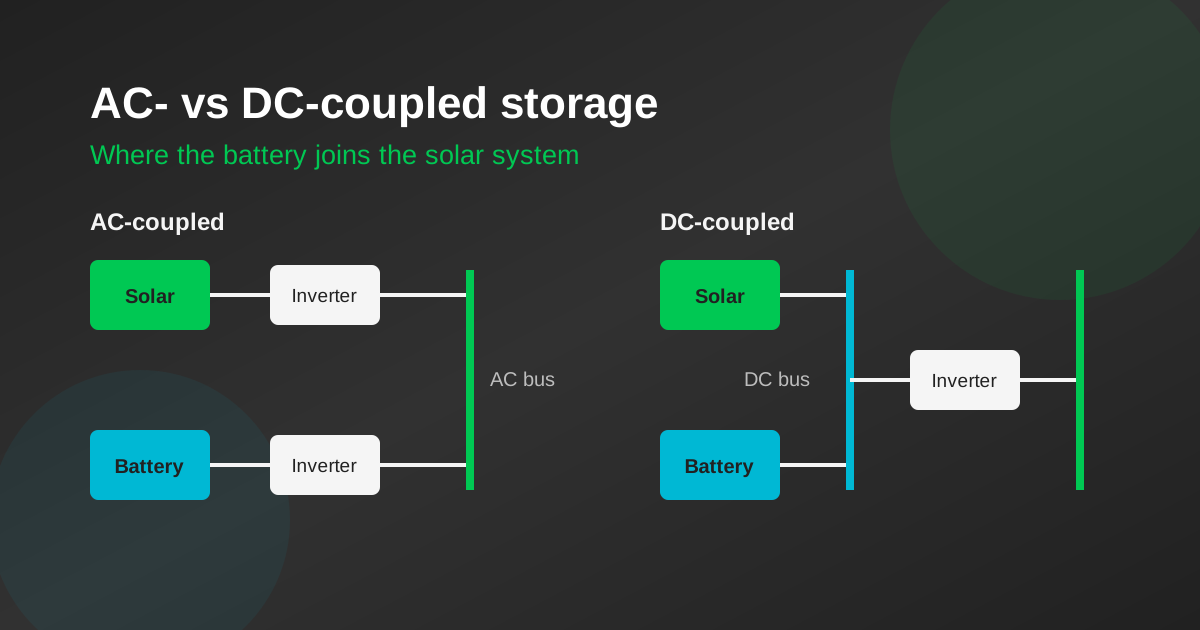
There are two answers. In an AC-coupled system the battery has its own bidirectional inverter and connects to the AC side, alongside the solar inverter. In a DC-coupled system the battery connects to the DC side of the solar array, through a DC-DC converter, and shares one inverter with the panels. Everything else — efficiency, flexibility, cost, ease of retrofit — follows from that choice.
The two architectures in practice
- •AC-coupled. Solar panels feed a solar inverter; the battery feeds its own power conversion system; both connect to the same AC busbar or switchboard. Each runs independently, and the site controller co-ordinates them.
- •DC-coupled. Solar panels and the battery share a DC bus. A DC-DC converter manages battery charge and discharge, and a single inverter connects the combination to the AC side. At home scale the same idea appears as a hybrid inverter with panel and battery inputs.
Neither is universally better. They suit different sites, different stages of a project and different jobs for the battery.
Efficiency: counting conversions
Every conversion between AC and DC, or between DC voltages, loses a little energy — typically one to three per cent per step with modern equipment. So the useful comparison is the number of steps a unit of solar energy takes on its way through the battery to the load.
In an AC-coupled system, solar energy destined for the battery is inverted to AC by the solar inverter, rectified back to DC by the battery inverter, stored, then inverted to AC again on discharge: three conversions. In a DC-coupled system it passes through a DC-DC converter into the battery and is inverted once on the way out: two conversions. On stored solar energy, DC coupling therefore saves a few percentage points.
The advantage shrinks or reverses when the battery is mostly charged from the grid, as it often is for peak shaving or tariff arbitrage, because grid energy has to be converted to DC either way. Where efficiency matters, ask about the specific path your energy will take, and set it against the full loss chain including cooling and standby.
Clipping recapture and inverter sizing
Utility solar plants are usually built with more panel capacity than inverter capacity — a DC-to-AC ratio of perhaps 1.2 to 1.4 — because panels rarely reach their rated output and the extra panels raise generation in the mornings, evenings and cloudy hours. The price is clipping: around midday on clear days, the panels could produce more than the inverter can pass, and the surplus is thrown away.
A DC-coupled battery sits upstream of the inverter, so it can absorb that clipped energy and release it later when the inverter has spare capacity. An AC-coupled battery cannot, because the energy is lost before it reaches the AC side. For a plant designed with a high DC-to-AC ratio this recaptured energy can be meaningful.
The shared inverter is also a ceiling. In a DC-coupled system, solar and battery output together cannot exceed the one inverter’s rating. If you want the battery to discharge at full power while the sun is also at full strength, AC coupling or a larger shared inverter is needed. Size the inverter for the combined duty, not for solar alone.
Retrofits versus new builds
AC coupling is the natural choice for adding storage to an existing solar installation. The solar inverters stay as they are; the battery and its own inverter connect to the same switchboard; the existing system and its warranties are left alone. It also means the battery can be sized, located and replaced independently of the solar plant, and a fault in one does not take the other down.
DC coupling is easiest to get right when it is designed in from the start: the panel strings, DC bus voltage, converter and shared inverter all have to be chosen together. Converting an existing plant to DC coupling usually means replacing inverters, re-doing string design and revisiting the connection approval, which removes most of its cost advantage.
Which suits Indian sites
C&I rooftops. Most Indian factories and commercial buildings that add storage already have rooftop solar with string inverters in place. The battery’s main job is usually managing maximum demand and time-of-day charges for the whole site, which depends on the building load, not just on solar. AC coupling at the low-tension switchboard fits both facts, and it lets the battery charge from the grid at night where the tariff makes that worthwhile. Our guides to storage for factories and offices and sizing a commercial BESS cover the load side.
Utility solar-plus-storage. For a new co-located plant whose aim is to shift midday solar into the evening, DC coupling has real attractions: clipping recapture, one fewer conversion on stored solar, and a shared inverter and grid connection. Where the battery must also charge from the grid or provide services independently of solar, AC coupling keeps those options cleaner.
Homes. Hybrid inverters, which are DC-coupled in principle, dominate new residential installations because they are compact and economical. AC coupling remains the route for adding a battery to an existing home solar system. Our guide to sizing solar and batteries for Indian homes covers that scale.
Making the choice
- •Is there existing solar, and are its inverters staying? If so, AC coupling is the default
- •Will the battery mostly store solar, or mostly manage grid demand and tariffs?
- •Does the solar design clip at midday, and by how much?
- •Does the battery need to discharge at full power while solar is also at full output?
- •How important is it that solar keeps running if the battery system is down, or the reverse?
Answer those and the architecture usually chooses itself. A proposal that recommends one approach without explaining it against these questions has skipped the most important step in the design.
Terms in this article
Frequently asked questions
What is the difference between AC-coupled and DC-coupled storage?+
In an AC-coupled system the battery has its own inverter and connects on the AC side alongside the solar inverter. In a DC-coupled system the battery connects to the solar array’s DC side through a DC-DC converter and shares a single inverter with the panels.
Is DC coupling more efficient?+
For solar energy that is stored and later discharged, usually yes, because it passes through two conversions instead of three. The advantage shrinks when the battery is mostly charged from the grid, as it often is for peak shaving or tariff arbitrage, because grid energy has to be converted to DC either way.
Which is better for adding a battery to existing rooftop solar?+
AC coupling is usually the practical choice. The existing solar inverters and their warranties stay untouched, and the battery connects with its own inverter at the same switchboard. Converting an existing plant to DC coupling generally means replacing inverters and redesigning strings.
Is storage right for your site?
Send us a month of electricity bills and your load profile, and we will tell you what a battery would save — including when it would not pay.