Reading a BESS Warranty: Capacity, Throughput and Performance Guarantees
A storage warranty is closer to a service contract than a product guarantee. Retention curves, throughput caps, availability, liquidated damages and operating limits decide what it is worth.
Published: 11 October 2026
C&I storage · 5 min read
Two documents, not one
A stationary storage contract usually carries two separate promises that are easy to read as one. The product warranty says the equipment is free of defects and will be repaired or replaced if it fails. The performance guarantee says the system will deliver a stated amount of energy, at a stated efficiency, for a stated share of the time, and puts money on the table if it does not.
The first protects you against broken hardware. The second protects the business case. They have different terms, different remedies and often different counterparties, and the gap between them is where disputes start.
The capacity retention curve
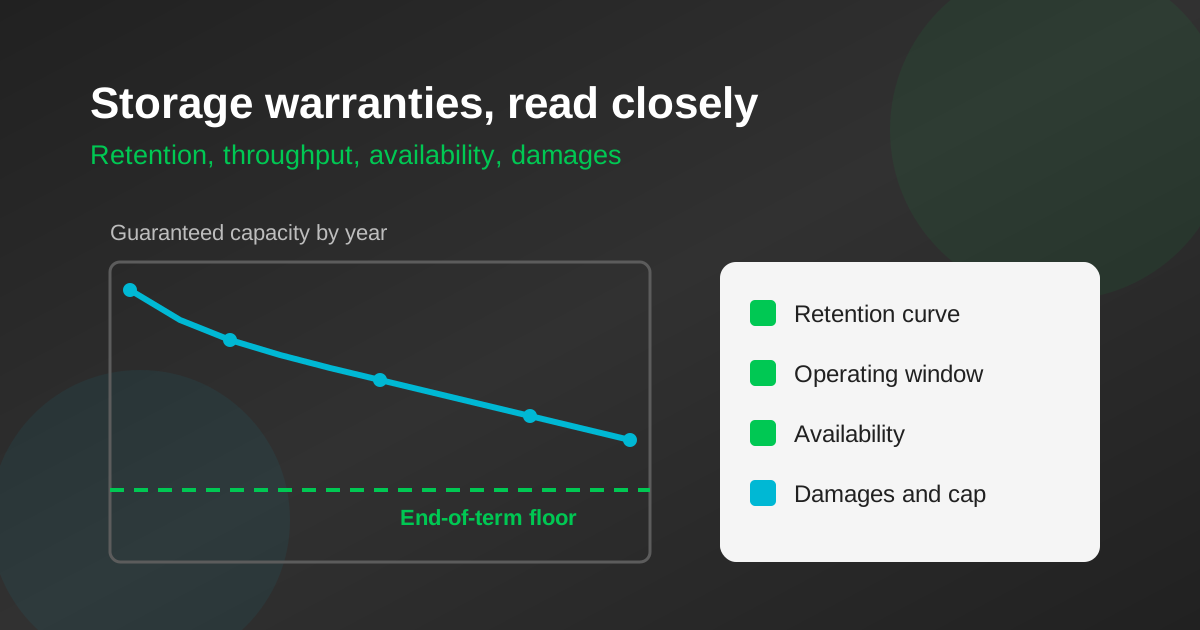
At the heart of any performance guarantee is a table: for each year of operation, the minimum energy the system will hold, usually expressed as a percentage of its capacity at commissioning or as a usable kWh figure. A common shape for an LFP system starts close to 100 per cent, falls faster in the first couple of years, then declines slowly towards somewhere in the 60–80 per cent range at the end of the term, depending on the duty the curve was written for.
Read three things on that curve. First, whether it is stated in usable or nameplate kWh, because the difference can be ten per cent or more. Second, whether it is measured at the DC side or at the point of connection. Third, how it is tested: the charge and discharge rate, the temperature, the state-of-charge limits and the frequency of tests. A capacity test run at a gentle rate on a cool morning will flatter any system.
The limits that sit beside it
A retention curve is never unconditional. It assumes a particular way of using the system, and the warranty spells out that assumption as a set of operating limits. Breaching them can reduce the guarantee or void it.
- •Energy throughput cap. A ceiling on the total MWh that may pass through the battery over the term, often equivalent to one full cycle a day or less. Exceed it and the guarantee may end early, even if the calendar term has not.
- •Cycles per day. Some warranties cap daily cycles separately, which matters if you plan to stack peak shaving with arbitrage.
- •C-rate. A maximum charge and discharge rate, commonly 0.5C or 1C for stationary LFP, sometimes with a separate limit on how long higher rates can be sustained.
- •State-of-charge window. Limits on how full and how empty the cells may be kept, and sometimes on how long they may rest at a high state of charge.
- •Temperature. A required cell or room temperature band, which in practice means the cooling system must keep working. In Indian summers this is the condition most likely to be tested.
Availability, damages and augmentation
For larger systems the guarantee extends beyond capacity. Availability is the share of time the system is ready to operate at its rated power, typically guaranteed somewhere in the high nineties per cent over a year. The definition matters more than the number: whether grid outages, scheduled maintenance and waiting for spare parts count against the supplier or are carved out.
Liquidated damages are the agreed payments when a guarantee is missed — so much per percentage point of availability shortfall, or per kWh of missing capacity. They are almost always capped, often as a share of the contract value or of annual service fees. A low cap turns a strong-sounding guarantee into a modest rebate.
Augmentation is the supplier’s obligation to add capacity during the term so the system keeps meeting the retention curve. Under a long-term service agreement this can be the supplier’s problem, at their cost. Without one, the curve simply describes your decline. If augmentation is promised, check that the site was laid out to accommodate it; our note on sizing for power, energy and duration covers why that has to be decided on day one.
Data is a condition, not a courtesy
Nearly every stationary storage warranty requires continuous monitoring: the battery management system logs, the cooling system status and the dispatch history, retained for the life of the system and accessible to the supplier, often by remote connection. Gaps in the data can be treated as a breach of operating conditions, on the reasoning that the supplier can no longer show the system was used within limits.
Two practical consequences follow. Keep the communications link up and budget for it. And ask whether replacing the supplier’s energy management software with a third-party controller affects the warranty, because some suppliers make their guarantee conditional on their own control logic.
Check the chain behind the integrator. The company that sells you the system often buys cells, inverters and containers from others. Ask whether their warranty to you is backed by matching warranties from their own suppliers, and what happens to your cover if the integrator stops trading.
How this differs from an EV battery warranty
An electric vehicle pack warranty is a product warranty and little else: a term in years, a limit in kilometres or cycles, a health threshold below which the pack is deemed failed, and a repair or replacement remedy. We walk through those four elements in how lithium battery warranty terms work.
A storage warranty is closer to a service contract. It guarantees an outcome over time, measures it with agreed tests, and pays compensation rather than only fixing parts. That is appropriate: a factory or a grid operator buying storage is buying a revenue or a saving, and the guarantee is meant to protect that.
What to settle before signing
- •The retention curve, year by year, in usable kWh at the point of connection
- •The capacity test procedure, its frequency, and who witnesses it
- •The throughput cap and daily cycle limit, checked against your intended duty
- •The operating window for temperature, C-rate and state of charge
- •The availability definition and every exclusion from it
- •Liquidated damages rates and the overall cap
- •Who pays for augmentation, and whether the site has room for it
- •Data and remote-access obligations, and the effect of a third-party EMS
None of this is adversarial. A supplier confident in their product will put clear numbers against each line, and the commissioning tests described in our guide to building and commissioning a BESS then become the baseline everyone measures against.
Terms in this article
Frequently asked questions
What is the difference between a BESS product warranty and a performance guarantee?+
The product warranty covers defects in the equipment and promises repair or replacement. The performance guarantee promises outcomes over time, such as usable capacity each year, efficiency and availability, and usually pays agreed compensation if they are missed. They often have different terms and sometimes different counterparties.
What is an energy throughput cap?+
It is a ceiling on the total energy that may pass through the battery during the warranty term, often set around one full cycle a day or less. If you exceed it, the capacity guarantee can end early even though the calendar term has not run out. Check it against how often you actually plan to cycle the system.
What does augmentation mean in a storage contract?+
Augmentation means adding battery capacity during the life of the system so that it continues to meet its guaranteed energy. Under some long-term service agreements the supplier must do this at its own cost. The site needs physical and electrical room for the extra equipment, which has to be planned at the start.
Can operating conditions void a battery storage warranty?+
Yes. Warranties usually set limits on temperature, charge and discharge rate, state-of-charge window and cycles per day, and require continuous monitoring data. Operating outside those limits, or losing the data that proves you stayed within them, can reduce or void the guarantee.
Is storage right for your site?
Send us a month of electricity bills and your load profile, and we will tell you what a battery would save — including when it would not pay.