Round-Trip Efficiency: Where the Energy Goes in a Battery Storage System
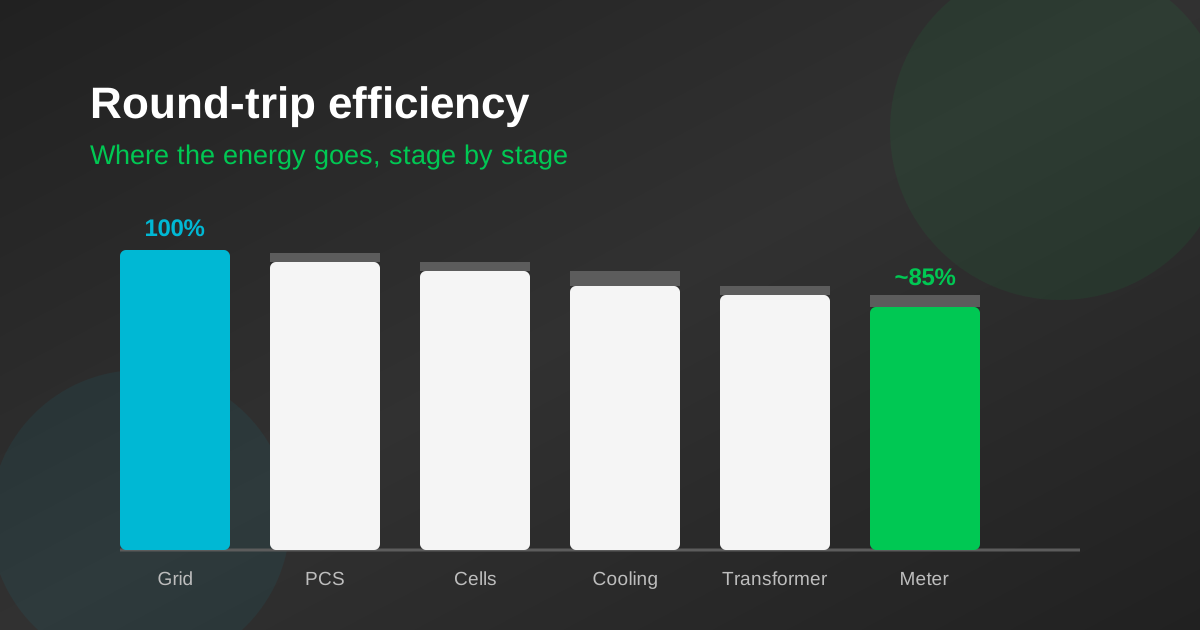
A battery quoted at 95 per cent efficient often returns about 85 per cent at the meter. The losses sit in the cells, the inverter, the transformer and the cooling, and they change the arbitrage maths.
Published: 11 October 2026
Explainer · 5 min read
One number, measured in different places
Round-trip efficiency is the share of energy you get back out of a storage system for every unit you put in. Charge it with 100 kWh, recover 85 kWh, and the round-trip efficiency is 85 per cent. Simple enough — until you notice that two brochures for similar systems quote 95 per cent and 86 per cent, and both are telling the truth.
The difference is where the meter sits. Energy is lost at every stage between the grid and the cells and back again, and a figure measured at the cell terminals leaves out most of those stages. The number that matters to whoever pays the bill is the one measured at the point where the system connects to the site or the grid, over a realistic duty cycle, including everything the system consumes to keep itself alive.
The loss chain, stage by stage
Follow a kilowatt-hour from the grid into the battery and back out. Typical ranges for a modern lithium iron phosphate (LFP) system look like this:
- •The cells. Internal resistance turns a little of every charge and discharge into heat. LFP cells at moderate rates typically return 94–97 per cent of what they absorb, measured in DC. Push them harder and the figure drops, because resistive loss rises with the square of current.
- •The power conversion system (PCS). The inverter converts AC to DC on the way in and DC to AC on the way out. A good utility or commercial PCS is around 97–98.5 per cent efficient each way near its rated load, so two passes cost three to five per cent. At light load efficiency falls off noticeably.
- •The transformer. Where the system connects at medium voltage, a step-up transformer adds core and copper losses, usually half a per cent to one per cent per pass. The core loss is there whenever the transformer is energised, whether the battery is working or not.
- •Auxiliary load. Cooling, controls, fire detection, lighting and communications all draw power. In a hot climate the HVAC or liquid-cooling chiller is the dominant term, and it can amount to several per cent of annual throughput on its own.
- •Standby and self-discharge. Between cycles the cells lose a small amount of charge, the PCS idles, and the auxiliary systems keep running. A system that cycles once a day and sits idle for eighteen hours pays this cost for most of its life.
How 95 per cent becomes 85
Multiply the stages together and the arithmetic does the rest. Take 1,000 kWh drawn from the grid. After the transformer (99 per cent) there are 990 kWh; after the PCS charging pass (98 per cent), 970 kWh reach the cells. The cells give back 95 per cent, so 922 kWh leave them. The PCS discharging pass leaves 903 kWh, and the transformer 894 kWh.
Now subtract the auxiliary load over the same cycle — say 40 kWh for cooling and controls on a warm day — and the meter sees about 854 kWh returned for 1,000 kWh bought. That is roughly 85 per cent, from a system whose cells are honestly described as 95 per cent efficient.
DC RTE versus AC RTE. A DC round-trip figure covers the battery side only, usually the cells and racks. An AC round-trip figure includes the PCS and, if stated at the point of connection, the transformer. Neither includes auxiliary load unless the document says so explicitly. Ask which boundary the number was drawn around, and whether auxiliary consumption is netted off.
Why Indian conditions push the number down
Auxiliary load is where climate shows up. Cells want to sit at roughly room temperature, and for much of the year Indian ambient conditions are well above it. A container in Rajasthan or Vidarbha in May runs its cooling harder than the same container in a temperate climate, and that energy comes out of the round trip.
Duty cycle matters too. A system cycled hard every day spreads its fixed standby losses over a lot of throughput, so they barely register. A system used occasionally for backup or for a few peak-shaving events a week carries the same idle losses over far less throughput, and its effective efficiency can be strikingly poor. Partial-load operation compounds this: an inverter running at a tenth of its rating is well off its best point on the efficiency curve.
What it does to arbitrage maths
The obvious error is to compare tariffs directly. If off-peak power costs ₹4 per kWh and peak power costs ₹9, the tempting conclusion is a spread of ₹5 on every unit shifted. It is not.
At 85 per cent round-trip efficiency, each kWh delivered at peak needs about 1.18 kWh bought off-peak. The effective cost of a stored unit is therefore ₹4 divided by 0.85, or about ₹4.71, and the real spread is ₹4.29. That is fourteen per cent less than the headline difference, on every cycle, for the life of the system.
The same logic gives a break-even rule: the peak price has to exceed the off-peak price divided by the round-trip efficiency before shifting energy earns anything at all, before even counting degradation. You can test your own tariffs and efficiency assumption in the BESS savings calculator.
Peak shaving is less sensitive, because its value comes from the demand charge avoided rather than the energy price difference; our explainer on peak shaving and demand charges explains why. Losses still cost money there, just a smaller share of the value.
Efficiency also drifts with age
Round-trip efficiency is not fixed at commissioning. As cells age their internal resistance rises, which means more heat per cycle, which means slightly lower cell efficiency and slightly more cooling. The drift is gradual over a well-managed LFP system’s life, but a fifteen-year financial model that holds efficiency constant at its day-one value is mildly optimistic every year after the first few.
What to ask for when buying
Efficiency is one of the few specifications a buyer can verify after installation, because the meter records both directions. That makes it worth pinning down in the contract rather than the brochure.
- •The round-trip efficiency at the point of connection, not at the cells or the inverter terminals
- •Whether auxiliary consumption is included, and the expected annual auxiliary energy in kWh
- •The test conditions: charge and discharge rate, ambient temperature, state-of-charge window
- •Efficiency at partial load, if your duty cycle will often run the PCS well below rating
- •Whether efficiency is guaranteed, how it is tested, and what happens if it falls short
A quote that says 95 per cent and a quote that says 86 per cent may describe the same hardware. The one that tells you where it measured is the one you can plan around. For how efficiency interacts with the other headline ratings, see our guide to sizing a commercial BESS.
Terms in this article
Frequently asked questions
What is round-trip efficiency in battery storage?+
It is the share of energy you get back out of a storage system for every unit you put in. A system that returns 85 kWh for every 100 kWh used to charge it has a round-trip efficiency of 85 per cent. The figure depends heavily on where it is measured.
Why is the quoted efficiency higher than what I see at the meter?+
Quoted figures are often measured at the cells or the inverter terminals. Between there and the meter sit the inverter in both directions, the transformer, and the auxiliary load for cooling and controls. Together these typically bring a 95 per cent cell figure down to around 85 per cent at the point of connection.
What is the difference between AC and DC round-trip efficiency?+
DC round-trip efficiency covers only the battery side, usually the cells and racks. AC round-trip efficiency includes the inverter and, if measured at the grid connection, the transformer. Neither includes auxiliary consumption unless the document says so explicitly.
How does efficiency affect battery arbitrage?+
Each kWh discharged needs more than one kWh bought to charge it, so the effective cost of stored energy is the charging price divided by the round-trip efficiency. At 85 per cent, power bought at ₹4 effectively costs about ₹4.71 by the time it is delivered, which narrows the spread on every cycle.
Want this applied to your own numbers?
Every solution page carries a calculator that shows its own arithmetic — storage savings, lithium against lead-acid, and home pack sizing.