Liquid vs Air Cooling in Battery Storage: Which Suits Your Site?
Cooling decides how evenly a battery ages, how much power it uses on itself, and how it copes with Indian heat and dust. How air and liquid cooling compare, and when each makes sense.
Published: 11 October 2026
Explainer · 5 min read
Batteries are fussy about temperature
A lithium iron phosphate cell is happiest in a narrow band, roughly 15 to 35 °C, and ideally near the middle of it. Above that band the side reactions that age a cell speed up; a common rule of thumb is that sustained operation ten degrees hotter roughly doubles the rate of calendar ageing. Below it, charging becomes risky and capacity temporarily falls.
A storage system also generates its own heat. Every charge and discharge loses a few per cent of the energy as heat inside the cells and the power electronics. Put that inside a sealed enclosure, on a concrete pad, in a Rajasthan or Vidarbha summer, and the cooling system becomes one of the most important decisions in the design.
The choice is usually framed as air versus liquid. This article explains how each works, what each costs to run, and where each makes sense.
How each system works
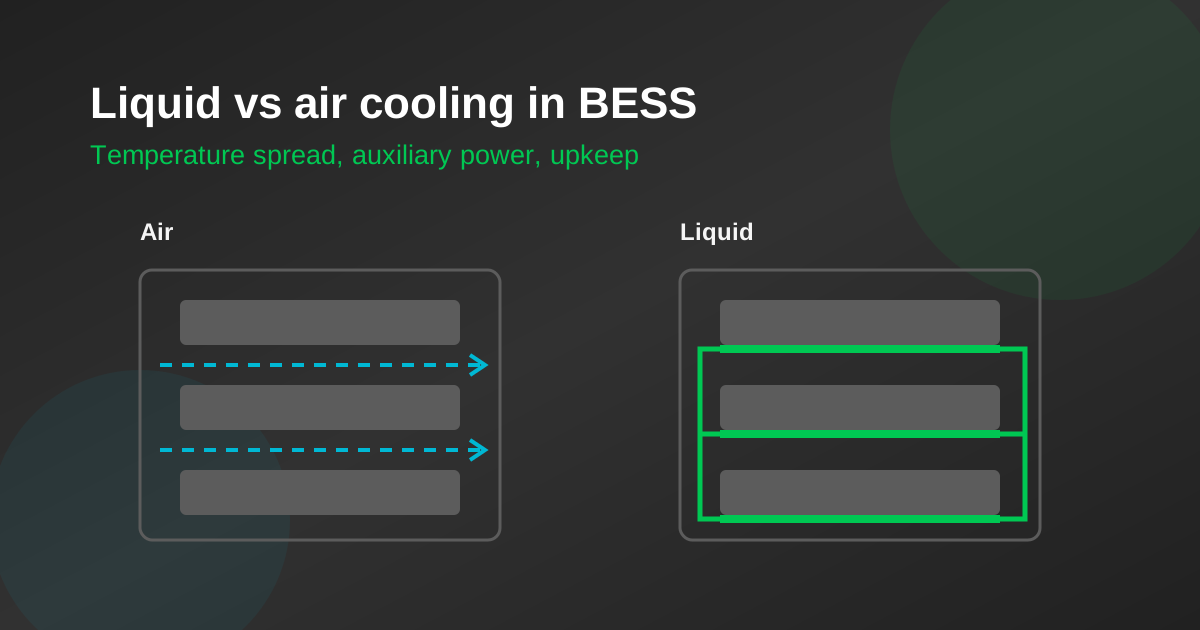
- •Forced-air cooling. An air conditioner or heat exchanger conditions the air inside the enclosure, and fans push it through the racks and between the modules. The cells are cooled by air passing over their surfaces.
- •Liquid cooling. A water-glycol coolant is pumped through cold plates in direct contact with the cells, picking up heat at source. A chiller outside the battery compartment rejects that heat to the outside air.
The physics favours liquid. Water-glycol carries far more heat per unit volume than air, and contact with a cold plate takes heat out of the cell directly instead of relying on air to reach every surface. The engineering question is whether that advantage is needed for a given system.
Uniformity matters more than the average
The headline temperature of a battery tells you less than the spread. If the cells at the top of a rack run eight degrees warmer than those at the bottom, they age faster. Over a few years they lose more capacity, and because the cells are in series, the weakest cells start to limit the whole string.
This is the main argument for liquid cooling. Well-designed liquid systems typically hold the cell-to-cell temperature spread to within about 3 to 5 °C. Air systems commonly see wider spreads, depending on airflow design and how densely the racks are packed. Uniform temperature means uniform ageing, which means the system’s usable capacity holds up for longer.
The trend towards larger cells makes this sharper. A big prismatic cell has more mass between its core and its surface, and air struggles to pull heat out evenly. That is one reason container-scale systems have moved almost entirely to liquid cooling.
Auxiliary power and maintenance
Cooling is paid for from the energy the battery would otherwise deliver, or bought from the grid separately. This auxiliary load is easy to overlook in a proposal and can be material in Indian conditions.
- •Liquid systems usually draw less auxiliary power for the same heat removed, because pumping liquid is more efficient than moving large volumes of air
- •Air systems are mechanically simpler: fans, filters and an air conditioner that any HVAC technician can service
- •Liquid systems add pumps, a chiller, coolant, hoses and fittings, and a leak becomes a failure mode that needs detection
- •Coolant needs periodic checking for level, concentration and contamination, on a schedule the supplier should state
- •Both need the outdoor heat-rejection unit kept clean; a clogged condenser coil hurts either design
Ask any supplier for the expected auxiliary consumption at your site’s summer ambient, not at a laboratory 25 °C. The two can be very different.
Dust, heat and Indian sites
Many Indian industrial sites combine high summer temperatures with fine dust, from roads, construction, cement or the process itself. This is where the two approaches diverge most.
An air-cooled system that draws outside air through the enclosure brings that dust to the cells, so it relies on filters that clog and must be changed on schedule. Closed-loop air designs avoid this but need a heat exchanger or air conditioner sized for the worst day. Liquid-cooled enclosures are typically sealed to a higher ingress rating, because the battery compartment does not need to exchange air with the outside at all.
Placement matters as much as technology. Shade, ventilation around the outdoor unit, and distance from heat sources all affect both designs. Our article on lithium batteries in Indian summer heat covers the cell-level effects, and balance of plant puts cooling in the context of everything else around the cells.
When each makes sense
- •Air cooling suits smaller cabinet systems at commercial buildings and light industrial sites, especially at modest power relative to energy (a C-rate of 0.5 or lower), where heat generation is gentle and the installation is indoors or shaded.
- •Liquid cooling suits container-scale systems, high-power applications that cycle hard, dense designs using large cells, and hot or dusty outdoor sites.
The C-rate point is worth understanding. A system discharging its full energy over four hours generates much less heat per cell than one asked to do it in one hour. Our guide to sizing a C&I battery in kW and kWh explains how that ratio is set.
What this means for a buyer
Neither technology is right in every case. A well-designed air-cooled cabinet in a shaded plant room can serve a factory well for its full life; a poorly specified one on an exposed roof will age early regardless of the cells inside it.
When comparing proposals, ask for the cooling design’s rated ambient range, the guaranteed cell temperature spread, the auxiliary consumption at your summer peak, the maintenance schedule and its cost, and whether the capacity warranty depends on the cooling being maintained in a particular way. Those answers tell you more about how the system will perform in year eight than the cooling label on the brochure.
Terms in this article
Frequently asked questions
Is liquid cooling better than air cooling for battery storage?+
Liquid cooling usually holds cells at a more uniform temperature and uses less auxiliary power for the same heat removed, which is why container-scale systems have largely adopted it. Air cooling is simpler and easier to service, and suits smaller cabinet systems at modest power in shaded or indoor locations.
Why does temperature uniformity matter in a battery?+
Cells that run hotter age faster. If some cells in a string run several degrees warmer than others, they lose capacity sooner, and because cells are connected in series the weakest ones limit the whole string. A tight temperature spread keeps ageing even and usable capacity higher for longer.
What maintenance does a liquid-cooled BESS need?+
Periodic checks of coolant level, concentration and contamination, inspection of pumps, hoses and fittings for leaks, and cleaning of the outdoor chiller’s heat-rejection coil. The supplier should state the schedule and whether the capacity warranty depends on it being followed.
Want this applied to your own numbers?
Every solution page carries a calculator that shows its own arithmetic — storage savings, lithium against lead-acid, and home pack sizing.