Why Storage Cells Keep Getting Bigger: 280Ah, 314Ah and 500Ah+
LFP storage cells have grown from 280Ah to 314Ah to 500Ah and beyond. Why bigger cells make cheaper, denser systems, what they give up, and what to ask when quotes use different cells.
Published: 11 October 2026
Explainer · 5 min read
A quiet race in amp-hours
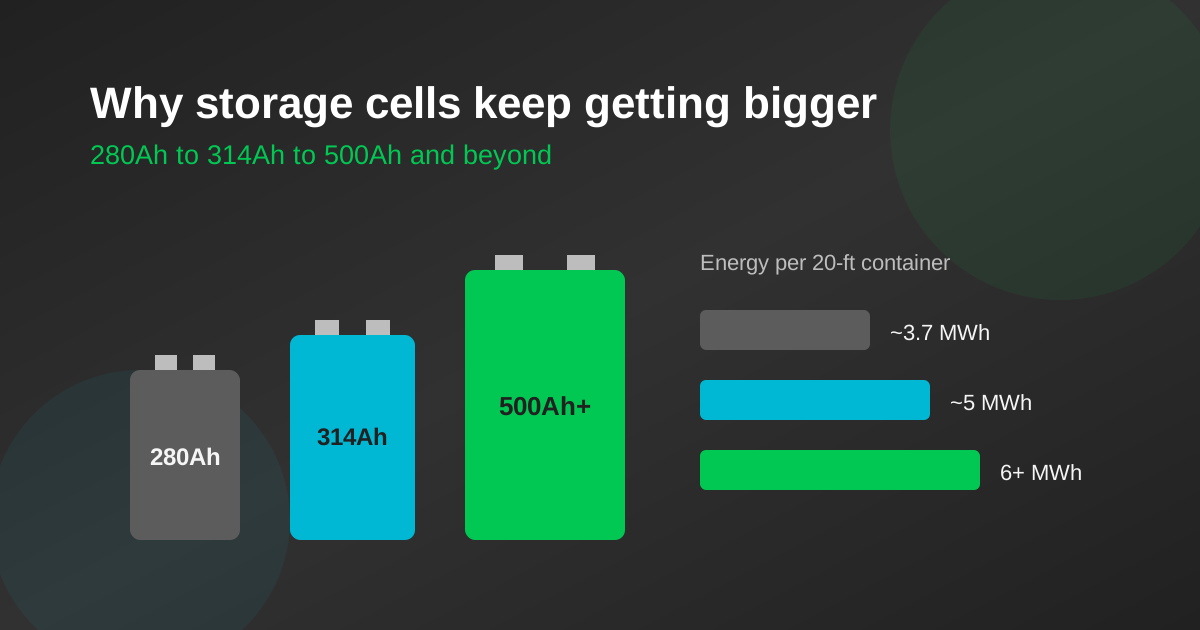
Battery storage has a size race that rarely makes headlines. The cell inside a stationary storage system — almost always a large prismatic lithium iron phosphate cell — has grown steadily in capacity. For several years the industry standard was the 280Ah cell. Then 314Ah became the default for new projects. Now manufacturers are shipping cells of 500Ah and more, and talking about larger ones.
Nominal voltage has stayed the same, at around 3.2 V for LFP. So each step up in amp-hours is a straight step up in energy per cell: a 280Ah cell holds roughly 0.9 kWh, a 314Ah cell roughly 1 kWh, and a 500Ah-plus cell 1.6 kWh or more. This article explains why the industry keeps doing this, what it gives up in exchange, and what it means when you are comparing quotes.
Why bigger cells are cheaper systems
A storage system is not just cells. Every cell needs a mechanical position, a busbar connection at each terminal, a voltage sense wire, and a slice of the BMS’s attention. Much of the cost and much of the failure risk lives in those connections, not in the chemistry.
- •Fewer parts. For the same energy, a larger cell means fewer cells, fewer welds, fewer busbars and fewer monitoring channels.
- •Better packing. Each cell has a casing, and casings and gaps take up space. Fewer, larger cells waste less volume on packaging.
- •Less assembly. Fewer cells to handle, test and place means lower factory labour and fewer opportunities for an assembly defect.
- •Lower site cost. More energy per enclosure means fewer enclosures, fewer foundations, less cabling and a smaller plot.
What it did to the container
The effect is most visible in the standard 20-foot container used for grid and large C&I projects. Built around 280Ah cells, a typical container held somewhere around 3.7 MWh. The move to 314Ah cells pushed the same footprint to roughly 5 MWh, helped by denser rack designs. Containers built on 500Ah-class cells are offered at 6 MWh and above.
That is close to a 60 to 70 per cent increase in energy per container in a few product generations, with the steel box itself unchanged. For a large project, that compounds into meaningfully less land, fewer foundations and shorter cable runs.
The same logic is filtering down into the cabinet-scale systems used at factories and commercial buildings, where 314Ah cells are now common.
What bigger cells give up
None of this is free. Larger cells change the engineering problem in ways a buyer should understand.
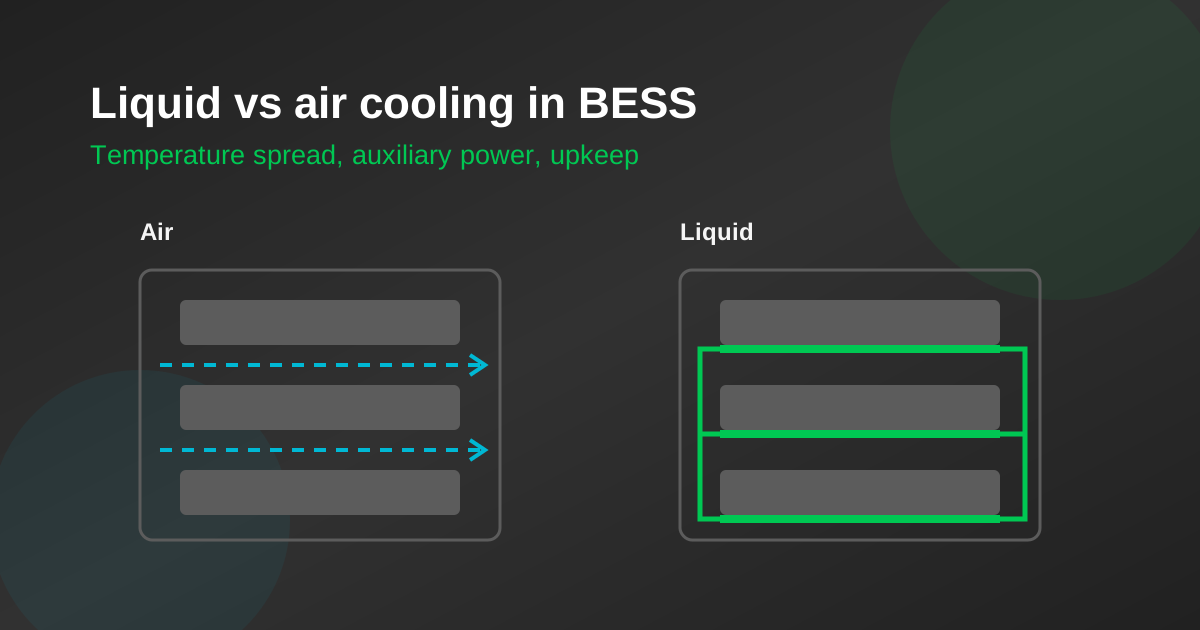
- •Thermal gradients. Heat generated in the middle of a large cell has further to travel to reach a cooled surface. The core can run warmer than the surface, and uneven temperature means uneven ageing inside a single cell
- •Failure consequence. A cell that goes into thermal runaway releases energy and gas in proportion to its size. More energy per cell and per container raises the stakes for spacing, venting and propagation testing
- •Coarser granularity. With fewer cells in series and parallel, a single weak cell is a larger share of the string, and the BMS has less room to work around it
- •Supply lock-in. Each cell format has a narrower field of qualified manufacturers in its early years. A design built on the newest format may have few alternative sources for replacements or augmentation
- •Less field history. A 280Ah cell has years of operating data behind it. The newest formats, by definition, do not
The industry’s answer to most of these is better thermal design — usually liquid cooling — and more rigorous propagation testing. Our article on BESS fire safety standards covers what that testing is meant to prove.
The augmentation problem
Format changes have a long tail that is easy to miss at purchase. Many storage contracts and business cases assume that, some years in, cells will be added or replaced to restore capacity lost to ageing. That plan quietly assumes compatible cells will still be on sale.
If the industry has moved on two formats by then, the original cell may be out of production. Mixing a new format into an old rack is rarely possible, because the dimensions, voltage curve and ageing behaviour differ, and the BMS is tuned to the original. The realistic options become a whole new rack or container alongside the old ones, or a stock of spare cells bought at the start and stored — which ages them too. Ask how augmentation will physically be done before you assume it will.
Comparing quotes when the cells differ
Two quotes for the same nominal kWh can be built on different cell formats, and the difference is not cosmetic. Ask each supplier:
- •Which cell format and capacity, from which cell manufacturer, and the cell datasheet
- •How long that cell has been in volume production, and how much is in the field
- •Whether replacement cells of the same format will be available for the warranty period, and how that is guaranteed
- •Usable energy, not just nominal — the depth of discharge and reserve the system actually runs at
- •The cell-to-cell temperature spread the thermal design achieves, and how it is measured
- •Propagation test results for the specific module and enclosure, not just the cell
Our guide to reading a lithium battery spec sheet explains which lines on a datasheet carry real information and which are marketing.
What this means for a buyer
Bigger cells are a genuine improvement, and they are a large part of why storage has become cheaper per kWh installed. For a factory, a newer format usually means a smaller footprint and a lower price for the same energy.
The judgement is about maturity. A well-established format from a manufacturer with a long production record is a lower-risk choice than the newest format from a supplier with limited history, even if the latter is a little cheaper on paper. Whichever you choose, the warranty, the replacement-cell commitment and the thermal design matter more than the headline amp-hours. If you are scoping a system, the commercial battery storage page sets out how we approach sizing and selection.
Terms in this article
Frequently asked questions
Why are battery storage cells getting bigger?+
Larger cells hold more energy each, so a system needs fewer cells, welds, busbars and monitoring channels for the same capacity. That lowers cost, packs more energy into each enclosure and reduces site work. The trade-off is harder thermal management and a larger consequence if a single cell fails.
How much energy does a 314Ah LFP cell hold?+
At the nominal LFP voltage of about 3.2 V, a 314Ah cell holds roughly 1 kWh, compared with about 0.9 kWh for a 280Ah cell. The usable energy in a system is lower, because it runs within a reserve at the top and bottom of the charge range.
Is a newer, larger cell format always the better choice?+
Not necessarily. Newer formats are usually cheaper per kWh and more compact, but they have less field history and fewer qualified suppliers in their early years. Ask how long the cell has been in volume production, and whether replacement cells will be available for the warranty period.
Want this applied to your own numbers?
Every solution page carries a calculator that shows its own arithmetic — storage savings, lithium against lead-acid, and home pack sizing.