Chinese Battery Testing and Pack Assembly Equipment: Who Makes What
Eleven Chinese makers of cell testers, graders, spot welders, balancers and end-of-line pack testers, grouped by plant size, and what an Indian pack maker should check before buying.
Published: 20 November 2026
Industry · 6 min read
What a pack plant actually has to test
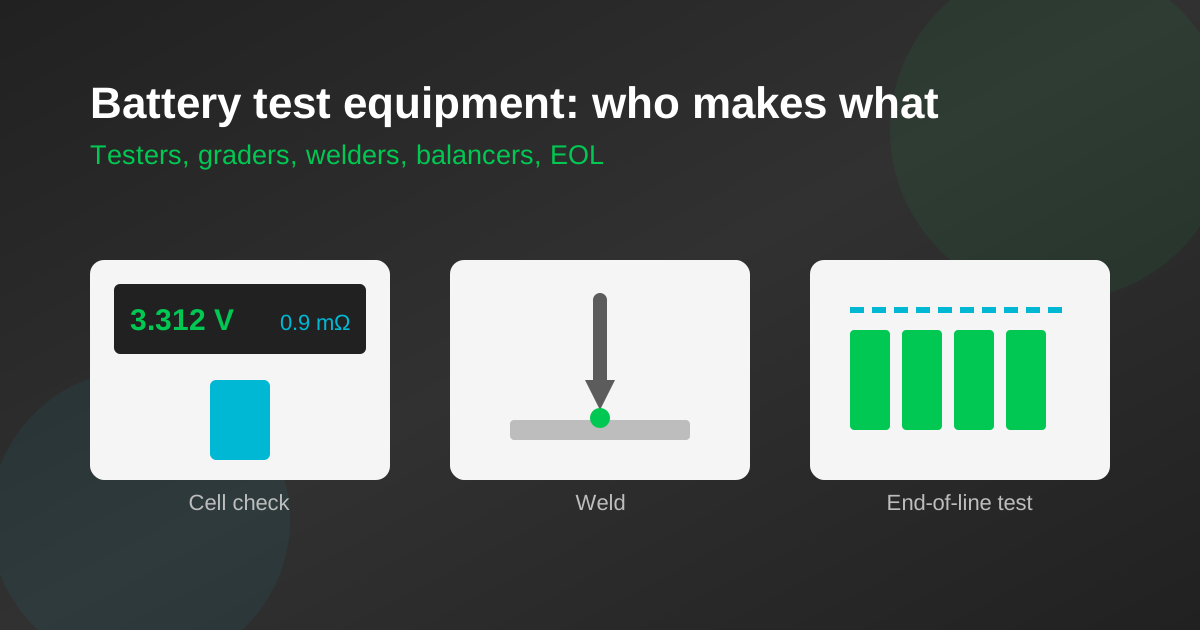
A lithium battery pack is only as good as its weakest cell, and most of the quality in a pack is decided before the first weld. The equipment below covers the steps an Indian pack assembler cannot skip, from checking incoming cells to proving the finished pack.
- •Incoming cell checks. Open- circuit voltage (OCV) and internal resistance on every cell, and a capacity test on a sample, so that a weak batch is caught before it is built into packs.
- •Grading and matching. Sorting cells into groups of close capacity and resistance. Mismatched cells are the commonest cause of a pack that fades early, as our explainer on cell balancing sets out.
- •Welding. Spot or laser welding of busbars and nickel strip, with consistent energy so joints neither heat the cell nor come loose.
- •Balancing. Bringing the groups in a series string to the same state of charge before a pack ships, and when it comes back for service.
- •End-of-line testing. Charging and discharging the finished pack, checking that the BMS trips where it should, and recording the result against the pack’s serial number.
- •Cycle testing. Running sample cells or packs through hundreds of cycles to check a supplier’s claims, which is how a quoted cycle life becomes something you have measured.
For small plants and pilot lines
These companies sell individual machines and bench equipment that a plant building a few hundred packs a month can buy one at a time.
- •Neware Technology (Shenzhen). Charge-discharge testers from single cells up to large packs, plus formation and grading systems and environmental chambers. Its testers are widely used in battery labs and quality-control rooms. Read the full profile.
- •Wuhan LAND Electronics (Wuhan). Compact, multi-channel battery test systems for cells, including lab-precision units, and a pack voltage and capacity matching unit. Listed on the Beijing Stock Exchange. Read the full profile.
- •Sunkko. Battery spot welders and internal-resistance testers at the low-cost end of the market, often the first welding equipment a small assembler buys. Read the full profile.
- •EnerKey (Shenzhen). Active balancers and equalizers for multi-cell series packs, and BMS protection boards, sold through Shenzhen Juyi. Useful for rebalancing packs in service. Read the full profile.
- •Xiamen Tmax Battery Equipments. Laboratory and pilot-line equipment, from testers to complete small pouch-cell and pack lines: a one-stop supplier for a plant setting up from scratch. Read the full profile.
- •Xiamen Acey New Energy Technology. A separate company from Tmax, despite sharing a city. Formation and capacity grading, cell sorters, pack spot welders, and BMS and pack testers.
For full-scale factories
These companies supply the automated lines that cell makers and large pack plants run. Most Indian assemblers will not buy from them directly yet, but their names come up wherever large-scale battery manufacturing is discussed, including in India’s own cell plans.
- •Fujian Nebula Electronics (Fuzhou). Cell, module and pack testing, BMS testers, pack end-of-line testers, formation and grading, and automated lines. Listed on Shenzhen’s ChiNext board, with a joint venture with CATL. Read the full profile.
- •Wuxi Lead Intelligent Equipment (Wuxi). Complete lithium battery production lines, including formation, grading and testing. Its Hong Kong listing prospectus, citing Frost & Sullivan, describes it as the world’s largest lithium-battery equipment supplier by 2024 revenue. Listed in Shenzhen and Hong Kong. Read the full profile.
- •Zhejiang Hangke Technology (Hangzhou). Formation and capacity-grading machines, OCV and internal-resistance testers, and sorting machines for cell makers. Listed on Shanghai’s STAR Market. Read the full profile.
- •Guangzhou Kinte Industrial (Guangzhou). Power and test equipment for battery makers, from a company that also builds industrial power systems. Read the full profile.
- •Hefei Kewell Power System (Hefei). Test power supplies, cell and pack charge-discharge systems, and test power for electric-vehicle motors and controllers. Listed on Shanghai’s STAR Market. Read the full profile.
Buying test equipment from China: what to check
The machines are usually good. What goes wrong is everything around them: the wrong power supply, software nobody can read, and no one to call when a channel fails.
- •The specification that matters to you: number of channels, current and voltage range, accuracy, and how often it records a reading
- •Software and data: whether results export to Excel or CSV, whether the interface is in English, and whether you can keep test records against pack serial numbers
- •Power: 230 V, 50 Hz, and how much the machine draws when every channel is discharging, because some testers return energy to the grid and others turn it into heat
- •Calibration: a certificate with the machine, and how it will be recalibrated in India each year
- •Service: a local partner or engineer, spare channel cards held in India, and the turnaround time when a channel fails
- •A factory acceptance test, in person or on video, with your own cells, before the final payment
- •Import costs: confirm duty, freight and clearance with your customs agent before ordering, rather than relying on the quoted price
Where to start
A small plant needs, at minimum, an internal-resistance tester for every incoming cell, a capacity tester for samples, a reliable spot welder, a balancer, and a way to cycle a finished pack before it ships. That is a bench, not a factory, and it is what separates an assembler from a pack maker. The state of health a customer eventually sees is decided by those first measurements.
The next posts in this series look at each company in turn: what it makes, which models suit which job, and what to ask before buying.
Terms in this article
Frequently asked questions
What equipment does a small lithium pack plant need?+
At minimum an internal-resistance tester for every incoming cell, a capacity tester for samples, a consistent spot welder, a balancer, and a way to charge and discharge each finished pack before it ships. That is a bench rather than a factory, and it is what separates a pack maker from an assembler.
Why grade and match cells before building a pack?+
Because a series pack is limited by its weakest cell group. Cells of different capacity or internal resistance drift apart with use, so sorting them into close groups before welding is the cheapest way to make a pack last.
What should I check before importing battery test equipment from China?+
The specification you actually need (channels, current, voltage, accuracy), software that exports data and works in English, 230 V operation, a calibration certificate and a plan for recalibration in India, local service and spares, a factory acceptance test with your own cells, and the full landed cost from your customs agent.
Want this applied to your own numbers?
Every solution page carries a calculator that shows its own arithmetic — storage savings, lithium against lead-acid, and home pack sizing.