Cell Balancing: Why One Weak Cell Decides Your Whole Pack
A battery pack is a chain of cells in series, and a chain is only as strong as its weakest link. Understanding balancing explains most of the odd behaviour drivers report.
Published: 30 July 2026
Explainer · 6 min read
A pack is a chain, not a tank
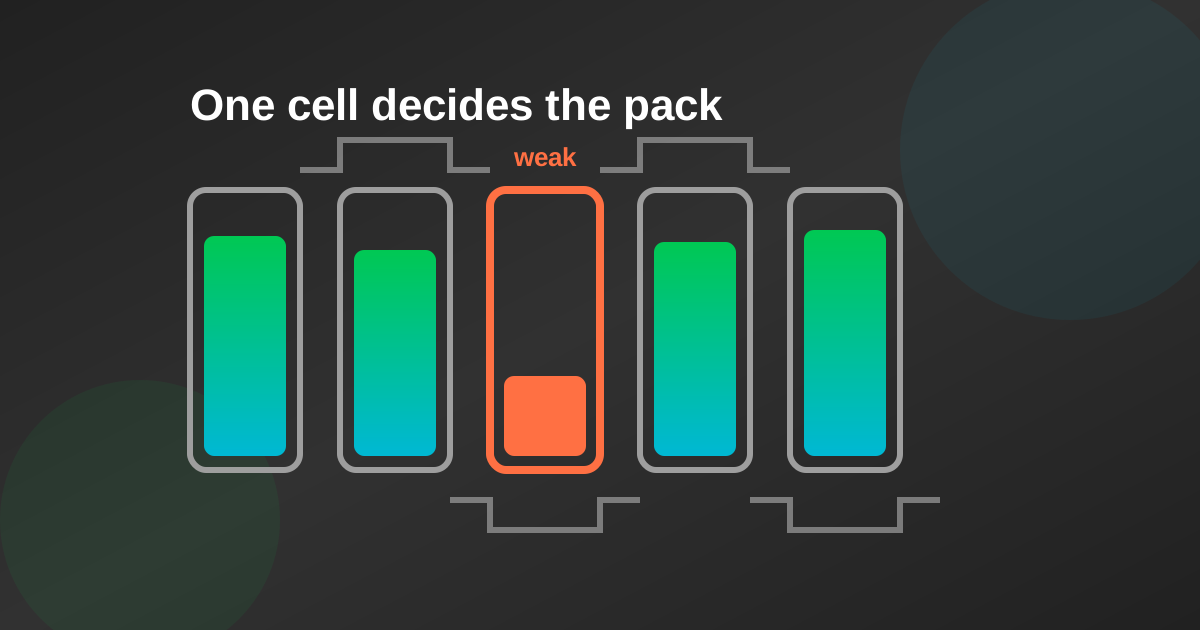
It is tempting to picture a battery as a single tank of energy. It is not. It is a set of individual cells wired in series to reach the voltage your vehicle needs, and every one of them carries the same current.
That has a hard consequence. Charging must stop when the fullest cell is full, and discharge must stop when the emptiest cell is empty. If one cell in a long string has fallen behind, the whole pack behaves like that cell, no matter how healthy the other forty-nine are.
Why cells drift apart
- •Manufacturing variation. No two cells are identical. Good manufacturers reduce this by matching cells carefully before assembly; cheap packs skip that step, and the drift starts on day one.
- •Temperature differences inside the pack. A cell in a hot corner ages faster than one in the middle of the airflow. Over hundreds of cycles, that gap compounds.
- •Self-discharge differences. Cells lose a little charge while sitting, and they do not all lose the same amount.
- •Repairs done badly. Dropping one brand-new cell into a pack of two-year-old ones creates a mismatch immediately, and it is usually the new cell that ends up stressed.
What the BMS does about it
Balancing is the job of the Battery Management System, and it comes in two forms.
Passive balancing is the common one. When cells reach the top of a charge unevenly, the BMS bleeds a small amount of energy off the fuller cells as heat until the others catch up. It is simple, reliable and slow, and it works well if it is given the chance — which means letting a charge complete fully sometimes, rather than always unplugging early.
Active balancing moves charge from fuller cells into emptier ones instead of wasting it. It is more efficient and more expensive, and it matters most on larger packs.
What imbalance feels like from the driver’s seat
- •The vehicle cuts out while the gauge still shows charge remaining
- •Range collapses suddenly over days rather than fading over months
- •Charging finishes noticeably faster than it used to
- •One area of the pack is warmer than the rest after a run
- •Range varies unpredictably between two otherwise identical days
These are the same symptoms an ageing pack produces — which is exactly why a measured diagnosis beats a guess. A service technician can read individual cell voltages and see in a minute whether the spread is normal or whether one group has fallen away.
Why roadside pack repair goes wrong
The instinct is reasonable: one cell group is weak, so replace that group and keep the rest. In practice this works only when the replacement cells are matched to the existing ones in capacity and internal resistance, the pack is rebalanced properly afterwards, and the work is done with the right equipment.
Without that, the new cells sit at a different state of charge from their neighbours, the BMS spends its life trying to close a gap it cannot close, and the pack comes back worse in a few months — sometimes with a safety problem that was not there before. A lithium pack opened by someone without the tools and training is a genuinely different risk from a lead-acid battery opened by the same person.
What to ask before you buy
- •Does the BMS monitor cells individually, or only the pack voltage as a whole?
- •Is balancing passive or active?
- •Can you see cell health or state of charge in an app, or is it invisible until failure?
- •Are cells matched at assembly, and is there documentation of it?
- •If a module fails in year two, who repairs it, with what equipment, and under what warranty terms?
The last question is the one most people forget to ask, and the one they most regret not asking.
Thinking about upgrading?
Talk to our team about the right pack for your vehicle, and about EMI options that keep the monthly outgo close to what you already spend.
Get in touch