SECI Tenders 800 MW of Four-Hour Standalone Battery Storage
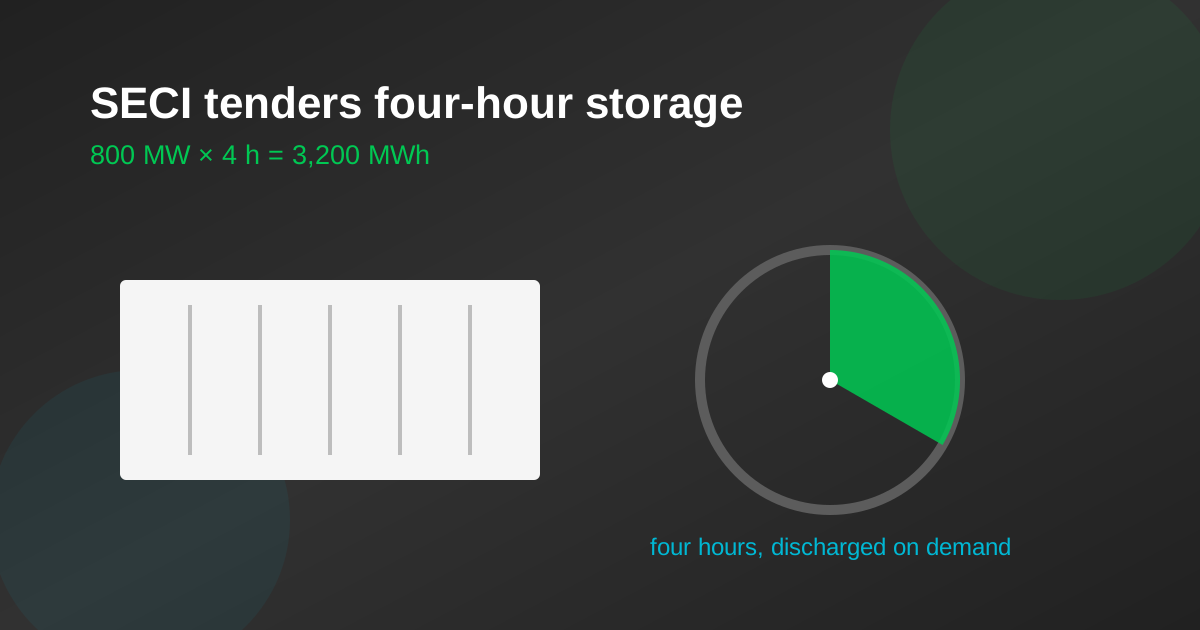
SECI has invited bids for 800 MW / 3,200 MWh of standalone storage, sited anywhere in India, with at least 51 per cent of charging energy from renewables. Bids are due on 30 October.
Published: 11 October 2026
Grid storage · 4 min read
What SECI has put out
Written 11 October 2026, on coverage by Energetica India, TaiyangNews, SolarQuarter and ESS News of a request for selection the Solar Energy Corporation of India issued on 1 October 2026. We have not read the tender document itself; figures are as reported.
The Solar Energy Corporation of India (SECI) has invited bids for 800 MW / 3,200 MWh of standalone battery storage, a tender it calls SECI-ESS-IV. TaiyangNews and SolarQuarter report that the request for selection was issued on 1 October 2026. Projects can be located anywhere in India, and each bidder may seek between 50 MW / 200 MWh and the full 800 MW / 3,200 MWh.
The ratio is the point. 3,200 MWh over 800 MW is four hours of storage. Maharashtra’s 4 GWh auction last month was for two hours; this asks for twice the energy behind every megawatt.
How the contract works
The developer builds, owns and operates the battery, and supplies stored energy to buying entities “on demand”, meaning the buyer decides when it is discharged. SECI sits in the middle as intermediary procurer: SolarQuarter reports that it signs power purchase agreements with the winning developers and back-to-back sale agreements with the buyers, and ESS News reports that the buyers will be named later.
- •At least 51 per cent of the energy used to charge the battery must come from renewable sources (all four reports)
- •Minimum system availability of 85 per cent, measured monthly (Energetica India)
- •Connection to the inter-state network at 220 kV or above, or to a state network (SolarQuarter)
- •A 20-year agreement from the scheduled or full commissioning date, whichever is later (SolarQuarter)
- •Selection by online bid followed by an electronic reverse auction
The developer is responsible for land, approvals and grid connection. Energetica India reports an earnest money deposit of ₹7.184 lakh per MW, a performance guarantee of ₹17.96 lakh per MW for winners, and a minimum net worth of ₹71.84 lakh per MW.
The renewable-charging rule. A battery charged from the grid at night on a coal-heavy mix would shift energy without making it cleaner. Requiring more than half the charging energy to be renewable ties the asset to its stated purpose: moving solar from midday into the evening.
Dates, and one to check
TaiyangNews gives an online bid deadline of 30 October 2026, offline submission by 3 November and bid opening on 4 November. SolarQuarter also reports a full-commissioning deadline of 30 April 2027. That would be unusually short for a four-hour project awarded in November, and we have not seen it in the other reports, so we would treat it as unconfirmed until the tender document is checked.
None of the four reports mentions viability gap funding, which has supported many of the recent state tenders. If there is none, bids will have to carry the full cost of the battery, which matters given the viability concerns Crisil raised in September.
What it means for this business
This is a utility-scale tender, and not one Wingzman would bid in. It matters for two reasons. First, the national renewable energy agency is now buying four-hour storage. A grid that buys evening hours from batteries is a grid whose peak prices and time-of-day tariffs are shaped by them, and that feeds through to what a factory pays.
Second, 3.2 GWh is a large claim on cells and containers. Every big award adds to demand for the same LFP supply that commercial and industrial buyers draw on. For a site weighing its own battery, the useful question is still the local one: what it costs to run the evening peak from storage instead of the grid. Our guide to how grid-scale storage earns explains the utility side; our C&I storage page covers the factory side.
Sources
Reporting this piece draws on. Figures were correct as published; scheme terms and commodity prices move.
- SECI Invites Bids for 800 MW/3,200 MWh BESSEnergetica India · 5 October 2026
- SECI Invites Bids For 800 MW BESS & 60 MW Solar In IndiaTaiyangNews · 5 October 2026
- SECI Issues 800 MW/3200 MWh Standalone BESS Tender Under Tariff-Based Competitive BiddingSolarQuarter · 5 October 2026
- India’s SECI seeks developers for 800 MW/3.2 GWh BESSESS News · 6 October 2026
Terms in this article
Frequently asked questions
What is SECI tendering?+
Supply of energy from 800 MW / 3,200 MWh of standalone battery storage, tendered as SECI-ESS-IV. Developers build, own and operate the batteries and supply stored energy on demand, with SECI acting as intermediary procurer.
When are bids due?+
TaiyangNews reports an online bid deadline of 30 October 2026, offline submission by 3 November and bid opening on 4 November. Bidders should confirm dates against the tender document on the ISN-ETS portal.
What are the main technical conditions?+
At least 51 per cent of charging energy must come from renewable sources, and Energetica India reports a minimum availability of 85 per cent measured monthly. Each bid must be between 50 MW / 200 MWh and the full 800 MW / 3,200 MWh.
Is storage right for your site?
Send us a month of electricity bills and your load profile, and we will tell you what a battery would save — including when it would not pay.