Storage Tariffs Firm Up as Crisil Warns 12 GWh of Projects Are at Risk
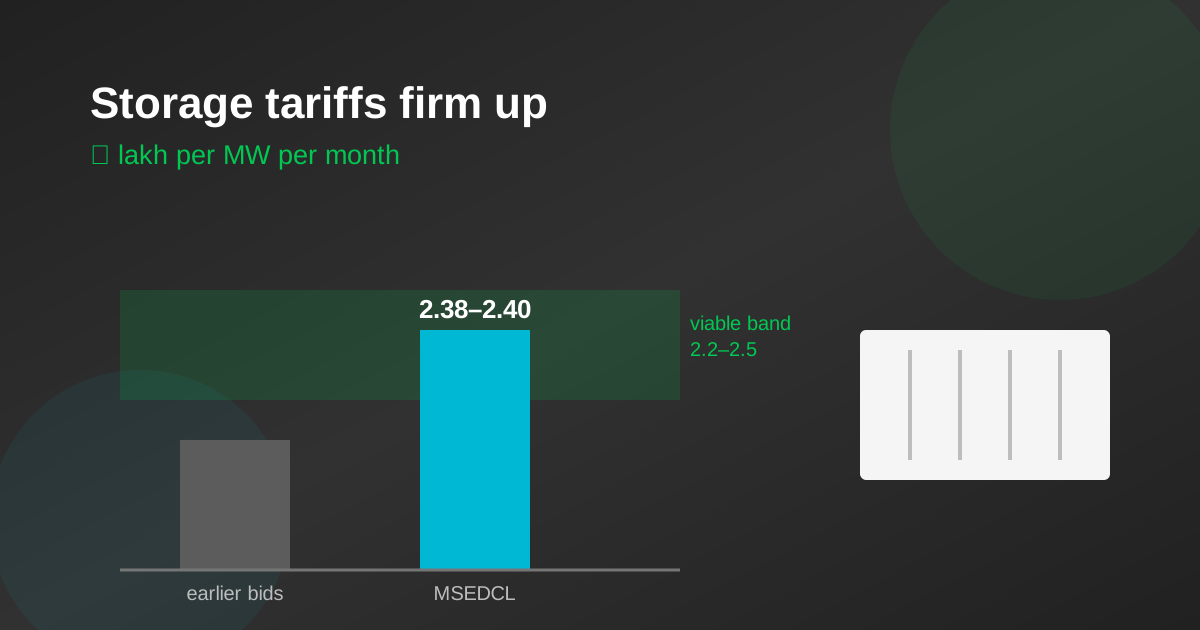
Maharashtra’s 4 GWh storage auction cleared at ₹2.38–2.40 lakh per MW per month. A week later Crisil said battery prices have hardened and about 12 GWh under construction faces weak returns.
Published: 30 September 2026
Grid storage · 5 min read
Two numbers from the same week
Written 30 September 2026, on Maharashtra State Electricity Distribution Co.’s auction results as reported by Saur Energy and Mercom India (21 September), and Crisil Ratings’ outlook as reported by pv magazine India, ANI and ESS News (28–29 September).
On 21 September, MSEDCL announced the winners of a 2,000 MW / 4,000 MWh standalone battery storage auction. The 1,500 MW Part A cleared at ₹2,38,000 per MW per month, and the 500 MW Part B at ₹2,40,000. The contracts run 15 years. Saur Energy reports that they require at least 6,300 cycles at no extra cost and commissioning within 18 months. Oriana Power took the largest share, with GK Energy and several smaller bidders taking the rest.
A week later, Crisil Ratings said India is likely to commission 45–50 GWh of battery storage across fiscal 2027 and 2028, out of 50–55 GWh scheduled. It also warned that a meaningful part of that pipeline is at risk.
What Crisil said
Of the capacity under construction, Crisil puts about 12 GWh, roughly 21 per cent, at risk of weak returns. For 8–9 GWh of that, it adds that project sponsors have limited experience in building storage. The cause, in the words of Manish Gupta, Senior Director and Deputy Chief Ratings Officer: “Battery prices have hardened in 2026, while tariffs bid out for these projects were relatively low.”
Crisil’s reference case is that tariffs of ₹2.2–2.5 lakh per MW per month, with batteries at $55–65 per kWh, give an equity return of 12–14 per cent. Projects that bid well below that band, or that assumed battery prices would keep falling, are the ones exposed.
Read together, the two numbers tell one story. Maharashtra’s clearing price sits inside Crisil’s viable band. That suggests bidders priced in what batteries cost now, rather than what they cost when earlier auctions were won. The risk Crisil describes is in the projects already signed at the lower tariffs of earlier rounds.
The size of the shift
- •About 1 GWh of battery storage had been commissioned by the end of fiscal 2026 (Crisil, via pv magazine India)
- •45–50 GWh is expected across the next two fiscal years: about 40 GWh government-auctioned, 10–15 GWh commercial, industrial and merchant
- •Storage was about 40 per cent of auctioned capacity in fiscal 2026, against about 5 per cent in fiscal 2024–25 (ANI)
Going from about 1 GWh to around 45 GWh in two years would need a supply chain, from cells to containers to commissioning crews, that is still being built. The cell side of that is why prices have hardened. Our August coverage of BESS cell supply tightness sets out the details.
What it means for this business
The 10–15 GWh Crisil attributes to commercial, industrial and merchant storage is the segment we serve. Two things follow from the week’s numbers.
- •Firmer tariffs are a sign of a market pricing risk properly. That is better for buyers than a race to the bottom that leaves stranded projects
- •For a factory buying storage, the lesson is the same as for a developer. Judge a quote on current cell prices and a named supply source, not on last year’s headlines
- •Sponsor experience is on Crisil’s list of risks for a reason. Commissioning, safety compliance and service over a 15-year contract are where inexperienced projects fail
Sources
Reporting this piece draws on. Figures were correct as published; scheme terms and commodity prices move.
- Oriana Power, GK Energy Win MSEDCL’s 2,000 MW / 4,000 MWh BESS TenderSaur Energy · 21 September 2026
- Maharashtra Announces Winners of 4 GWh Battery Energy Storage AuctionMercom India · 21 September 2026
- India likely to commission 45-50 GWh of BESS capacity across fiscals 2027 and 2028: Crisilpv magazine India · 28 September 2026
- Battery energy storage system capacity in India set to reach 45-50 GWh over two fiscal years: Crisil RatingsThe Tribune (ANI) · 28 September 2026
Frequently asked questions
What price did Maharashtra’s storage auction clear at?+
The 1,500 MW Part A at ₹2,38,000 per MW per month and the 500 MW Part B at ₹2,40,000, for two-hour storage on 15-year contracts, as reported on 21 September 2026.
How much battery storage does Crisil expect India to commission?+
45–50 GWh across fiscal 2027 and 2028, out of 50–55 GWh scheduled: about 40 GWh government-auctioned and 10–15 GWh commercial, industrial and merchant. About 1 GWh had been commissioned by the end of fiscal 2026.
Why does Crisil think some storage projects are at risk?+
Battery prices hardened in 2026 while many projects were bid at low tariffs. Crisil puts about 12 GWh, around 21 per cent of capacity under construction, at risk of weak returns, and flags 8–9 GWh where sponsors also have limited implementation experience.
Is storage right for your site?
Send us a month of electricity bills and your load profile, and we will tell you what a battery would save — including when it would not pay.