China’s Battery Exports Hit a Record in October as Its Export Rebate Runs Out
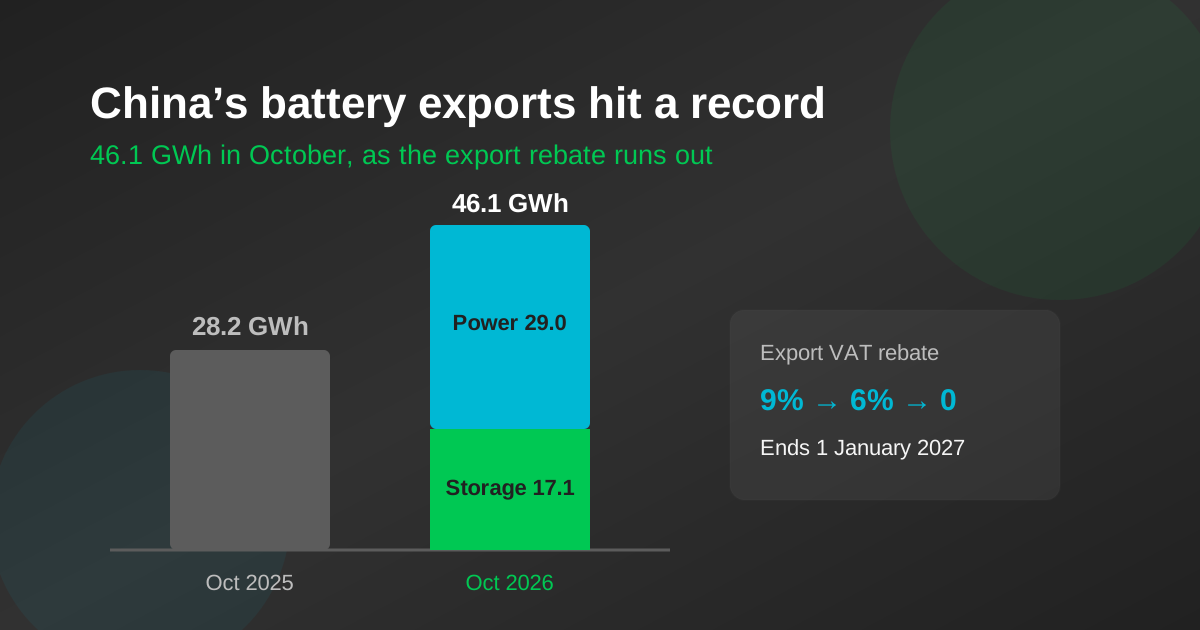
China exported a record 46.1 GWh of power and storage batteries in October, worth US$11.0 billion on customs data, with storage cells up 94 per cent. The 6 per cent export VAT rebate ends on 1 January 2027.
Published: 20 November 2026
Industry · 3 min read
What happened
Written 20 November 2026, on China Automotive Battery Innovation Alliance figures reported by CnEVPost on 19 November, customs figures cited by the analyst Cui Dongshu on 20 November, SMM analysis of 30 October, and Caixin and China Daily reporting of the rebate change on 10 January 2026.
China shipped more batteries abroad in October than in any month before. CnEVPost, reporting data from the China Automotive Battery Innovation Alliance (CABIA), puts combined exports of power and energy-storage batteries at 46.1 GWh, up 63.4 per cent on October 2025 and 4.8 per cent on September. Exports were 20.0 per cent of the industry’s sales for the month.
The value figures point the same way. Cui Dongshu, secretary-general of the China Passenger Car Association, wrote on 20 November that lithium battery exports were US$11.0 billion in October, up 57 per cent year on year, citing customs data. On our arithmetic that puts October 2025 at roughly US$7.0 billion.
Storage cells grew fastest
The CABIA split, as reported by CnEVPost:
- •Power (vehicle) batteries: 29.0 GWh exported in October, up 49.4 per cent year on year
- •Energy-storage batteries: 17.1 GWh, up 94.4 per cent year on year and 9.7 per cent on September
- •January to October: 349.0 GWh in all, up 53.0 per cent, of which 228.7 GWh power and 120.3 GWh storage
Neither source breaks October down by destination country, and we have not found an India-specific figure for the month. The most recent India number we can cite is annual: a Koan Advisory and Institute of Chinese Studies report, covered by Outlook Business in September, found that China supplied US$3.9 billion, or 83.6 per cent, of India’s lithium-ion battery imports in 2025–26.
The rebate clock
The backdrop is a tax change announced in January. The Ministry of Finance and the State Taxation Administration cut the export VAT rebate on battery products from 9 per cent to 6 per cent from 1 April 2026, and it ends entirely on 1 January 2027, as Caixin and China Daily reported at the time. Caixin described the aim as easing a price war in green technology; the China Photovoltaic Industry Association said it would reduce the risk of trade friction.
SMM notes that the applicable rate is set by the export date on the customs declaration, so goods declared before 31 December still earn 6 per cent. In an analysis on 30 October it expected year-end shipments to “heat up”, but mostly as “a moderate pull-forward of recent orders” on utility-scale storage projects with fixed delivery dates, while home-storage distributors were still working through old stock.
A record month is not the same as a price signal. SMM’s view is that storage-cell prices “still have room to pull back” and that “buying now may be more expensive than buying later.”
How much of the lost rebate reaches the buyer is the open question. When the cut was announced, EVTank’s Wu Hui told Caixin he expected a limited impact, because Chinese battery prices sit well below Japanese and Korean ones and the cost can be absorbed by producers or buyers.
What it means for this business
Wingzman builds LiFePO4 packs for e-rickshaws, two- and three-wheelers and storage, and most of the cells in Indian packs come from China. For an Indian buyer the practical points are narrow:
- •Orders that will not clear Chinese customs by 31 December should be quoted on the assumption that the rebate is gone; ask suppliers to say which basis their price uses
- •The rebate is worth up to 6 per cent of the export value to the seller, not a 6 per cent price rise; how it splits between maker and buyer is a negotiation
- •The record volumes were driven by storage cells, so mobility buyers should not read them as tightness in two- and three-wheeler cell supply
- •Rushing orders forward carries freight, storage and working-capital costs that can outweigh the rebate, which is SMM’s point too
The rupee–yuan exchange rate matters as much as the tax: see how a strong yuan and weak rupee squeeze Indian cell buyers, and Europe’s storage stock build ahead of the same rebate cut. For the chemistry itself, see LFP battery in our glossary.
Sources
Reporting this piece draws on. Figures were correct as published; scheme terms and commodity prices move.
- China's October power battery installations hit record 99.4 GWh as LFP share reaches 86.9%CnEVPost · 19 November 2026
- 崔东树:1-10月中国商品贸易出口强势增长 汽车与锂电池表现突出Investing.com China (Zhitong Finance) · 20 November 2026
- [SMM Analysis] Rush to Export or Wait for Price Cuts? The Energy Storage Stockpiling Game Under a Six-Point Tax Rebate DifferenceShanghai Metals Market (SMM) · 30 October 2026
- China to Eliminate Export Tax Rebates for Solar and Batteries by 2027Caixin Global · 10 January 2026
- China to adjust or cancel export tax rebates for photovoltaic and battery productsChina Daily · 10 January 2026
- India’s Electronics Push Is Growing, But So Is Its Dependence On Chinese ComponentsOutlook Business · 12 September 2026
Terms in this article
Frequently asked questions
How many batteries did China export in October 2026?+
CnEVPost, reporting China Automotive Battery Innovation Alliance data, puts combined power and storage battery exports at a record 46.1 GWh, up 63.4 per cent year on year: 29.0 GWh of power batteries and 17.1 GWh of storage batteries. The analyst Cui Dongshu, citing customs data, put lithium battery exports at US$11.0 billion for the month, up 57 per cent.
What is happening to China’s export tax rebate on batteries?+
The Ministry of Finance and the State Taxation Administration cut the export VAT rebate on battery products from 9 per cent to 6 per cent from 1 April 2026, and it ends on 1 January 2027. SMM notes that the rate is set by the export date on the customs declaration.
Will Chinese cells cost Indian buyers 6 per cent more from January?+
Not necessarily. The rebate is worth up to 6 per cent of export value to the seller, and how that splits between maker and buyer is negotiated. EVTank’s Wu Hui told Caixin in January he expected a limited impact, and SMM said on 30 October that storage-cell prices still have room to fall.
Want this applied to your own numbers?
Every solution page carries a calculator that shows its own arithmetic — storage savings, lithium against lead-acid, and home pack sizing.