How Grid-Scale Battery Storage Makes Money
A grid battery earns from several revenue streams at once, and few projects are viable on any single one. How value stacking works, and what makes a project bankable.
Published: 14 August 2026
Grid storage · 7 min read
Rarely one revenue stream
A grid-scale battery is an expensive asset that sits idle much of the time if it is dedicated to a single purpose. The economics generally only work when the same asset earns from several sources across the day and year.
This is usually called value stacking, and it is the core of any serious business case.
The main revenue streams
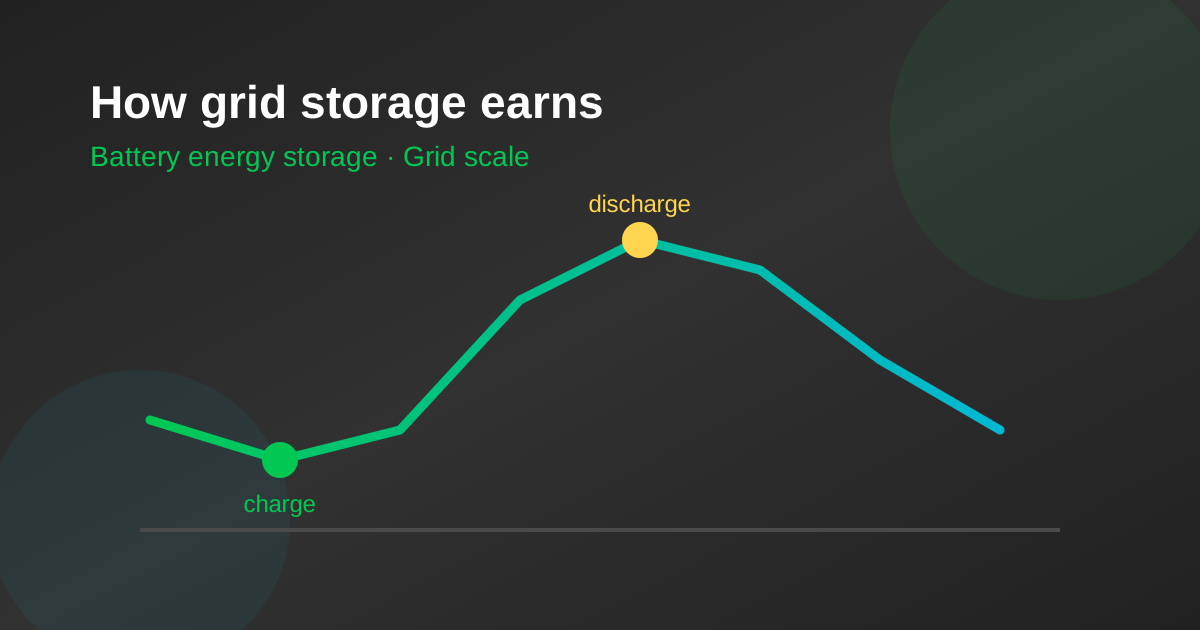
- •Energy arbitrage. Buy when prices are low, sell when they are high. The value depends on the spread between those prices and how often a wide spread occurs, and it is reduced by round-trip losses.
- •Capacity or availability payments. Being paid to be there and ready, rather than for energy delivered. This is the most bankable form of revenue because it does not depend on market volatility.
- •Ancillary services. Fast frequency response and similar services that exploit a battery’s millisecond reaction time. High value per MW, but these markets can saturate as more storage connects.
- •Renewable firming. Contracting with a solar or wind plant to smooth its output so it can sell a more predictable and higher-value profile.
- •Network support. Being paid to relieve congestion at a specific point on the network, deferring a costlier upgrade.
Why arbitrage alone rarely funds a project
The arithmetic is unforgiving. You capture the price spread minus round-trip losses, and you can only do it as often as the spread appears and as often as you are willing to cycle the asset.
Every cycle also consumes battery life. A project that cycles aggressively to chase arbitrage reaches its end-of-life capacity sooner, which has to be accounted for as a real cost rather than treated as free.
The tension inside value stacking
Stacking is not free money. Capacity committed to one service is unavailable for another, and the conflicts are real:
- •Energy held in reserve for a capacity obligation cannot be sold into an arbitrage opportunity
- •Committing to frequency response constrains the state of charge you can operate at
- •Cycling hard for arbitrage brings forward the date at which contracted capacity can no longer be met
A credible model prices these conflicts explicitly. One that adds every available revenue stream together at full value is describing something the asset cannot physically do.
What makes it financeable
- •Contracted revenue with a creditworthy counterparty over a horizon long enough to service debt
- •Clear regulatory treatment — how the asset is classified, charged for network use, and dispatched
- •Performance and capacity warranties from the supplier, tied to the revenue assumptions
- •A defined augmentation plan for maintaining capacity as cells degrade
- •Insurance and fire protection design accepted by lenders and local authorities
- •An operator with a track record, and a defined response when the system underperforms
The risks that actually bite
Two dominate. The first is revenue uncertainty: ancillary service markets are shallow and can saturate quickly as capacity connects, so a model built on today’s prices for those services may not hold.
The second is degradation. Capacity fade is not a technicality; it directly reduces what the asset can sell. Whether it is managed by oversizing at the start or by augmentation later, it must be funded from somewhere in the model.
Because market design and regulation for storage in India continue to evolve, verify the current framework with the relevant regulator before relying on any general description.
Frequently asked questions
How do grid batteries make money?+
Mainly through energy arbitrage — charging when power is cheap and discharging when it is expensive — plus capacity or availability payments, ancillary services such as frequency response, and contracts to firm the output of renewable plants. Most projects combine several of these rather than relying on one.
What is value stacking in battery storage?+
Earning from more than one revenue stream with the same asset — for example providing frequency response most of the time while still being available for evening peak discharge. It improves returns but requires careful management, because energy or capacity committed to one service is not available for another.
What makes a storage project bankable?+
Predictable, contracted revenue over a long enough horizon to service debt. Merchant exposure to volatile market prices is much harder to finance than a contracted offtake with a creditworthy counterparty. Warranty and performance guarantees on the battery matter too, since capacity fade directly reduces revenue.
Thinking about upgrading?
Talk to our team about the right pack for your vehicle, and about EMI options that keep the monthly outgo close to what you already spend.
Get in touch