China Makes Its E-Motorcycle Battery Safety Standard Mandatory From July 2027
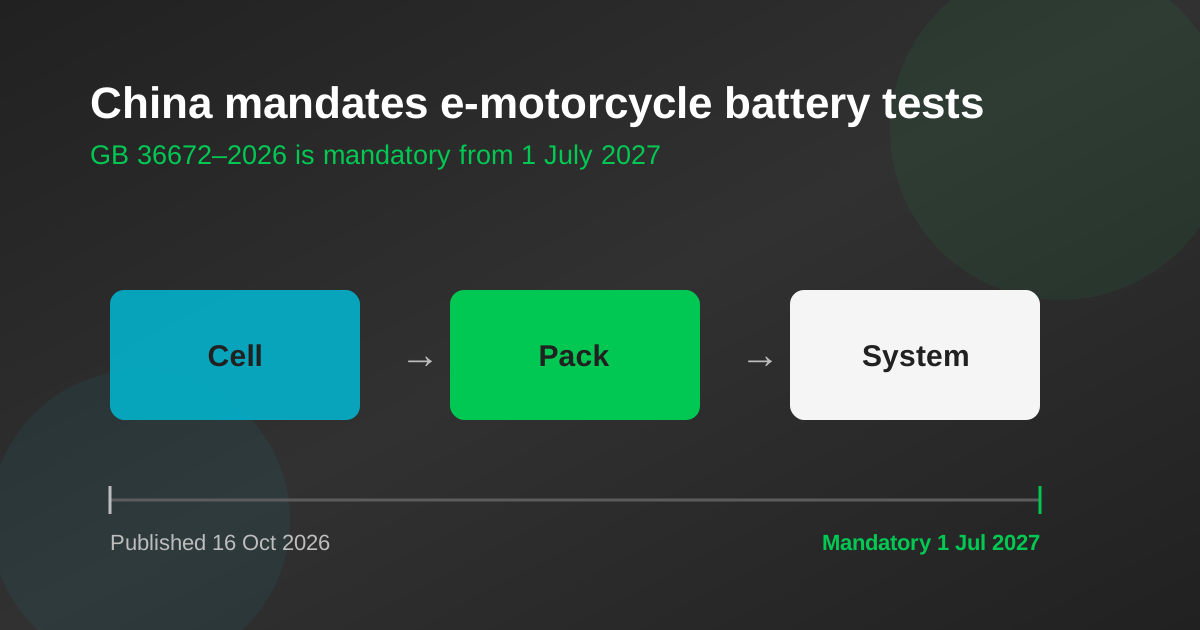
China has approved GB 36672–2026, turning its safety standard for lithium-ion batteries in electric motorcycles and mopeds into a mandatory one from 1 July 2027, with new tests including thermal propagation and flame retardancy.
Published: 20 November 2026
Mobility · 3 min read
What happened
Written 20 November 2026, on the State Administration for Market Regulation’s announcement of 16 October 2026 as reported by People’s Daily, Yicai and IT Home the same day, and The Paper’s May 2024 explainer on the separate e-bike battery standard.
China has turned its safety standard for lithium-ion batteries in electric motorcycles and electric mopeds from a recommendation into a legal requirement. The State Administration for Market Regulation, which also runs the national standards body, announced on 16 October that it had approved GB 36672–2026, Safety requirements for lithium-ion batteries used in electric motorcycles and electric mopeds, People’s Daily and Yicai report. It takes effect on 1 July 2027.
The regulator drafted it with the Ministry of Industry and Information Technology, and gave the reason plainly: the e-motorcycle industry has grown fast, lithium-ion batteries are used ever more widely in it, and the safety risks have grown with them.
What the standard changes
As reported by People’s Daily, Yicai and IT Home, the standard does three things:
- •It sets safety tests at three levels, the cell, the pack and the battery system, and ties the pass criteria at each level to the next
- •It adds tests built around real failure conditions such as low-temperature charging, impact and thermal runaway: heating after low-temperature cycling, crush, handle strength, thermal propagation, flame retardancy and marking
- •It fixes rules for what counts as the same battery type and how tests are run, which the reports say addresses inconsistent judgements across test labs
None of the reports we read gives the numerical limits, such as how long a pack must contain a single failing cell. Those sit in the standard’s text, which we have not seen.
The word that matters is “mandatory”. Under China’s Standardisation Law, as The Paper explained in 2024, products that do not meet a mandatory standard may not be produced, sold or imported there.
Where it fits
The new standard fills a gap the earlier e-bike rule left. GB 43854–2024, the mandatory standard for electric-bicycle batteries in force since 1 November 2024, covers only e-bike packs with a maximum output of 60 volts. The Paper’s explainer noted that it does not apply to scooters, balance boards, electric motorcycles or electric tricycles. GB 36672–2026 now brings electric motorcycles and mopeds under a mandatory rule too. The reports do not say whether three-wheeled vehicles are within its scope.
What it means for this business
Wingzman assembles LiFePO4 packs for e-rickshaws and two- and three-wheelers in India, from cells that are mostly made in China. The Chinese standard does not govern what is sold in India; that is AIS 156. What it changes is what Chinese suppliers must build for their home market:
- •Cell makers selling into China’s e-motorcycle market will need cells that pass the new cell-level tests from July 2027, so certified product will exist on the same lines that supply export customers
- •An Indian pack maker can ask a supplier whether a cell has been tested to GB 36672–2026 and ask for the report; that is a stronger question than asking for a datasheet
- •Pack-level tests such as thermal propagation and flame retardancy apply to Chinese pack designs, not to a pack assembled in India from imported cells, so the cell report covers only part of the risk
- •Containing one failing cell is a pack design problem as much as a cell problem: spacing, venting, barrier materials and the BMS decide it
For how a single cell failure spreads, see thermal runaway, and for India’s own rule, read our guide to AIS 156 battery safety.
Sources
Reporting this piece draws on. Figures were correct as published; scheme terms and commodity prices move.
- 明年7月起实施!电动摩托车锂电池强制性国标批准发布People’s Daily · 16 October 2026
- 明年7月起实施 电动摩托车锂电池强制性国标批准发布Yicai · 16 October 2026
- 明年 7 月起实施,电动摩托车锂电池强制性国标发布IT Home · 16 October 2026
- 强制性国标发布!九问九答解读《电动自行车用锂离子蓄电池安全技术规范》The Paper · 10 May 2024
Terms in this article
Frequently asked questions
What is GB 36672–2026?+
A mandatory Chinese national standard, Safety requirements for lithium-ion batteries used in electric motorcycles and electric mopeds, announced by the State Administration for Market Regulation on 16 October 2026. It upgrades an earlier recommended standard to a mandatory one and takes effect on 1 July 2027.
What new tests does it add?+
According to People’s Daily, Yicai and IT Home, it adds heating after low-temperature cycling, crush, handle strength, thermal propagation, flame retardancy and marking, and sets requirements at cell, pack and battery-system level. The reports do not give numerical limits.
Does it apply to battery packs sold in India?+
No. It governs batteries produced or sold in China. In India, electric two- and three-wheeler batteries are tested under AIS 156. An Indian pack maker can still ask a Chinese cell supplier for a GB 36672–2026 test report, but pack-level tests depend on the pack design.
Thinking about upgrading?
Talk to our team about the right pack for your vehicle, and about EMI options that keep the monthly outgo close to what you already spend.
Popular: Lithium e-rickshaw battery