India Put ₹5,400 Crore Behind Grid Storage. What Actually Changed.
Viability Gap Funding widened to 30 GWh, SECI and POWERGRID put record tenders into the market, and a PLI tranche was carved out for grid cells. What that means for the supply chain — and why none of the money is for your factory.
Published: 22 August 2026
Grid storage · 9 min read
Where things stand
Written 22 August 2026. Tender sizes and bid dates move; the figures below are as reported through mid-August 2026.
India has been talking about grid-scale storage for years. In 2026 the talking turned into budget lines and bid documents, and the pace changed sharply. Three things happened more or less at once: the Ministry of Power widened its Viability Gap Funding for standalone battery storage, the central agencies put unusually large tenders into the market, and a tranche of the Advanced Chemistry Cell production incentive was carved out specifically for grid storage rather than for vehicles.
The money
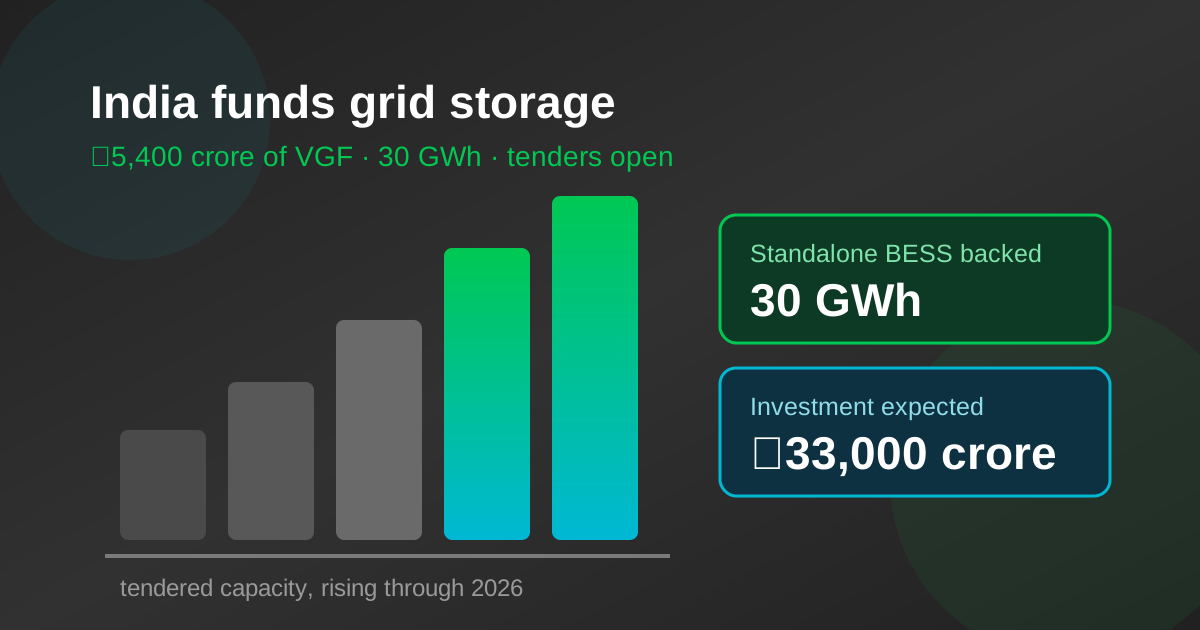
The headline is a ₹5,400 crore expansion of Viability Gap Funding to support a further 30 GWh of standalone battery energy storage. The allocation splits into roughly 25 GWh spread across fifteen states — Rajasthan, Gujarat and Maharashtra taking the largest shares — and 5 GWh reserved for NTPC. Analysts covering the scheme expect it to pull in something around ₹33,000 crore of total investment.
VGF is worth understanding properly, because it is frequently described as a subsidy and it is not quite one. It is a capital grant that closes the gap between what a storage project costs to build and what it can earn at a tariff a distribution company will actually sign. It exists because storage in India is being procured before the revenue stacks that make it pay elsewhere — frequency regulation, capacity markets, genuine time-of-day arbitrage — are fully developed here.
The tenders
- •SECI issued what trackers describe as the largest Indian BESS tender to date under its FDRE-IX auction: 1,200 MW of firm and dispatchable renewable energy on a build-own-operate basis, with a mandatory four-hour co-located storage requirement. That single condition implies about 4,800 MWh of batteries.
- •POWERGRID floated a 500 MW / 1,000 MWh standalone BESS tender in July 2026, aimed at inter-regional grid stability rather than at firming a particular generator, with bids due in mid-August.
- •Rajasthan issued a 500 MW / 2,000 MWh standalone tender after the central VGF guidelines were relaxed — note the four-hour duration, which is a different product from the two-hour systems that dominated earlier rounds.
- •SJVN invited bids in late July for a 265 MW / 530 MWh standalone project in Haryana under the VGF scheme.
The detail worth noticing is duration. Early Indian storage procurement leaned on two-hour systems, which suit a sharp evening peak. Four-hour mandates are a different engineering and cost problem, and they signal that the buyer wants energy shifted across a block of hours rather than a peak clipped.
The cells
Money and tenders do not produce storage on their own; cells do. In July 2026 the government opened bidding on a further 10 GWh tranche of the Advanced Chemistry Cell production-linked incentive, and this tranche was carved out explicitly for grid-scale storage applications rather than being left to compete with automotive demand.
That carve-out is a reasonable read of the constraint. India can tender gigawatt-hours faster than it can make them, and a developer who wins a bid still has to buy cells in a global market where automotive demand sets the price. The lithium carbonate price has roughly doubled off its late-2025 low, which is not helping. Whether the PLI tranche closes that gap in time for the current tender wave is the open question of the next two years.
What this does and does not mean for a factory or an office
If you run a commercial or industrial site and you have read that the government is putting ₹5,400 crore behind batteries, the honest position is that this money is not for you. VGF supports grid-connected, utility-scale standalone storage procured through competitive bidding. It does not subsidise a battery behind your meter.
What the tender wave does change for a C&I buyer is indirect, and still real:
- •Supply chain depth. A domestic pipeline measured in tens of GWh brings EPC contractors, integrators, commissioning engineers and spares into the country. Two years ago the scarce input for a mid-sized C&I project was not cells, it was people who had built one before.
- •Standards and safety practice. Utility procurement forces the fire, protection and testing requirements into contracts, and that discipline flows down to smaller installations.
- •Price direction, in both directions. Domestic cell manufacturing at scale should ease landed cost over time. Near-term, a large domestic tender pipeline competing for the same cells during a lithium price rebound does the opposite.
None of that changes the arithmetic that decides whether storage pays on your site, which remains your demand charge, your tariff spread and your load profile. You can put those numbers in directly with the BESS savings calculator.
Sources
Reporting this piece draws on. Figures were correct as published; scheme terms and commodity prices move.
- VGF scheme expands to support 30 GWh of new standalone BESS development in IndiaJMK Research & Analytics
- SJVN invites bids for 265 MW / 530 MWh standalone BESS project in Haryana under VGF schemeSolarQuarter · 27 July 2026
- India coverage, July–August 2026Energy-Storage.News
- India’s battery storage boom: getting the execution rightIEEFA
Frequently asked questions
What is Viability Gap Funding for battery storage?+
A capital grant that closes the gap between what a storage project costs to build and the tariff a distribution company will actually sign. It exists because India is procuring storage before the revenue streams that make it pay elsewhere — frequency regulation, capacity markets, deep time-of-day arbitrage — are fully developed here. It is not a subsidy on the purchase price of a battery.
Can a factory get VGF for its own battery?+
No. VGF supports grid-connected utility-scale standalone storage procured through competitive bidding. It does not apply to storage behind your meter. What the tender wave does give a commercial buyer is indirect: more EPC contractors and commissioning engineers in the country, and safety and testing practice pushed down from utility contracts.
Why do the new tenders specify four hours of storage?+
Because the buyer wants energy shifted across a block of hours rather than a peak clipped. Earlier Indian procurement leaned on two-hour systems, which suit a sharp evening peak. Four hours is a different engineering and cost problem, and the shift signals what the grid is now being asked to solve.
Will this make batteries cheaper in India?+
Over time, probably — domestic cell manufacturing at scale should ease landed cost, and the ACC PLI tranche carved out for grid storage is aimed at exactly that. Near term it may do the opposite, because a large domestic tender pipeline is competing for the same cells during a lithium price rebound.
Want this applied to your own numbers?
Every solution page carries a calculator that shows its own arithmetic — storage savings, lithium against lead-acid, and home pack sizing.
Get in touch