China’s First National Battery Plan Puts Discipline Ahead of Capacity
Seven Chinese agencies have issued a 2026–30 plan for the battery industry: solid-state at scale, 15,000-cycle lithium cells and tighter control of capacity and price competition, with no capacity target. Storage is everywhere in it, without a number.
Published: 11 October 2026
Policy · 3 min read
What happened
Written 11 October 2026, on reporting by Xinhua and CnEVPost on 28 September, China Daily on 29 September and ESS News on 1 October. We have not read the plan in the original Chinese.
On 28 September China published a development plan for its “new-type” battery industry covering the 15th Five-Year Plan period, 2026 to 2030. CnEVPost and ESS News report that the document is dated 14 September and was issued jointly by seven government bodies, including the Ministry of Industry and Information Technology (MIIT) and the National Development and Reform Commission.
Xinhua, carried on the central government’s English website, quotes academician Nan Cewen of Tsinghua University calling it China’s first dedicated national-level plan for the battery industry. The same report gives the industry’s output value during 2021–2025 as more than 1 trillion yuan.
The 2030 targets
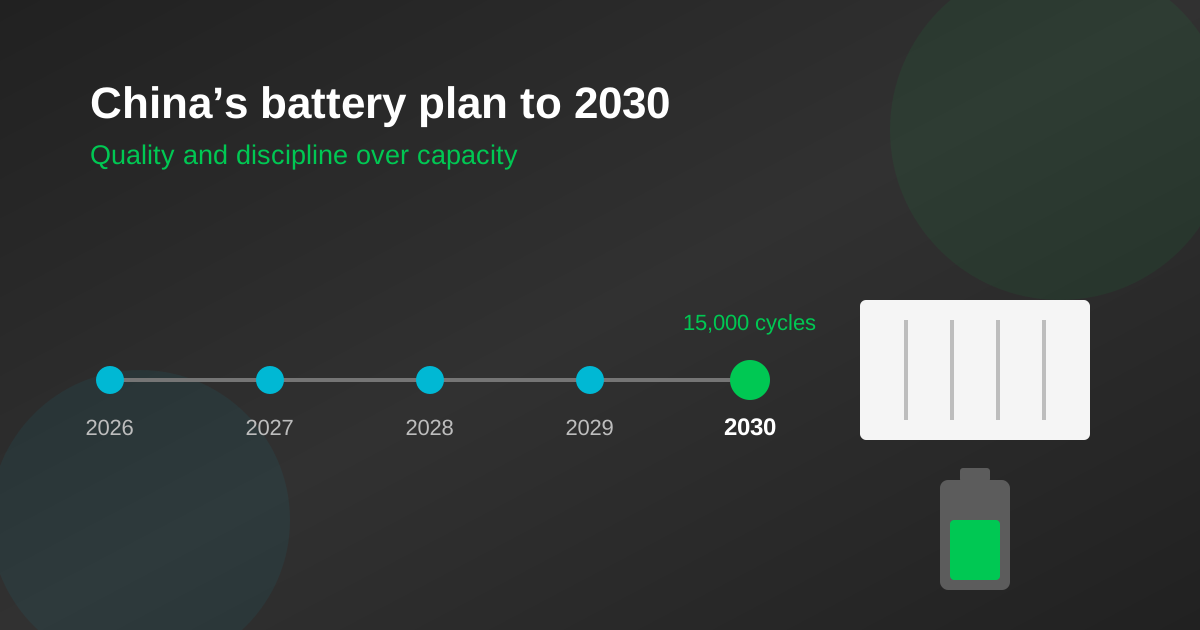
Xinhua, CnEVPost and ESS News report the same three headline goals for 2030:
- •Initial large-scale use of all-solid-state batteries
- •A cycle life of 15,000 cycles for long-life lithium batteries
- •Product defect rates at leading manufacturers at the parts-per-billion level
Xinhua says the plan sets 19 priority tasks across five areas. ESS News notes what it does not contain: no capacity or output-value target, no sodium-ion deployment target and no cost targets. The 15,000-cycle figure applies to long-life lithium cells in general, not specifically to storage.
Where storage fits
Storage runs through the document without a number attached. ESS News reports that the government wants battery deployment to expand on the generation and grid sides, in industrial parks and in data centres, and that MIIT calls for closer alignment of supply with actual demand.
On chemistry, the plan describes a supply system centred on lithium batteries with sodium and flow batteries as complements, according to both Xinhua and CnEVPost. CnEVPost adds that the sodium section calls for long-cycle-life storage batteries. ESS News reads nothing in the plan as suggesting sodium-ion should replace lithium iron phosphate. Our earlier piece on sodium-ion going commercial covers where that chemistry stands today.
The governance lines matter more than the targets. ESS News reports that MIIT said authorities will strengthen capacity early-warning mechanisms, product-quality supervision and the regulation of price competition, and that the plan supports mergers and more orderly overseas investment. CnEVPost adds that companies must set up used-battery collection systems matched to their sales volumes.
That fits a pattern. In September China also paused approvals for new battery-factory projects and added a consumption tax on batteries, as we reported in our piece on cell prices. ESS News characterises the plan as a shift from capacity-led expansion toward technology, quality and supply discipline.
What it means for this business
As we reported in August, India’s storage build still runs on imported cells, and China holds most of the world’s cell-making capacity. Beijing’s industrial policy is, in effect, part of an Indian buyer’s supply contract. The plan is a statement of direction, not a set of rules, and its effect on prices will depend on how it is implemented.
- •Curbs on price competition and on new capacity point away from the oversupply that pushes cell prices down; we would not plan a project around cheaper cells
- •A 15,000-cycle lithium cell, if it arrives at scale, would change the lifetime arithmetic of a commercial and industrial system more than a lower upfront price
- •Lithium iron phosphate remains the core chemistry; nothing here suggests a C&I buyer should wait for something else
- •Recycling and traceability rules may shape what documentation accompanies imported cells, though the plan as reported sets no export requirement
For why so much of the chain sits in China in the first place, see why China dominates battery cells; for what a storage system does for a factory, see our battery storage page.
Sources
Reporting this piece draws on. Figures were correct as published; scheme terms and commodity prices move.
- China sets 2030 battery targets, backs sodium-ion and solid-stateESS News · 1 October 2026
- China unveils five-year plan for new-type battery industryXinhua, via english.www.gov.cn · 28 September 2026
- China unveils 5-year battery plan targeting large-scale all-solid-state use by 2030CnEVPost · 28 September 2026
- Plan powers charge of new-type battery industryChina Daily · 29 September 2026
Terms in this article
Frequently asked questions
What is China’s new-type battery industry plan?+
It is a development plan for China’s battery industry for 2026–2030, published on 28 September 2026 and issued jointly by seven government bodies including MIIT and the NDRC. Xinhua quotes academician Nan Cewen calling it China’s first dedicated national-level plan for the battery industry.
What are its 2030 targets?+
Initial large-scale use of all-solid-state batteries, a 15,000-cycle life for long-life lithium batteries, and parts-per-billion defect rates at leading manufacturers. ESS News notes it sets no capacity, output-value, sodium-ion deployment or cost target.
Does the plan affect battery storage prices in India?+
Not directly; it is a statement of direction, and its effect depends on implementation. Its emphasis on capacity early-warning and regulating price competition points away from the oversupply that pushes cell prices down, which matters because most storage cells used in India come from China.
Want this applied to your own numbers?
Every solution page carries a calculator that shows its own arithmetic — storage savings, lithium against lead-acid, and home pack sizing.