Why China Dominates the Battery Cell Industry
It is not cheap labour — cell production is highly automated. Six structural advantages built over two decades explain the position, and understanding them changes how you buy batteries.
Published: 15 August 2026
Industry · 9 min read
The scale of it
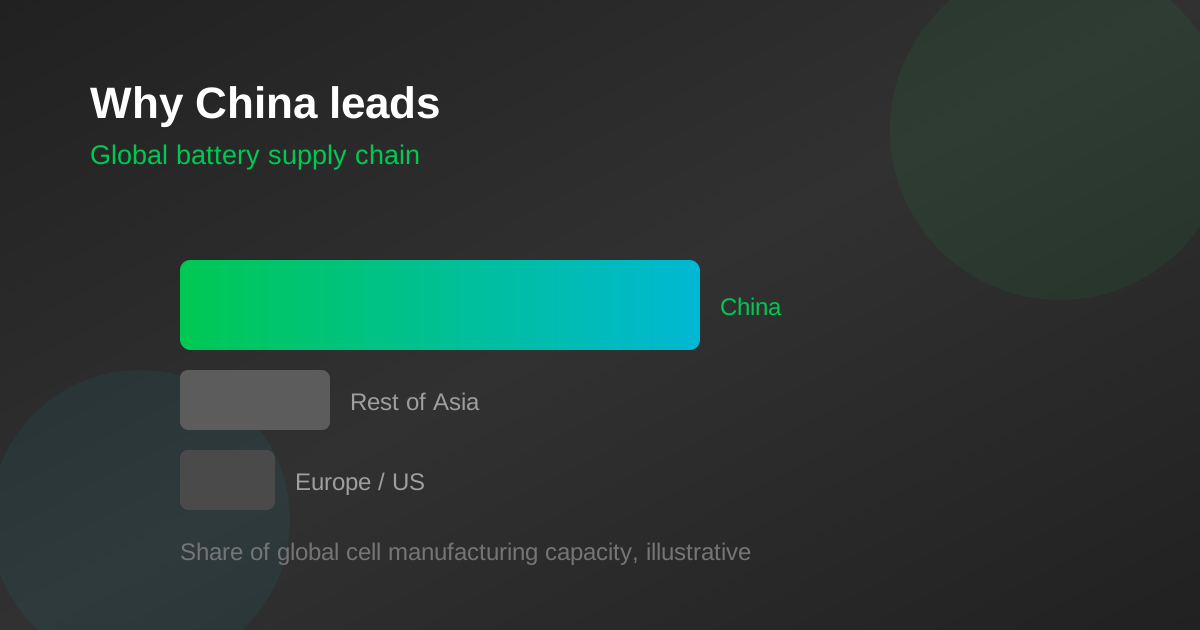
China manufactures the large majority of the world’s lithium-ion cells, and its two largest producers alone account for a substantial share of global output. Every other country combined — Korea, Japan, the United States, Europe, India — makes up the remainder.
This is usually explained as cheap labour. That explanation is wrong, and getting it wrong leads to bad strategy. Cell manufacturing is highly automated; labour is a small share of cost. The real advantages are structural, and they took two decades to build.
1. It started upstream, not at the cells
The decisive move was not building cell factories. It was taking control of the middle of the supply chain — refining raw materials into battery-grade chemicals, and converting those into cathode and anode materials.
Mining is globally distributed. Refining is not. A country can hold the ore and still depend entirely on someone else to turn it into something a battery can use. That is the position most of the world is in, and it is covered in detail in our piece on why refining is the real chokepoint.
2. Vertical integration across every layer
The largest Chinese producers are not cell companies. They hold interests spanning mining stakes abroad, refining, cathode and anode production, separators, electrolyte, cells, packs, and increasingly recycling that feeds material back to the start.
A competitor that buys cathode on the open market is negotiating against a firm that makes its own. That is not a cost gap that better factory management closes.
3. Scale, and the learning curve that comes with it
Battery costs follow a learning curve: each doubling of cumulative production drives a predictable percentage cost reduction. This is not a metaphor, it is an observed relationship, and it means the party that produced the most units has structurally lower costs than a newer entrant with identical technology.
A new entrant is therefore not competing against today’s Chinese cost base. They are competing against it after their competitor has moved further down the curve during the three years it takes to build the plant.
4. Speed of construction, and patient capital
Gigafactories in China have been built and commissioned in a fraction of the time typical elsewhere, with land, power and permits arranged as a matter of industrial policy rather than negotiated project by project. Capital has been available at low cost and with tolerance for years of losses to secure position.
Where a Western or Indian project spends two years on permits and power connections, the equivalent Chinese project is already producing and moving down its learning curve.
5. A domestic market large enough to absorb the ramp
New cell lines produce poor yields at first. Absorbing that early output requires a large, tolerant domestic market — which China had, through sustained domestic EV adoption and grid storage deployment.
A country building cells for export alone has no equivalent shock absorber for the ramp-up period, which is precisely when costs are worst.
6. The equipment layer, which almost nobody discusses
Cell production requires highly specialised machinery: coaters, calenders, winders, stackers, formation and ageing equipment. A large share of that equipment is Chinese-made.
This is a quiet but serious dependency. A country can build a gigafactory anywhere in the world and still be buying the machines, the process know-how and the commissioning engineers from the incumbent.
What this means practically
- •Cell pricing and availability are exposed to policy decisions, not only market demand
- •Second-sourcing matters more here than in most component categories
- •Claims of “made in India” batteries usually mean pack assembly here with imported cells — worth asking which is meant
- •The gap is closable at the pack and BMS layer far sooner than at the cell layer
For what closing it would actually involve, see our assessment of India’s position.
Frequently asked questions
Why does China dominate lithium battery production?+
Six structural reasons rather than cheap labour: control of midstream refining and cathode production, deep vertical integration across every layer, scale that puts them far down the cost learning curve, fast plant construction with patient capital, a large domestic market to absorb early low-yield output, and dominance of the specialised production equipment itself.
Is it just about lower labour costs?+
No. Cell manufacturing is highly automated and labour is a small share of cost. The decisive advantages are upstream and midstream — refining, cathode and anode materials — plus the cost reduction that comes automatically from having produced the most cumulative units.
What does this mean for battery buyers in India?+
Cell prices and availability can move on policy decisions taken elsewhere rather than on demand, so second-sourcing matters more than in most component categories. It is also worth asking a supplier which step actually happens in India — usually pack assembly around imported cells, which is legitimate but should be stated plainly.
Thinking about upgrading?
Talk to our team about the right pack for your vehicle, and about EMI options that keep the monthly outgo close to what you already spend.
Get in touch