Lithium Fell Almost 10% in a Week. Storage Cell Prices Did Not.
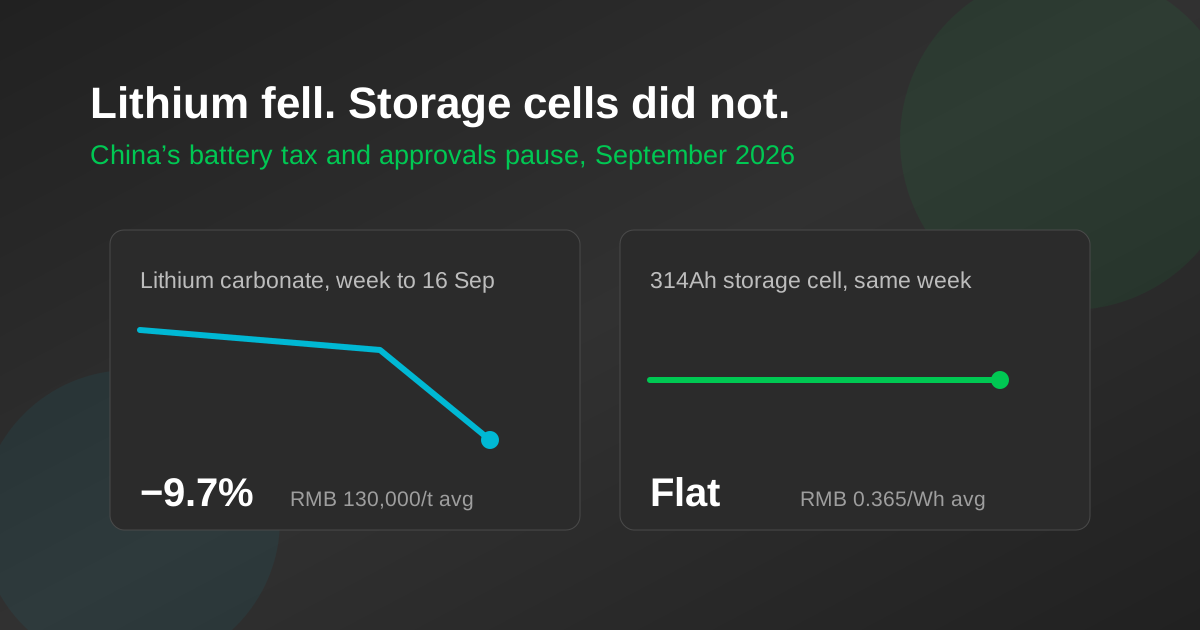
Lithium carbonate dropped 9.7% in the week to 16 September, but storage cell prices held flat. A new Chinese consumption tax on batteries and a pause on new battery-factory approvals stand between the raw material and the cell.
Published: 30 September 2026
Industry · 4 min read
What happened
Written 30 September 2026, on InfoLink Consulting’s weekly storage price reports of 16 and 23 September, and reporting by Caixin and Energy-Storage.News on 9–10 September.
In the week to 16 September, InfoLink put battery-grade lithium carbonate at RMB 128,000–132,000 per tonne, an average of RMB 130,000, down 9.7% week on week. SC6 spodumene, the concentrate it is made from, fell 13.1% to an average of US$1,850 per tonne.
Storage cells barely moved. The large 280Ah and 314Ah cells used in grid containers held at an average of RMB 0.365/Wh. The following week lithium carbonate recovered 1.5% to RMB 132,000, and InfoLink again reported cell prices flat.
Why cells did not follow
Two policy changes in China sit between the raw material and the cell. The first is a consumption tax on batteries. InfoLink describes it as a “2% consumption tax, with the rate set to increase to 4% from September 1, 2027”. EVE Energy told customers that from 1 September a 2% surcharge would be added to the base price of all domestic battery products, and that “export-bound products will be eligible for tax rebates”, Energy-Storage.News reported.
The second is supply. Caixin reported on 10 September that China had “temporarily suspended construction of new power and energy-storage battery projects pending a year-end review”, noting that planned new capacity this year had reached about 1.5 times China’s total battery output in 2025. InfoLink says executives confirmed on 9 September that approvals for new projects have tightened, while projects already filed and under construction are not affected for now.
A tax that raises the delivered price and a pause that caps future capacity both work against a lithium-led fall in cell prices.
Two numbers for the same cell
Energy-Storage.News reported that CATL raised its 314Ah storage cell from RMB 0.414/Wh to RMB 0.423/Wh. That is well above InfoLink’s RMB 0.365/Wh average for the same format, but the two are not in conflict. CATL’s figure is its own list price; InfoLink’s is an average of traded spot prices across suppliers. As we noted in our piece on lithium price assessments, a quoted price depends on who is measuring and what they are measuring.
The one format that did soften was the 100Ah cell. InfoLink put it at an average of RMB 0.438/Wh on 16 September, down 0.6% on the week. That is small. InfoLink attributes it to the format’s premium fading as home storage and export demand eased.
What it means for this business
The 100Ah class is the format used in e-rickshaw, two- and three-wheeler and home backup packs, which is what we build. A 0.6% weekly move is not a trend, and it came before the flat reading of 23 September.
- •A falling lithium price is not, on its own, a reason to expect cheaper cells this quarter
- •Reporting says export-bound products are eligible for rebates on the new tax; how this lands on Indian import prices is not yet clear
- •The approvals pause affects future capacity, not cells already being made
- •Import cost also depends on the yuan, which moves independently of either lithium or policy
For the currency side, see how yuan strength feeds into cell import costs.
Sources
Reporting this piece draws on. Figures were correct as published; scheme terms and commodity prices move.
- Lithium salt prices retreat markedly; cell prices edge down while system prices hold steadyInfoLink Consulting · 16 September 2026
- Lithium salt prices recover amid weekly volatility; cell and system prices hold steadyInfoLink Consulting · 23 September 2026
- Exclusive: China Pauses New Battery Projects Pending Capacity ReviewCaixin Global · 10 September 2026
- CATL, EVE Energy lead Chinese manufacturers’ battery storage cell price hikesEnergy-Storage.News · 9 September 2026
Frequently asked questions
Why did storage cell prices not fall with lithium in September 2026?+
China added a 2% consumption tax on batteries from 1 September 2026, rising to 4% from 1 September 2027, and tightened approvals for new battery-factory projects. InfoLink reported 280Ah and 314Ah storage cells flat at an average of RMB 0.365/Wh while lithium carbonate fell 9.7% in the week to 16 September.
Did any cell format get cheaper?+
The 100Ah cell, used in e-rickshaw, two- and three-wheeler and home backup packs, averaged RMB 0.438/Wh on 16 September, down 0.6% on the week. InfoLink attributes this to its premium fading as home storage and export demand eased. Cell prices were flat again on 23 September.
Does the Chinese battery consumption tax apply to exports?+
EVE Energy said the surcharge applies to domestic battery products and that export-bound products will be eligible for tax rebates, as reported by Energy-Storage.News. How this affects prices paid by Indian importers is not yet clear.
Want this applied to your own numbers?
Every solution page carries a calculator that shows its own arithmetic — storage savings, lithium against lead-acid, and home pack sizing.