India Has Tendered 260 GWh of Storage. It Has Built 2 GWh of Cells.
Wood Mackenzie puts a globally competitive Indian cell industry 10 to 15 years away. A 5 GWh plant runs at minus 10 per cent EBITDA, breakeven needs 10 GWh, and full domestic content would add about 30 per cent to project capex.
Published: 26 August 2026
Industry · 9 min read
Where things stand
Written 26 August 2026, from a Wood Mackenzie assessment published 20 August. Pipeline and capacity figures are analyst estimates, and announced capacity in particular is a statement of intent rather than a measurement.
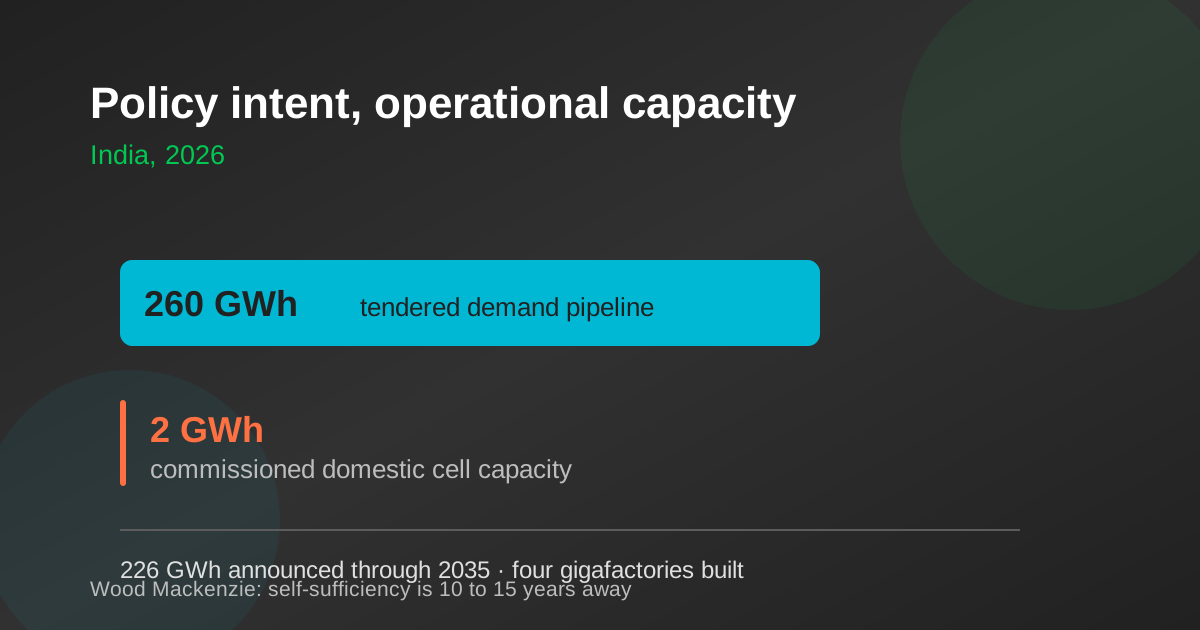
India’s competitive storage tenders in 2026 add up to a demand pipeline of roughly 260 GWh. India’s commissioned domestic cell manufacturing capacity is about 2 GWh. Domestic cells are therefore covering under one per cent of what the country has already asked the market to supply.
Wood Mackenzie’s director Ankita Chauhan put it in one sentence: “The gap between policy intent and operational capacity is wide.”
The numbers behind the sentence
- •226 GWh announced through 2035, 2 GWh built. Four players have commissioned gigafactories. Announced capacity and capacity are separated by a decade of execution.
- •China holds about 2,695 GWh of cumulative capacity. India’s entire announced 2035 ambition is smaller than a rounding error against the incumbent’s existing base.
- •Locally made cells are expected to cost 25 to 40 per cent more than imports. Not because Indian manufacturing is intrinsically expensive — India is assessed as second only to China on cost, with a 9 per cent advantage over South Korea — but because scale is missing.
- •A 5 GWh plant runs at about −10 per cent EBITDA. Breakeven needs roughly 10 GWh and healthy margins need 20 GWh. Most announced Indian plants are sized below the point where the arithmetic works.
- •10 to 15 years to a globally competitive, self-sufficient cell industry. That is the headline finding, and it is a longer horizon than most of the policy is written against.
The binding constraint is not capital, land or intent. It is that a sub-scale cell plant loses money in a way no subsidy comfortably fixes, and getting to scale requires surviving the years before you have it.
The domestic content requirement is the live question
A 20 per cent domestic content requirement now applies to grid-scale BESS projects. Wood Mackenzie estimates that scaling that to 100 per cent would add roughly 30 per cent to total capital cost on a 100 MW, two-hour project.
That figure is the whole policy argument in one number. Thirty per cent more capital for every megawatt-hour deployed in the interim, in exchange for an industry that exists at the end of it. Whether that is a good trade depends entirely on whether the industry actually materialises — which is precisely what the 10-to-15-year finding calls into question.
It also has an immediate effect on the system prices we wrote about in our note on the three-fold spread in turnkey storage costs: India is deliberately choosing not to buy at the cheapest available price.
Reading this honestly
- •A tender pipeline is not demand. Tendered capacity includes projects that will be re-bid, deferred or cancelled, and comparing it against built factories overstates the gap somewhat.
- •Cells are not the whole battery. Module and pack assembly, BMS, thermal design, enclosures, testing and installation are already done in India at real volume, and they are a large share of the value.
- •Import dependence is not the same as vulnerability, but it is not nothing either. It is a currency exposure, a freight exposure and a policy exposure, all at once.
- •Europe tried this and largely failed. We wrote separately on what happened there, and the lesson was that money and political support did not substitute for process yield.
What it means if you are buying
For anyone specifying a battery in India over the next few years, the honest reading is that the cells in it will be imported, and that this is not a defect in the supplier you are talking to. What separates a good pack from a bad one here is not the flag on the cell — it is the pack engineering, the BMS, the thermal design, the testing and the warranty behind it, all of which are done locally and vary enormously.
For anyone reading the manufacturing announcements as a reason to wait: do not. A decade is a long time to run on a worn-out lead-acid set. We have written on what catching up would actually require and on why Europe’s attempt did not work.
Sources
Reporting this piece draws on. Figures were correct as published; scheme terms and commodity prices move.
- India's battery storage self-sufficiency remains over a decade awayWood Mackenzie · 20 August 2026
- India's BESS supply chain suffers a 'policy intent and operational capacity' gap, with battery cell self-sufficiency a decade or more awayEnergy-Storage.News
- Powering ahead: the future of EV battery manufacturing in IndiaObserver Research Foundation
Frequently asked questions
How much battery cell capacity does India actually have?+
About 2 GWh commissioned, against roughly 226 GWh announced through 2035 and a 2026 competitive tender pipeline of around 260 GWh. Four players have commissioned gigafactories. Domestic cells are covering under one per cent of what the country has already asked the market to supply. For scale, China holds around 2,695 GWh of cumulative capacity.
Why can India not just build gigafactories faster?+
Because a sub-scale cell plant loses money in a way subsidy does not comfortably fix. Wood Mackenzie assesses a 5 GWh facility as running at about minus 10 per cent EBITDA, with breakeven around 10 GWh and healthy margins needing 20 GWh. Most announced Indian plants are sized below the point where the arithmetic works, and reaching scale means surviving the years before you have it.
Do Indian-made cells cost more than imported ones?+
Currently yes, by an expected 25 to 40 per cent — not because Indian manufacturing is intrinsically expensive but because scale is missing. On underlying cost competitiveness India is assessed second globally only to China, with about a 9 per cent advantage over South Korea.
What does the domestic content requirement cost?+
A 20 per cent domestic content requirement now applies to grid-scale BESS projects. Wood Mackenzie estimates that taking a 100 MW, two-hour project to 100 per cent domestic content would add roughly 30 per cent to total capital cost. That number is the whole policy argument: more capital per megawatt-hour now, in exchange for an industry at the end of it.
Should I wait for Indian-made cells before buying a battery?+
No. On a 10 to 15 year horizon that is a long time to run on a worn-out pack. The cells in an Indian battery will be imported for the foreseeable future and that is not a defect in your supplier. What varies enormously, and what you should actually assess, is the pack engineering, BMS, thermal design, testing and warranty — all of which are done locally.
Want this applied to your own numbers?
Every solution page carries a calculator that shows its own arithmetic — storage savings, lithium against lead-acid, and home pack sizing.
Get in touch