Sodium-Ion Crossed From Pilot to Production. It Still Does Not Undercut LFP.
A 60 GWh supply agreement and the first mass-produced sodium-ion passenger car moved the chemistry past demonstration in 2026. Its natural home is short-range mobility — which is India’s largest EV market.
Published: 27 August 2026
Industry · 8 min read
Where things stand
Written 27 August 2026. Cost and energy-density figures vary considerably between sources — treat the ranges as indicative.
Sodium-ion batteries have been eighteen months from commercialisation for about a decade. In 2026 that changed, and the evidence is contractual rather than technical.
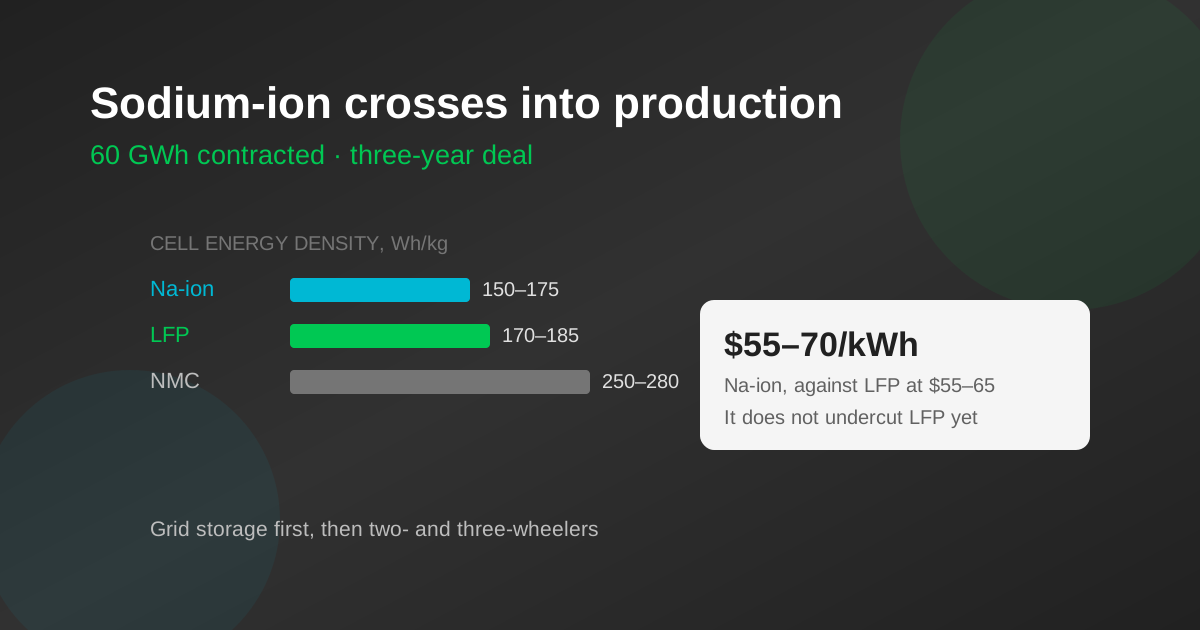
On 27 April 2026, CATL and Beijing HyperStrong announced a three-year, 60 GWh sodium-ion supply agreement for energy storage — described as the largest sodium-ion order announced to date. What makes it different from previous sodium-ion news is that it pairs a contracted volume at industrial scale with a stated production-readiness timeline, rather than a demonstration project or a memorandum of understanding.
Earlier, in February 2026, CATL and Changan unveiled the first mass-production passenger vehicle with sodium-ion cells, using CATL’s Naxtra chemistry, for a mid-2026 launch. CATL has said it expects at least 10,000 EVs to use its sodium batteries during 2026.
Where the chemistry actually sits
- •Energy density: roughly 150–175 Wh/kg at cell level, against about 170–185 for LFP and 250–280 for high-nickel NMC.
- •Cost: reported cell costs cluster in the $55–70/kWh range. Note that this is not below LFP in China, where LFP cells are quoted at $55–65/kWh.
- •Advantages that are not density: cold-weather performance, thermal stability, and a supply chain with no lithium, cobalt or nickel exposure. It also uses aluminium current collectors on both electrodes rather than copper on the anode side, which removes a real cost item.
Analyses through 2026 are consistent that sodium-ion does not yet undercut LFP at current volumes, whatever the long-run abundance argument says. Sodium is a thousand times more abundant than lithium; that has not yet turned into a cheaper cell, because cost at this stage is set by scale and process maturity rather than by the price of the metal.
Why this is a three-wheeler story
The consistent read across analyses is that sodium-ion wins where energy density matters least and cost and supply security matter most: grid storage first, then short-range mobility — two-wheelers, three-wheelers, urban delivery.
That is precisely the Indian market. India is the world’s largest market for electric three-wheelers.
The physics supports the segmentation. Sodium’s ion is 34 per cent larger than lithium’s and its atom is 3.3 times heavier, which caps capacity at around 1,166 mAh/g against lithium’s 3,862. It also will not intercalate into graphite, so sodium cells need hard carbon anodes with a sloping rather than flat voltage curve and lower first-cycle efficiency.
None of that is fatal for a vehicle doing 60 to 80 km a day at low speed. All of it is fatal for a long-range car. Why sodium behaves that way is covered in why lithium won.
Indian activity
Faradion, acquired by Reliance Industries, is the most visible domestic name, with Jamnagar capacity reported as scheduled for 2026 start-up. India’s ACC PLI programme is chemistry-neutral, so sodium-ion investment qualifies under it.
The honest assessment
The most likely outcome through the next decade is a dual-chemistry market rather than a replacement — LFP holding the high-energy applications, sodium-ion taking share where its supply-chain and thermal advantages outweigh its density deficit.
For anyone in three-wheelers, that makes sodium-ion worth watching closely and not yet worth designing around. The signal to watch is not another density announcement; it is a second large contracted order, or a sodium cell quoted below LFP for a comparable specification.
Sources
Reporting this piece draws on. Figures were correct as published; scheme terms and commodity prices move.
- CATL secures world’s largest sodium-ion battery order with 60 GWh dealCarNewsChina · 27 April 2026
- CATL secures world’s largest sodium-ion battery order with HyperstrongESS News
- CATL expects at least 10,000 EVs to use its sodium batteries this yearCnEVPost · 24 June 2026
- How CATL moved sodium-ion batteries from lab chemistry to GWh-scale realityBattery Technology
Frequently asked questions
What changed for sodium-ion in 2026?+
The evidence became contractual rather than technical. On 27 April 2026 CATL and Beijing HyperStrong announced a three-year, 60 GWh sodium-ion supply agreement for energy storage — the largest announced to date — pairing a contracted industrial volume with a production-readiness timeline rather than a demonstration or an MoU. In February 2026 CATL and Changan unveiled the first mass-production passenger vehicle with sodium-ion cells, using CATL’s Naxtra chemistry, for a mid-2026 launch.
Is sodium-ion cheaper than LFP yet?+
No. Reported sodium-ion cell costs cluster in the $55 to $70 per kWh range, against LFP in China at $55 to $65. Analyses through 2026 are consistent that sodium-ion does not yet undercut LFP at current volumes, whatever the long-run abundance argument says — cost at this stage is set by scale and process maturity rather than by the price of the metal.
Where does sodium-ion actually make sense?+
Where energy density matters least and cost and supply security matter most: grid storage first, then short-range mobility — two-wheelers, three-wheelers and urban delivery. At roughly 150 to 175 Wh/kg against LFP’s 170 to 185 and high-nickel NMC’s 250 to 280, it is not a long-range car chemistry. It does offer cold-weather performance, thermal stability, no lithium, cobalt or nickel exposure, and aluminium current collectors on both electrodes instead of copper.
Why is this particularly relevant to India?+
Because India is the world’s largest market for electric three-wheelers, and that is precisely the segment sodium-ion suits — vehicles doing 60 to 80 km a day at low speed, where a density deficit is tolerable and supply-chain security is not. Faradion, acquired by Reliance Industries, is the most visible domestic name, with Jamnagar capacity reported as scheduled for 2026 start-up, and the ACC PLI programme is chemistry-neutral so sodium-ion qualifies.
Will sodium-ion replace lithium?+
Most likely not — the probable outcome through the next decade is a dual-chemistry market, with LFP holding the high-energy applications and sodium-ion taking share where its supply-chain and thermal advantages outweigh its density deficit. For anyone in three-wheelers that makes it worth watching closely and not yet worth designing around. The signal to watch is a second large contracted order, or a sodium cell quoted below LFP for a comparable specification.
Want this applied to your own numbers?
Every solution page carries a calculator that shows its own arithmetic — storage savings, lithium against lead-acid, and home pack sizing.
Get in touch