Home Battery Storage in India: Is a BESS Worth It for Your House?
A home battery does three different jobs — backup, solar self-consumption and tariff arbitrage — and only some of them pay back in India today. How to work out which applies to you.
Published: 14 August 2026
Home storage · 8 min read
A home battery does three different jobs
“Is a home battery worth it” has no single answer, because a battery energy storage system can be bought for three quite different reasons. The economics of each are not the same.
- •Backup. Keeping lights, fans, router and fridge running through a power cut. The value here is reliability, not rupees, and most Indian households already understand it well.
- •Solar self-consumption. Storing the surplus your rooftop system generates at noon so you use it at 8pm instead of exporting it cheaply and buying it back expensively.
- •Tariff arbitrage. Charging when electricity is cheap and discharging when it is expensive. This only works where your tariff genuinely varies by time of day, which for most Indian residential connections it currently does not.
Be clear which one you are buying. Most disappointment with home storage comes from paying for one job and expecting another.
Backup: the easiest case to justify
If your area sees frequent or long outages, the calculation is not really financial. The question is what you need running and for how long.
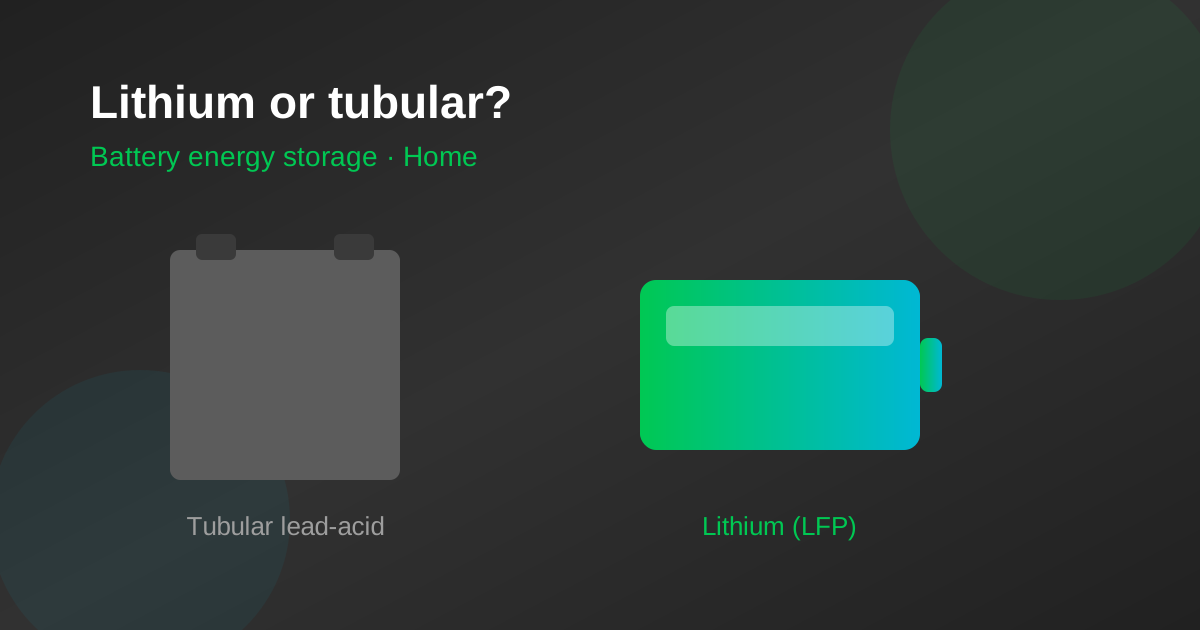
Compared with a conventional inverter and tubular battery, a lithium BESS is lighter, lasts far more cycles, needs no water topping, and does not lose capacity noticeably towards end of life. It also costs more upfront. See our comparison of lithium and tubular home batteries.
Solar self-consumption: where the maths gets interesting
This is the case that has changed most. If your state pays you well for exported solar under net metering, a battery has to compete with that, and often loses. If your export rate is low, or you are on gross metering, or there are limits on how much you can export, then storing your own generation for evening use is worth real money.
The number to find is the gap between what you are paid for a unit you export and what you pay for a unit you import. The wider that gap, the better a battery looks. Because net metering rules differ by state and change over time, check your own DISCOM’s current policy rather than a general figure.
Tariff arbitrage: be sceptical for now
Time-of-day tariffs are being introduced progressively for larger consumers in India, and the direction of travel is clear. But for a typical residential connection today, the price you pay does not vary enough across the day for arbitrage alone to fund a battery.
If someone is selling you a home battery on arbitrage savings, ask to see your own tariff schedule and the specific rates being assumed.
How to size it
Size around the load you want to run during an outage, not your total connected load.
- •List the circuits you actually need — lights, fans, router, fridge, a few sockets. Air conditioning changes the answer completely, so decide deliberately.
- •Add up their power draw in watts.
- •Multiply by the hours of backup you want. That gives watt-hours.
- •Add margin for inverter losses and for not discharging the pack fully.
- •Separately, check the inverter can supply the peak draw when everything starts at once — motors draw a surge on startup.
This gives you two numbers: kWh (how much energy) and kW (how fast you can draw it). Both matter, and they are not interchangeable.
What to check before buying
- •Chemistry in writing — LFP is the usual choice for stationary home storage
- •Cycle life with its depth of discharge and temperature assumptions
- •BMS protections listed individually
- •Where it will be installed: ventilated, away from living space and escape routes, out of direct heat
- •Warranty duration and, more importantly, the exclusions
- •Who services it locally, and the turnaround time
- •Whether it is compatible with your existing solar inverter, or needs a hybrid one
Frequently asked questions
Is a home battery storage system worth it in India?+
It depends which job you need it to do. If you face frequent or long power cuts, the value is reliability and it is easy to justify. If you have rooftop solar and export at a low rate, storing surplus for evening use can pay back. If you have neither, a battery bought purely for tariff savings rarely pays for itself at residential tariffs.
What is the difference between a home BESS and a normal inverter?+
A conventional inverter and battery provide backup when the grid fails. A modern BESS does that too, but can also store solar generation for later use, shift consumption between times of day, and report state of charge and health. The hardware overlaps; the control and intelligence differ.
How big a battery does a house need?+
Size it around the load you actually want to run during an outage and for how long, not around your total connected load. List the essential circuits, add up their watts, multiply by the hours of backup you want, then add margin for inverter losses and for not fully discharging the pack.
Thinking about upgrading?
Talk to our team about the right pack for your vehicle, and about EMI options that keep the monthly outgo close to what you already spend.
Get in touch