Can a Lithium Battery Work With Your Existing Home Inverter?
A lithium pack can sometimes replace a tubular battery on the same inverter — if the charging profile, voltage window and cut-offs suit it. What to check, and when to replace the inverter instead.
Published: 19 November 2026
Home storage · 4 min read
The short answer: sometimes, with the right settings
Most Indian homes with backup already own an inverter, bought years ago for a tubular lead-acid battery. When that battery wears out, the natural question is whether a lithium pack can simply take its place on the same two cables.
Sometimes it can. Often it can with a setting changed. And sometimes the inverter is the wrong partner for lithium, and keeping it will shorten the life of the expensive part of the system. The answer depends on how your inverter charges, what voltages it works between, and whether the battery and inverter can talk to each other.
How a lead-acid inverter charges
An inverter built for lead-acid charges in stages. It pushes current until the battery reaches a set voltage (the bulk and absorption stages), then drops to a lower float voltage and holds the battery there indefinitely to make up for self-discharge. Some also run a periodic equalise charge at a higher voltage, deliberately overcharging to stir the electrolyte and even out the cells.
On a typical 12V system, absorption sits somewhere around 14.4V, float around 13.5 to 13.8V, and equalise can go to 15V or beyond. Settings differ between tubular, flat-plate and sealed batteries, which is why many inverters have a battery-type selector.
Lithium iron phosphate wants something simpler: a constant current up to a fixed voltage, then stop. It does not need a float, and it must never be equalised. A 12.8V lithium pack is full at roughly 14.2 to 14.6V, so the absorption voltage of many lead-acid profiles is close to acceptable. The float and equalise stages are where the trouble starts.
The voltage window and the low-battery cut-off
An inverter has two voltage limits that matter: the level at which it stops charging, and the level at which it shuts down on low battery. Both were chosen for lead-acid.
- •Low-battery cut-off. Lead-acid inverters often shut down around 10.5V on a 12V system. A lithium pack is nearly empty well before that, so the BMS will usually disconnect first. The inverter then sees its battery vanish rather than run down gradually.
- •Battery gauge. Lithium holds an almost flat voltage for most of its discharge. An inverter that estimates charge from voltage will show “full” for a long time and then “empty” very suddenly.
- •Charge current. A home inverter charges slowly, often at a modest fraction of what a lithium pack can accept. That is harmless; it simply leaves some of lithium’s faster charging unused.
- •Discharge current. The pack’s BMS must handle the inverter’s full draw. A 900W load on a 12V system pulls something like 80 to 90 amps once inverter losses are counted, and more for a moment when a fridge or pump starts.
The system voltage must also match: a 12V inverter needs a 12.8V pack, a 24V inverter a 25.6V pack. That sounds obvious, but a mismatch is not something to discover on the day of installation.
Lithium-ready inverters and BMS communication
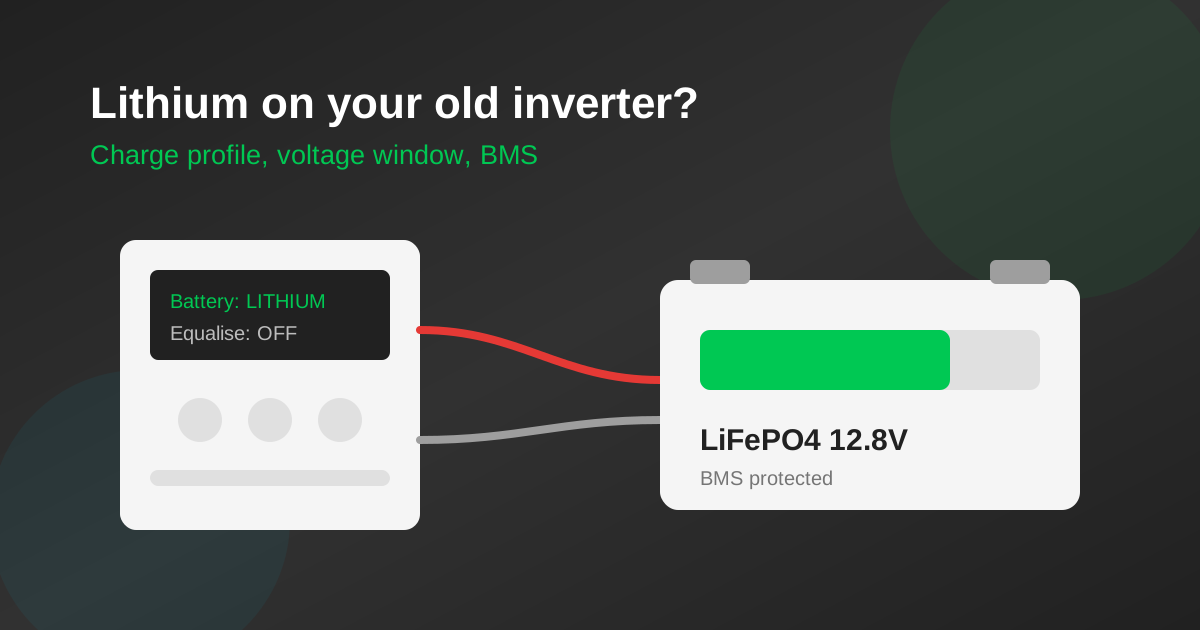
A lithium-ready inverter has a lithium setting, or user-adjustable charge and cut-off voltages, so it can be set to charge to the right voltage, skip float or hold a low one, and never equalise. Many newer home inverters offer this. Check the manual, not the box.
Some go further and talk to the pack’s battery management system over a data link such as CAN or RS485. The BMS then tells the inverter how much current it can accept, when it is full and what its true state of charge is, and the inverter follows. This closed-loop control is common on hybrid solar inverters and rare on basic home inverters. It is the most reliable arrangement, but it works only when the inverter maker supports that battery’s protocol, so check the compatibility list.
An inverter without communication can still run lithium safely, in open loop, provided its voltages are set correctly and the BMS is trusted to protect the pack.
What an installer should check
- •System voltage of the inverter, and that the pack matches it
- •Whether the inverter has a lithium mode or adjustable charge voltages, and what they are set to
- •That equalise is disabled and float is off or set to a level the battery maker accepts
- •The inverter’s low-battery cut-off, relative to the BMS cut-off
- •The BMS continuous and peak current ratings against the inverter’s maximum draw
- •Cable size, a correctly rated fuse or DC breaker on the battery lead, and tight terminals
- •Whether the BMS recovers on its own after a low-voltage shutdown, or needs to be woken
- •Placement: cool, ventilated and away from escape routes
A good installer measures the inverter’s actual charging voltage with a meter, rather than trusting the setting on its display.
Retrofit or replace the inverter
Keep the inverter if it has a lithium mode or adjustable voltages, is in good condition and is sized for your load. Replace it if it has fixed lead-acid charging with an equalise stage you cannot turn off, if it is old enough that it may fail soon anyway, or if you are adding rooftop solar and want a hybrid inverter that can manage both. Our guide to sizing a home solar battery covers that case. For the wider choice of battery, see the lithium inverter battery page.
Warranty is part of the decision. A battery maker may require an approved or lithium-compatible inverter, and an inverter maker may exclude batteries it did not specify. Ask both, and get the answer in writing, before connecting them.
A checklist before you swap
- •Find your inverter’s model, system voltage and manual
- •Confirm it has a lithium setting or adjustable charge and cut-off voltages
- •Make sure equalise can be switched off
- •Match the pack voltage to the inverter
- •Check the BMS current rating against your inverter’s maximum load
- •Ask the battery seller which inverters they approve, in writing
- •Have a qualified installer set and measure the voltages, and fit a DC fuse
- •If the inverter cannot be set for lithium, budget for a new one
Terms in this article
Frequently asked questions
Can I use a lithium battery with my old inverter?+
Sometimes. It depends on whether the inverter can be set to charge to the right voltage for lithium, whether its equalise stage can be switched off, whether its system voltage matches the pack, and whether the pack’s BMS can handle the inverter’s full current draw. An inverter with fixed lead-acid charging is a poor match.
Why is equalise charging a problem for lithium batteries?+
Equalise deliberately overcharges a lead-acid battery to even out its cells. On a lithium iron phosphate pack it pushes the voltage above the safe limit. The BMS should cut the charge off, but a pack repeatedly driven into its protection is being treated badly. Equalise must be disabled.
What is a lithium-ready inverter?+
An inverter with a lithium battery setting, or adjustable charge and cut-off voltages, so it can charge a lithium pack correctly and never equalise it. Some also communicate with the battery’s BMS over a data link, which lets the battery tell the inverter how to charge it.
Replacing an inverter battery?
Tell us what you need to keep running during a cut, and we will size a lithium pack to it — and say so if a tubular battery is the cheaper choice.
Popular: Lithium inverter battery