Lithium inverter battery

Lithium Inverter Battery for Home

Most Indian homes with backup run a tubular lead-acid battery that needs distilled water every few months and a replacement every few years. A lithium battery removes the maintenance and lasts far more cycles — but it costs more up front, and in a home that rarely loses power a tubular battery can still be the cheaper choice. This page sets out how to tell which applies to you.

Lithium or tubular: the honest comparison

A tubular battery is much cheaper on the day you buy it, and that is why it still dominates. But an inverter battery is a consumable, so the fair comparison is cost per cycle delivered: divide the price by the rated cycles, for both.

If your area loses power daily, you cycle the battery daily, and the arithmetic usually favours lithium. If you lose power a handful of times a year, a tubular battery is replaced on age rather than cycles, and the case for lithium weakens.

  • Lithium is compact and far lighter — easier in a flat or on an upper floor
  • No water topping or terminal cleaning
  • Deeper usable discharge without shortening its life, and faster charging
  • Capacity holds up towards the end of its life rather than fading steadily
  • Sealed and does not vent gas like lead-acid, though it should still be placed somewhere cool and ventilated
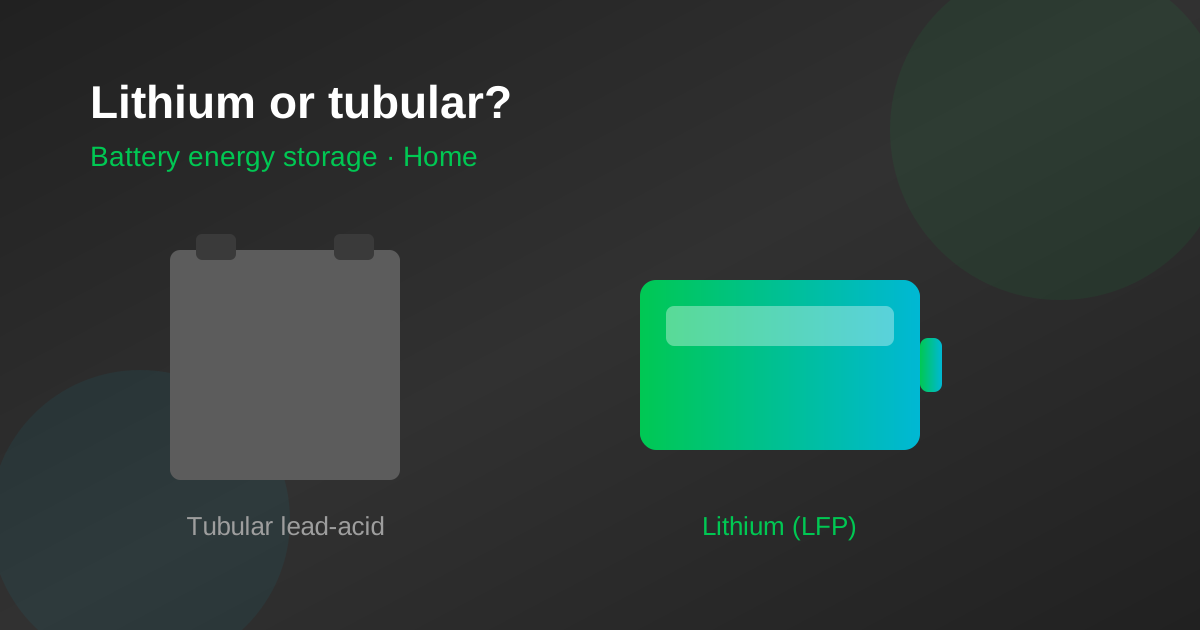
Lithium vs tubular inverter battery, in full

When tubular is the better buy

We would rather say this before you buy than after. The calculator on this page reports it plainly when tubular comes out cheaper on your numbers.

  • Infrequent outages, where the battery ages out rather than cycling out
  • A tight upfront budget where the lithium premium is not available
  • A location with established local service for lead-acid and none for lithium

Sizing: start from what you want to run

An undersized pack fails during the outage you bought it for; an oversized one is money sitting idle. Size around the load you want backed up, not your total connected load.

  • List what you need running — lights, fans, router, fridge, a few sockets. Air conditioning changes the answer completely, so decide deliberately.
  • Add up their power in watts and multiply by the hours of backup you want.
  • Add margin for inverter losses and for not discharging the pack to empty. That is your kWh target.
  • Separately, check the inverter can supply the peak draw when everything starts at once.
Sizing a home or solar battery

Before replacing a tubular battery with lithium

A lithium pack is not a drop-in replacement on every system. The charging profile is different, and a lead-acid charger or an old inverter’s charging logic can damage it.

  • Confirm the inverter is lithium-compatible, or budget for a new one
  • Never use a lead-acid charger or charging profile on a lithium pack
  • Confirm voltage compatibility, physical fit and secure mounting
  • Have the changeover done by a qualified technician
  • Hand the old battery to an authorised recycler — lead-acid is hazardous waste and has real scrap value

With rooftop solar

Storage lets midday solar cover the evening instead of being exported cheaply and bought back at the retail rate. Whether that pays depends on your state’s net-metering terms: the wider the gap between what you are paid for an exported unit and what you pay for an imported one, the better a battery looks.

Most existing solar systems can take storage, but some inverters are storage-ready and some need a hybrid unit — check the model before assuming either way.

Is home battery storage worth it in India?

Run the numbers

What would it cost you?

The same arithmetic we use, with your numbers instead of ours — including the cases where the answer is no.

How big a pack, and what does it save?

Start from what you want to keep running during an outage, and for how long. The size follows from that — and once you have a size, the comparison against a tubular battery becomes arithmetic.

Estimated saving

Pack you need

3.1 kWh

2.8 kWh delivered at the socket. The tubular equivalent is about 3 × 150Ah units, because it should not be run as deep.

Tubular over 10 years3 × 3 units₹1.35 L
Lithium over 10 years1 pack at ₹1,00,392 each₹1.00 L
Lithium comes out ahead by₹34,608

An estimate from your inputs, not a quotation. Sizing also depends on your existing inverter and wiring, which is worth a look before anyone quotes.

How this is calculated

Sizing. Usable energy = load × hours ÷ 85% inverter efficiency. That is then grossed up by the depth each chemistry can safely be taken to — 90% for lithium, 60% for tubular. Using one figure for both would understate the tubular bank a buyer actually has to purchase.

Ownership cost counts replacements over the period, rounded up, at the prices you enter. Tubular is priced per 150Ah (≈1.8 kWh) unit and rounded up to whole units, because that is how it is sold.

Solar self-consumption values surplus at your retail tariff, on the basis that stored energy displaces a unit you would otherwise buy back in the evening. If your discom pays a good feed-in rate, the real gain is the difference between the two rates, not the full tariff — so treat this line as an upper bound.

Not included: water topping and maintenance on tubular, the ventilated space it needs, capacity fade between replacements, or any installation cost. These mostly favour lithium and are left out to keep the comparison conservative.

Further reading

Go deeper

Frequently asked questions

Is a lithium inverter battery better than tubular?+

Lithium is lighter, needs no water topping, lasts far more cycles and holds its capacity for longer. Tubular is much cheaper up front. With frequent outages the cost per cycle usually favours lithium; with rare outages, tubular can be the cheaper choice.

Can I use a lithium battery with my existing inverter?+

Only if the inverter is lithium-compatible. Lithium needs a different charging profile, and a lead-acid charger or an old inverter’s charging logic can damage the pack. Check the model, and budget for a new inverter if it is not compatible.

What size of lithium battery does my home need?+

Add up the watts of what you want running during an outage, multiply by the hours of backup you want, and add margin for inverter losses and for not discharging the pack to empty. That number is your kWh target.

Can I add a battery to the solar I already have?+

Usually yes, though it depends on your existing inverter — some are storage-ready and some need a hybrid unit. Whether it pays depends on your state’s net-metering terms, so check your DISCOM’s current policy.

Lithium inverter battery

Tell us what you are trying to power.

Send us the bill, the load list or the duty cycle. We will come back with a size, a cost and the arithmetic behind both — including the cases where the answer is that you do not need us.