Reading a Lithium Battery Warranty: What “Five Years” Actually Covers
Two packs with the same five-year warranty can protect you very differently. The limit, the threshold, the remedy and the exclusions decide what you have bought — the headline number decides almost nothing.
Published: 30 September 2026
Buying guide · 7 min read
The headline number is the least useful line
“Five-year warranty” is printed on the box, the banner and the invoice. It is also the part of the warranty that tells you least. Two packs sold with the same five years can protect you very differently, because what matters is not how long the promise lasts but what, exactly, is being promised — and what has to go wrong before it applies.
A lithium battery warranty is a short legal document with four moving parts: a limit, a threshold, a remedy, and a list of exclusions. Read those four and you know what you have bought. Read only the headline and you know what you have been told.
The limit: years, cycles, or whichever comes first
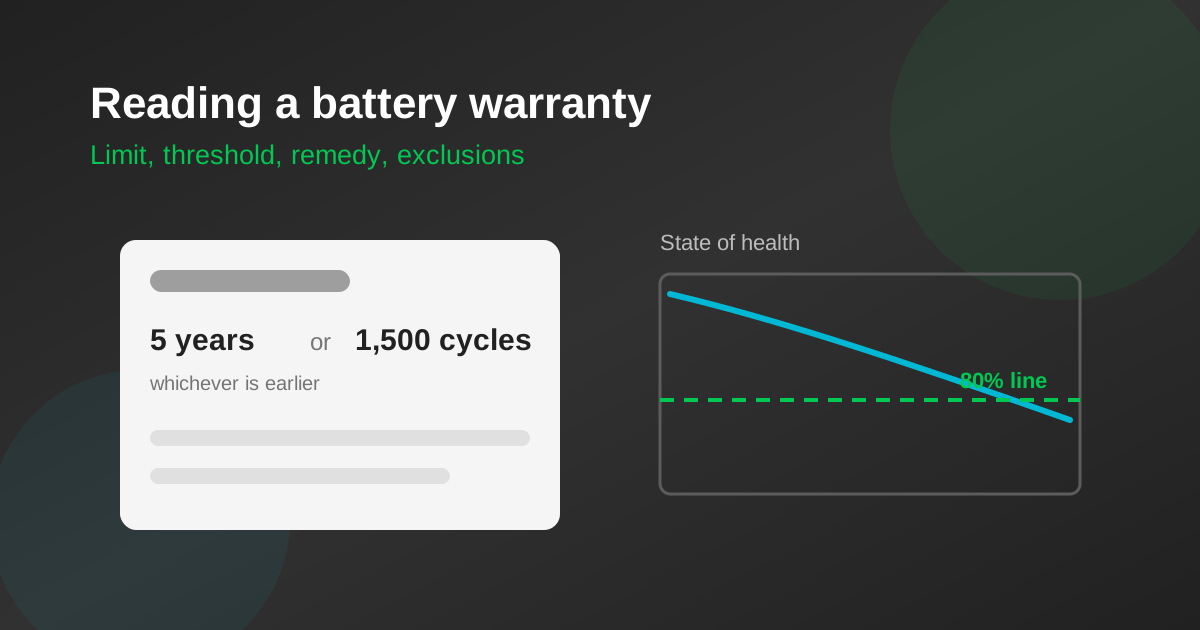
Most warranties are written as a time limit, a cycle limit or both, joined by the phrase “whichever is earlier”. Those three words decide the real length of cover, and for a commercial vehicle they almost always point at the cycles.
An e-rickshaw that runs a full shift and charges every night uses roughly one full cycle a day. At 300 working days a year, a warranty of “five years or 1,500 cycles, whichever is earlier” is already a race between the two — and a vehicle that is also topped up at midday, or works more days than that, uses the cycles up years before the calendar runs out. For a home inverter battery that cycles only during power cuts, the same wording means the calendar governs instead.
Ask, too, how cycles are counted. A good battery management system (BMS) records energy throughput, so a cycle is usually defined as a full pack’s worth of energy in and out, however many partial charges that took. Where there is no logging, the seller will fall back on the calendar — which is one reason a pack with monitoring is easier to claim against.
The threshold: what counts as failed
Every lithium battery loses capacity with use. A warranty does not promise that it will not; it promises that it will not lose more than a stated amount within the limit. That amount is the threshold, usually written as a state of health — for example, that the pack will retain at least 70 or 80 per cent of rated capacity.
The threshold is the most important number in the document and the one most often left out of the conversation. A pack that has faded to 75 per cent is not defective under an 80 per cent threshold — it is covered. Under a 70 per cent threshold, it is normal wear, and you have no claim until it falls further. Same battery, same range loss, opposite answers.
The threshold also needs a method. Capacity measured at what temperature, at what discharge rate, from what state of charge? If the warranty does not say, the test is whatever the service centre decides on the day. Our guide to reading a spec sheet explains why those conditions move the result.
The remedy: repair, replace, or pro-rata
Once a claim is accepted, what do you get? There are three common answers.
- •Repair. The seller opens the pack and replaces the failed cells, BMS or connectors. For a single bad cell group this is often the right fix, and it is quicker than a new pack. Ask whether repaired packs carry the rest of the original warranty.
- •Full replacement. A new pack, free. Check whether the replacement is warranted afresh or only for the time left on the original — most are the latter.
- •Pro-rata. You pay a share of a new pack in proportion to the time or cycles already used. A pro-rata warranty in its final year may be worth little more than a discount voucher. Many warranties are full replacement for an initial period and pro-rata after it; find out where that line sits.
Downtime is a cost the remedy rarely covers. For a driver, a week without the vehicle is a week without income. Ask how long a claim typically takes, whether a loaner pack is available, and who pays to move the battery to and from the service point.
The exclusions: where claims are actually decided
Almost every rejected claim is rejected under an exclusion. They are not unreasonable in themselves — a seller cannot warrant a pack against a crash — but you should know them before the day you need to argue about one.
- •Using a charger other than the one supplied or approved
- •Opening the pack or breaking the tamper seal
- •Water ingress from submersion, beyond the stated ingress protection rating
- •Physical damage — impact, crushing, a dropped pack
- •Operating or storing outside the stated temperature range
- •Leaving the pack fully discharged for an extended period
- •Connecting additional loads or modifying the wiring
Two of these deserve particular attention. The charger exclusion matters because a cheap replacement charger with the wrong cut-off voltage is one of the most common ways a good pack is damaged. And the deep-discharge exclusion matters because a vehicle parked for a month during an illness or a festival can drain slowly to a level the BMS cannot recover from — which is why our note on storage recommends parking a pack part-charged, not empty.
Evidence: the BMS log is on your side
A warranty dispute is usually a disagreement about what happened to the battery. Without records, it is your word against a service engineer’s inspection. With a BMS log — temperatures, voltages, charge cycles, fault events — it is a matter of reading what the pack recorded.
That cuts both ways, and it should. A log that shows the pack repeatedly charged above its limit supports the seller. A log that shows one cell group drifting under normal use supports you. Either way the argument gets shorter. If your battery carries monitoring, ask whether you can see the data yourself, not only the seller.
Ten questions to ask before you buy
- •Is the limit in years, cycles or both — and which will I reach first at my usage?
- •How is a cycle counted?
- •What state of health is the threshold, and how is capacity tested?
- •Is the remedy repair, replacement or pro-rata — and from when does pro-rata apply?
- •Does a replacement pack get a fresh warranty or the remainder of mine?
- •Which chargers are approved?
- •What is the full list of exclusions?
- •How long does a claim take, and is a loaner available meanwhile?
- •Who pays to transport the pack for inspection?
- •Is the warranty transferable if I sell the vehicle?
Get the answers in writing, on the warranty card or the invoice. A warranty that exists only in what the salesperson said is not a warranty.
Terms in this article
Frequently asked questions
What does “years or cycles, whichever is earlier” mean?+
The warranty ends at whichever limit you reach first. A commercial vehicle that charges fully every day uses around 300 cycles a year or more, so on a vehicle the cycle limit usually governs. A home battery that cycles only during power cuts will usually reach the time limit first.
Is losing capacity covered by a battery warranty?+
Only beyond a stated threshold. Every lithium battery fades with use, so a warranty promises that the pack will retain at least a stated share of its rated capacity — often 70 or 80 per cent — within the limit. Fade above the threshold is normal wear; fade below it is a claim.
What is a pro-rata battery warranty?+
Under a pro-rata warranty you pay part of the cost of a replacement in proportion to the time or cycles already used. Many warranties give full replacement for an initial period and switch to pro-rata after it, so it is worth knowing where that line sits.
Why are battery warranty claims rejected?+
Most rejections fall under an exclusion: an unapproved charger, a broken tamper seal, water ingress beyond the ingress rating, physical damage, operation outside the temperature range, or a pack left fully discharged for a long period. Read the exclusions before you buy, not after.
Thinking about upgrading?
Talk to our team about the right pack for your vehicle, and about EMI options that keep the monthly outgo close to what you already spend.
Popular: Lithium e-rickshaw battery