China’s Storage Plan Sets 300 GW for 2030 and Hands Growth to the Market
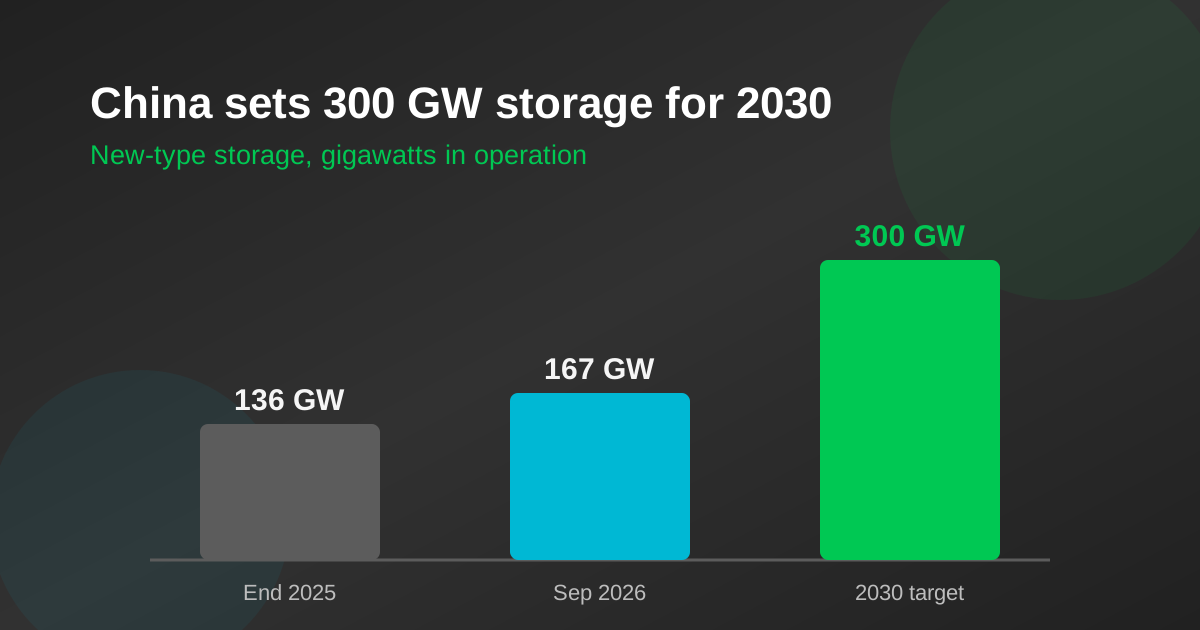
China’s NDRC and NEA issued a five-year plan for new-type energy storage on 13 November: 300 GW by 2030 at about three hours’ average duration. The target is modest against 167 GW already running; the shift from mandates to capacity payments and market revenue is the real change.
Published: 20 November 2026
Policy · 3 min read
What happened
Written 20 November 2026, on ESS News and Fastmarkets reporting of 19 November, the Xinhua report carried by the Global Times on 14 November, and pv magazine’s 5 November report of National Energy Administration figures.
China’s National Development and Reform Commission and National Energy Administration issued a five-year implementation plan for new-type energy storage on 13 November, covering 2026 to 2030. New-type storage means everything other than pumped hydro: in practice, mostly lithium-ion batteries.
The headline target is 300 GW of installed new-type storage by 2030, with an average duration of about three hours. ESS News works out that this implies roughly 900 GWh, but notes the plan sets no separate national energy (GWh) target.
Where the 300 GW goes
ESS News reports the following breakdown for 2030:
- •More than 240 GW serving provincial power systems, including about 110 GW added during the period
- •Within that, about 140 GW of independent grid-side storage able to support peak demand
- •50–60 GW at the large renewable energy bases, chiefly the desert wind and solar projects
The starting point is not far behind. pv magazine reports NEA data showing 167 GW and 435 GWh of new-type storage in operation at the end of September 2026, up 63 per cent on a year earlier, with about 31 GW added in the first nine months of the year. At that pace the remaining 133 GW would be built well before 2030 (our arithmetic).
That is why the Xinhua report quotes Xu Dongjie of the China Electric Power Planning and Engineering Institute calling 300 GW a “prudent, science-based minimum target”, one meant to help prevent investment-driven boom-and-bust cycles.
From mandates to markets
The more important change is how storage is meant to earn its keep. Fastmarkets recalls that in February 2025 China barred authorities from requiring storage as a condition for approving or connecting new renewable projects. That removed the rule that had driven much of the early build. The new plan puts revenue in its place:
- •It reinforces the capacity pricing for independent grid-side storage introduced in January 2026, and calls for reliable-capacity compensation once spot markets run continuously
- •Storage is to earn from frequency regulation, reserves and ramping as well as from buying cheap and selling dear
- •Where spot markets run continuously, storage should generally be dispatched on market results, with grid operators keeping emergency powers
- •Charging and discharging prices are to be set through market trading, according to the Xinhua report
The target is modest; the rulebook is the news. China is betting that a storage project which has to pay for itself in a market will be built and run better than one built to satisfy a permit condition.
On technology, ESS News reports that lithium-ion stays dominant, sodium-ion is to be used more widely, and compressed air, flow batteries and flywheels are to move towards commercial use. The plan also warns against disorderly expansion of battery manufacturing, a theme of Beijing’s battery policy this year.
What it means for this business
Wingzman builds LiFePO4 packs and commercial storage in India, mostly from imported cells. The plan does not change cell prices on its own, but it bears on us in three ways:
- •Chinese domestic demand stays large and steady to 2030, so Indian buyers keep competing with it for storage cells
- •A three-hour average points cell makers towards the large-format LFP cells used in longer systems, which is what Indian storage tenders increasingly ask for
- •China’s move from mandates to capacity payments and ancillary-service revenue is worth watching as India works out how standalone storage should be paid
For how a grid battery earns money once mandates go, see how grid-scale storage makes money; for the plan on the manufacturing side, see China’s national battery industry plan. The arbitrage leg is explained under energy arbitrage in our glossary.
Sources
Reporting this piece draws on. Figures were correct as published; scheme terms and commodity prices move.
- China shifts energy storage policy toward market-based growth in new five-year planESS News · 19 November 2026
- China maps shift to market-based energy storage, what does it mean for batteries?Fastmarkets · 19 November 2026
- China to boost new types of energy storage during 2026-2030Global Times (Xinhua) · 14 November 2026
- China’s energy storage fleet grows to 167 GW as utilization improvespv magazine · 5 November 2026
Terms in this article
Frequently asked questions
What is China’s 2030 target for new-type energy storage?+
The implementation plan issued by the NDRC and NEA on 13 November 2026 targets 300 GW of new-type storage by 2030, with an average duration of about three hours. ESS News works out that this implies roughly 900 GWh, but the plan sets no separate GWh target.
How far is China from that target?+
pv magazine reports NEA data showing 167 GW and 435 GWh in operation at the end of September 2026, with about 31 GW added in the first nine months of the year. At that pace the remaining 133 GW would be built before 2030, which is why one official adviser called 300 GW a minimum target.
What changes for how storage earns money in China?+
The plan reinforces capacity payments for independent grid-side storage introduced in January 2026, calls for storage to earn from frequency regulation, reserves and ramping as well as arbitrage, and says that where spot markets run continuously, storage should generally be dispatched on market results.
Want this applied to your own numbers?
Every solution page carries a calculator that shows its own arithmetic — storage savings, lithium against lead-acid, and home pack sizing.