Cabinet Backs 92 GWh of Grid Storage With ₹14,500 Crore, and a 40% Local Content Rule
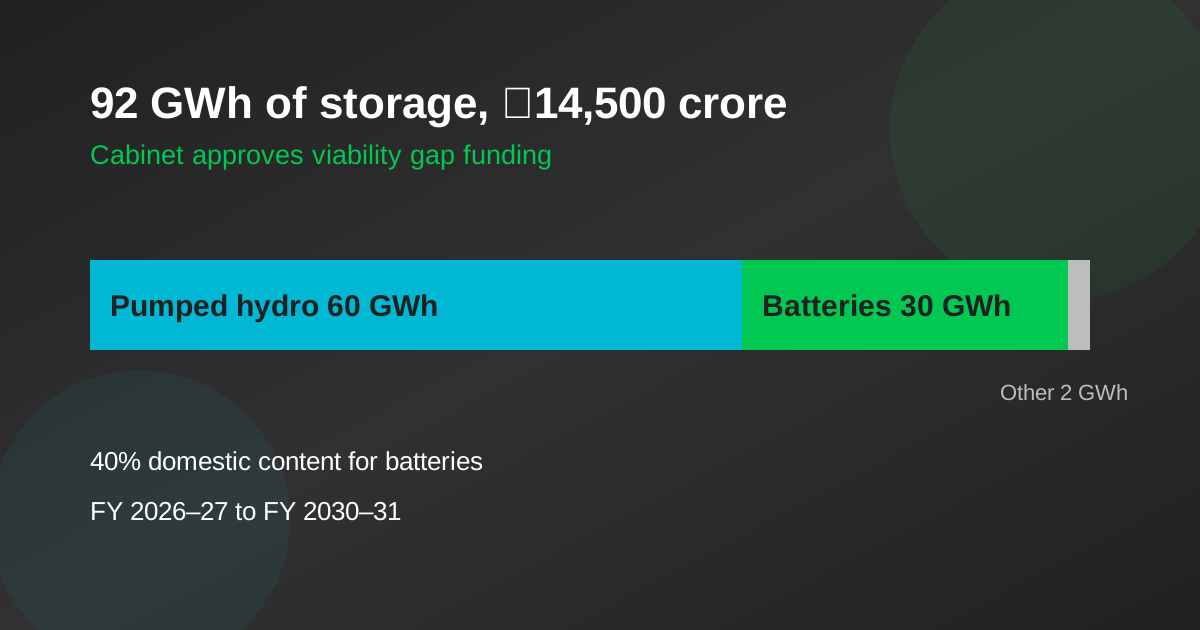
The Union Cabinet has approved viability gap funding for 30 GWh of batteries, 60 GWh of pumped hydro and 2 GWh of other storage to FY 2030–31, with a 40 per cent domestic content rule for battery projects. What it covers, and what the release leaves open.
Published: 12 November 2026
Policy · 3 min read
What happened
Written 12 November 2026, on the Press Information Bureau release of 4 November 2026 and reporting by Deccan Chronicle and Mercom India the same day. Scheme guidelines had not been published at the time of writing.
The Union Cabinet approved a Viability Gap Funding scheme for grid-scale energy storage on 4 November, with ₹14,500 crore of central support for FY 2026–27 to FY 2030–31. According to the PIB release, it is meant to support 92 GWh of storage that is “yet to be commissioned”.
- •60 GWh of pumped hydro storage
- •30 GWh of battery energy storage systems (BESS)
- •2 GWh of alternative storage technologies
PIB puts the total investment the scheme should draw at ₹97,600 crore, and says the new capacity is equivalent to 170 per cent of India’s present grid-scale storage. It cites a requirement for 411 GWh of grid-scale storage by 2031–32.
Who gets the money, and on what terms
Capacity will be allocated through tariff-based competitive bidding. Public and private electricity distribution companies are eligible for support on battery and pumped hydro projects; alternative-technology projects can be taken up by public and private entities.
The condition that matters most for the battery supply chain is a minimum domestic content requirement of 40 per cent for BESS projects. PIB says it will “complement existing supply-side incentives for battery manufacturing”. The release does not define how domestic content will be counted — whether cells must be made in India, or whether packs, containers and power conversion count towards the 40 per cent.
VGF covers about 15 per cent of the expected investment. That is our arithmetic on PIB’s figures: ₹14,500 crore against ₹97,600 crore. The rest must come from developers and lenders, recovered through the tariffs the auctions discover.
What the release does not say
- •How the ₹14,500 crore is divided between batteries, pumped hydro and other technologies, or the support per MWh
- •How the 30 GWh of batteries relates to the earlier VGF expansion for 30 GWh of standalone BESS; we have not been able to confirm whether this is new capacity or a restatement
- •Which agency runs the bidding, and when the first tenders open
- •What counts towards the 40 per cent domestic content
The same Cabinet meeting, Deccan Chronicle reports, also cleared a ₹2,814 crore scheme to promote domestic processing of critical minerals, with a 30 per cent capital subsidy for four plants — two for lithium and two for nickel — through 2030–31.
What it means for this business
This scheme pays distribution companies to procure grid storage. It does not subsidise a factory, an office or a home buying its own battery, and nothing in the release suggests it will.
- •Commercial and industrial storage is still bought on its own economics: demand charges, time-of-day tariffs and diesel displaced
- •A 40 per cent domestic content rule, once defined, should add Indian demand for packs, containers and possibly cells, which over time widens local supply for smaller buyers too
- •Over time, more grid storage could narrow the gap between peak and off-peak power prices, and with it part of the saving a site battery earns from time-of-day tariffs
- •Until the guidelines are out, any claim about what this does to battery prices is a guess
For how the support works, see viability gap funding and our earlier report on the ₹5,400 crore VGF expansion; on the cell question, see India’s storage cell gap; for factory storage, see our battery storage page.
Sources
Reporting this piece draws on. Figures were correct as published; scheme terms and commodity prices move.
- Cabinet approves Rs.14,500 crore Viability Gap Funding Scheme for development of 92 GWh Grid-Scale Energy Storage SystemsPress Information Bureau · 4 November 2026
- Cabinet Clears ₹14,500-Cr Energy Storage SchemeDeccan Chronicle · 4 November 2026
- Cabinet Approves ₹145 Billion Viability Gap Funding for 92 GWh Energy StorageMercom India · 4 November 2026
Terms in this article
Frequently asked questions
What did the Cabinet approve on 4 November 2026?+
A viability gap funding scheme with ₹14,500 crore of support for FY 2026–27 to FY 2030–31, to back 92 GWh of grid-scale storage not yet commissioned: 60 GWh of pumped hydro, 30 GWh of battery storage and 2 GWh of alternative technologies, with an estimated total investment of ₹97,600 crore.
Who can receive the funding?+
Capacity is allocated through tariff-based competitive bidding. According to the PIB release, public and private distribution companies are eligible for support on battery and pumped hydro projects, and public and private entities can take up alternative-technology projects. Battery projects must meet a 40 per cent domestic content requirement.
Can a factory get this subsidy for its own battery storage?+
Nothing in the release suggests so. The scheme funds grid-scale storage procured by distribution companies through auctions. Commercial and industrial storage behind a site’s meter is still justified on its own savings.
Want this applied to your own numbers?
Every solution page carries a calculator that shows its own arithmetic — storage savings, lithium against lead-acid, and home pack sizing.