Your Unsold Stock Is Ageing: Calendar Loss in Battery Inventory
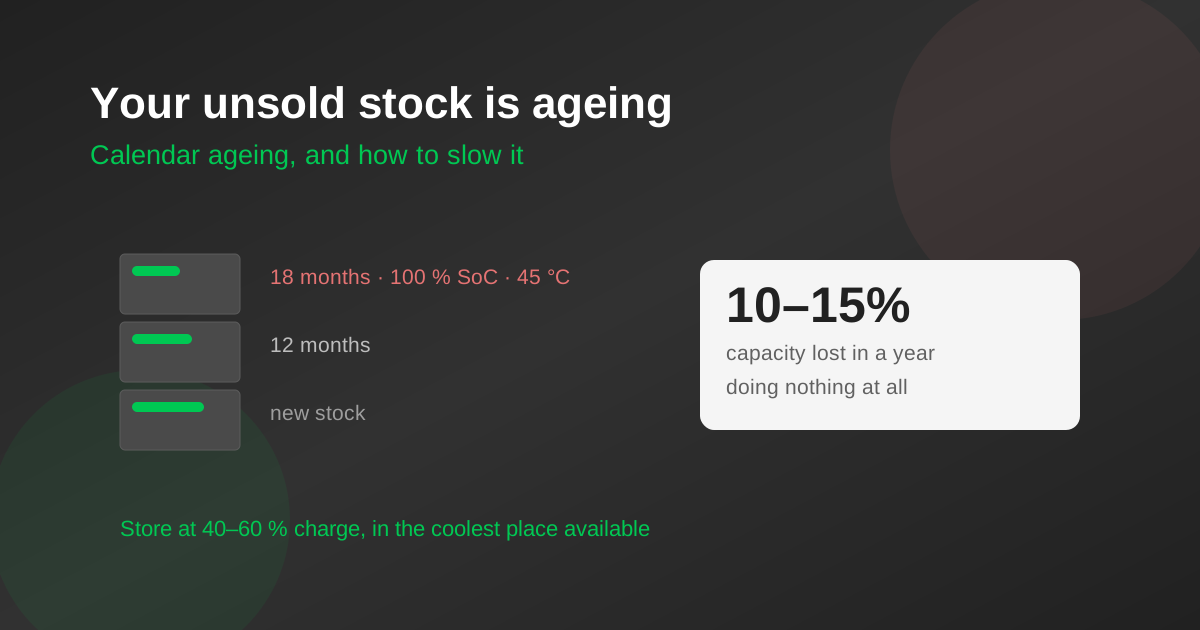
A fully charged pack in a hot godown can lose 10 to 15 per cent of its capacity in a year having done nothing at all. Two decisions control that, both are free, and neither usually gets made.
Published: 27 August 2026
Battery care · 7 min read
The loss nobody has on a stock sheet
Most battery ageing advice is written for the person using the battery. This is written for the person holding it before anyone uses it — the distributor with 400 packs in a godown, the OEM with a quarter’s buffer stock, the financier who has repossessed a fleet and is waiting for a buyer.
A lithium pack does not sit still. It ages while parked, on a clock that runs whether or not anyone switches it on, and the two things that set the speed of that clock are both under your control and both usually ignored.
Two kinds of ageing, and only one of them involves use
- •Cycle ageing happens through charging and discharging. Everyone expects this, warranties are written around it, and it is what people mean when they say a battery is “used up”.
- •Calendar ageing happens whether the pack is used or not. It is driven by the slow growth of the passivating film on the anode, and it is worst at high state of charge and high temperature.
The second one is the one that shows up as an unexplained write-down.
A fully charged pack sitting in a hot warehouse can lose 10 to 15 per cent of its capacity in a year having done nothing at all. That is a direct financial loss, and it is invisible until somebody tests the stock — usually the customer, usually after delivery.
Why state of charge matters when nothing is happening
A cell at high state of charge has a fully lithiated anode sitting at its most reducing potential — which is exactly the condition under which the electrolyte wants to decompose against it. The protective film that formed during manufacture keeps growing, slowly, and every nanometre of growth consumes lithium that never comes back.
Drop the state of charge and you drop the anode potential away from that maximum, and the reaction slows. Drop the temperature and it slows again, for the ordinary reason that all chemical reactions slow when cooled.
Neither of these requires equipment. They require a decision about how stock arrives and where it is put.
What to actually do
- •Store at 40 to 60 per cent charge. Not full. If cells arrive at 100 per cent because that is how the supplier shipped them, that is worth raising with the supplier — and worth discharging to storage state if the stock will sit for months.
- •Store in the coolest place available, which usually means not under a metal roof and not in the room that also holds the chargers. Ambient is the baseline that everything else adds to.
- •Rotate stock first-in-first-out and mean it. A pack that has sat eighteen months at the back of a rack is not the same product as the one at the front, whatever the label says.
- •Test a sample before it ships, not after a complaint. A capacity check on a few cells from a batch that has been in storage tells you what you are actually selling.
- •Record arrival date and storage state of charge on the stock record. If you cannot answer “how long has this been here and at what charge”, you cannot forecast the warranty exposure it carries.
The commercial version of this
Cells are a perishable asset. That sentence is uncontroversial in the industry and almost never reflected in how inventory is actually financed.
Two consequences worth carrying into a commercial conversation:
- •Inventory holding cost for batteries is higher than the interest rate on the working capital, because the asset is losing capacity as well as costing money to hold. A twelve-month stock position in a hot warehouse can lose more to calendar ageing than to financing.
- •A warranty term written for one market can be loss-making in another with an identical product. Ambient temperature belongs in the calculation alongside duty cycle — and if the stock spent six months at 45 °C before sale, part of the warranty period has already been consumed before the customer takes delivery.
None of this is an argument against holding stock. It is an argument for holding it cool, holding it part-charged, and knowing how old it is.
Related reading
This piece deliberately covers only the parked pack. For what heat does to a battery in service — and which precautions are worth the trouble once a vehicle is running — see why Indian summers are hard on lithium batteries. For the charging side, the seven charging habits guide covers the in-use half of the same chemistry. And if you are testing stock before it ships, the capacity test procedure in Battery 101 is the bench method.
Frequently asked questions
What is calendar ageing and how is it different from cycle ageing?+
Cycle ageing happens through charging and discharging, and it is what warranties are usually written around. Calendar ageing happens whether the pack is used or not — it is driven by the slow growth of the passivating film on the anode, and it is worst at high state of charge and high temperature. A stored pack is ageing on a clock that runs even though nobody has switched it on.
How much capacity can a stored battery lose?+
A fully charged pack sitting in a hot warehouse can lose 10 to 15 per cent of its capacity in a year having done nothing at all. That is a direct financial loss on inventory, and it is invisible until somebody tests the stock — which is usually the customer, after delivery.
What state of charge should batteries be stored at?+
40 to 60 per cent, in the coolest place available. A cell at high state of charge has a fully lithiated anode sitting at its most reducing potential, which is exactly the condition under which the electrolyte wants to decompose against it, and every nanometre of film growth consumes lithium permanently. Dropping the state of charge moves the anode potential away from that maximum and slows the reaction; dropping the temperature slows it again.
What should a distributor actually change?+
Five things, none of which need equipment. Store at 40 to 60 per cent rather than full, and raise it with the supplier if stock arrives at 100 per cent. Store away from metal roofs and charger rooms. Rotate stock first-in-first-out and mean it. Test a sample before it ships rather than after a complaint. And record arrival date and storage state of charge on the stock record — if you cannot answer how long a pack has been there and at what charge, you cannot forecast the warranty exposure it carries.
Does storage ageing affect warranty economics?+
Directly. If stock spent six months at 45 per cent above ambient before sale, part of the warranty period has already been consumed before the customer takes delivery. Inventory holding cost for batteries is also higher than the interest rate on the working capital, because the asset is losing capacity as well as costing money to hold — a twelve-month position in a hot warehouse can lose more to calendar ageing than to financing.
Thinking about upgrading?
Talk to our team about the right pack for your vehicle, and about EMI options that keep the monthly outgo close to what you already spend.
Get in touch