Buying a Used or Refurbished Lithium Battery: What to Check
“Refurbished” can mean a graded rebuild or a coat of paint. How to check a second-hand pack’s state of health, spot damage, read the paperwork and judge whether the price is fair.
Published: 17 November 2026
Buying guide · 5 min read
Why used lithium packs are suddenly everywhere
As e-rickshaw fleets and early home installations move to lithium, a second-hand market has followed. Packs come off vehicles that changed hands, out of fleets that upgraded, and back from warranty claims. They reappear on marketplace listings and in small workshops as “used”, “second-hand” or, most often, “refurbished”, at a fraction of the price of a new pack.
Some of them are a sensible buy. Many are not. The difference is rarely visible from the outside, and the seller usually knows far more than you do. This guide is about closing that gap before you pay.
What “refurbished” can mean
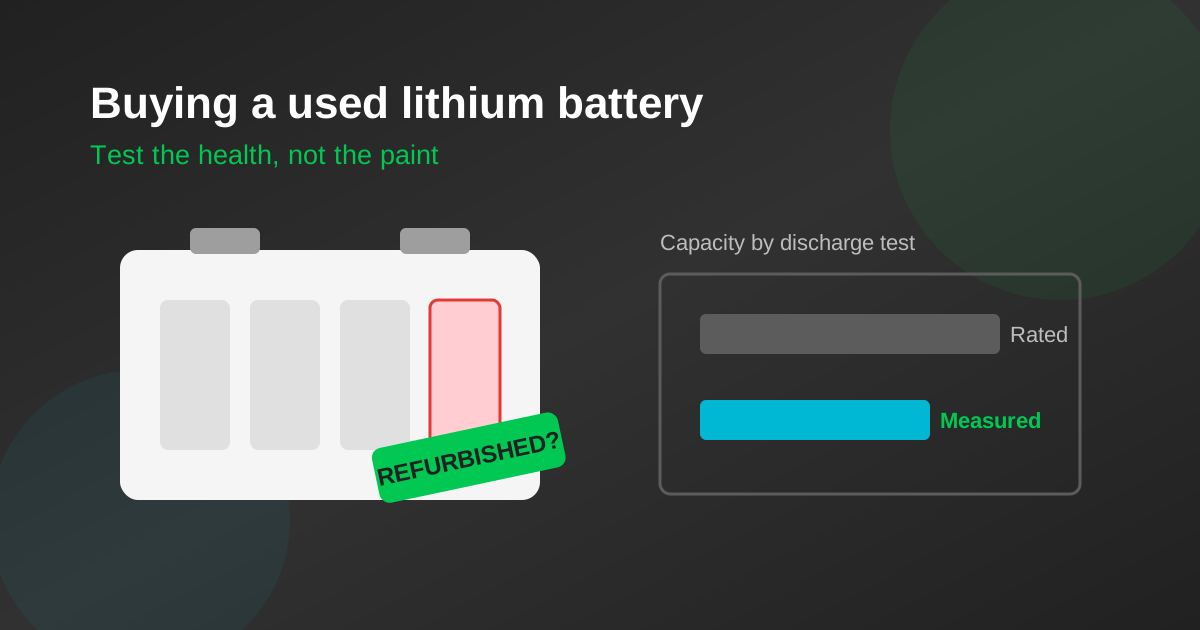
There is no single meaning. The same word covers work that ranges from careful re-engineering to a coat of paint. Ask the seller which of these was done, and to show you, not just tell you.
- •Cosmetic only. The case was cleaned or repainted, a new label applied, perhaps new terminals. Nothing inside was tested or changed. This is a used pack with better presentation.
- •BMS replaced. The battery management system was swapped, often because the original failed. That can be a genuine repair — or a way to clear old fault logs and hide how the pack was treated.
- •Weak groups swapped. One or two failed cell groups were replaced with other used or new cells. This works only if the replacements are matched to the rest.
- •Regrouped from graded cells. The pack was taken apart, every cell tested, and a new pack built from cells of similar capacity and resistance. Done properly, this is the most honest form of refurbishment.
Only the last two involve real work on the cells, and only the last starts by measuring everything. Our explainer on cell balancing explains why a pack built from mismatched cells behaves like its weakest one from the first week.
How to check state of health
The number that matters is state of health: how much of its original capacity the pack still holds. A label, a charge gauge and a voltage reading do not tell you this. Three checks do.
A capacity test. Charge the pack fully, then discharge it at a steady, known current until the BMS cuts off, and count the amp-hours delivered. Compare that with the rated figure. A pack rated at 100Ah that delivers 78Ah is at roughly 78 per cent health. This takes hours and needs a load bank or a discharge tester, so a seller who has done it should have a printed result. Ask for it, with the date and the discharge current.
BMS data. A BMS with a display port or app can show the cycle count, individual cell voltages, the highest temperatures it has seen and any recorded faults. A cycle count in the thousands on a pack sold as “lightly used” settles the question. A brand-new BMS with a zero count on old cells tells you nothing, which is itself worth noting.
Internal resistance and voltage spread. Resistance rises as cells age, and a cell with much higher resistance than its neighbours will heat and sag under load. At rest, the cell groups in a healthy lithium iron phosphate pack sit within a few tens of millivolts of each other. A spread of a hundred millivolts or more after the pack has rested is a sign of a weak group or poor matching.
Damage you can see and smell
Before any test, look at the pack closely. Walk away from any of these:
- •A bulging, warped or cracked case, or a lid that no longer sits flat
- •Swollen cells, if the pack is opened — swelling does not reverse and the cell is unsafe
- •Water marks, rust or white crust on terminals, bolts or the BMS board
- •Discoloured, melted or re-taped wiring, or scorch marks near connectors
- •A sweet or chemical smell from the pack
- •Fresh paint over dents, or a broken or missing tamper seal
E-rickshaw packs deserve extra suspicion around water. A vehicle that has driven through monsoon flooding may have a pack that works today and corrodes from the inside over the following months.
Paperwork and warranty
A used pack with no papers is a pack with no history. At the least, ask for a GST invoice naming the seller, the original manufacturer and serial number, the capacity test report and a written statement of what refurbishment was done. A business that refurbishes batteries as a trade should be able to tell you whether it is registered under the Battery Waste Management Rules.
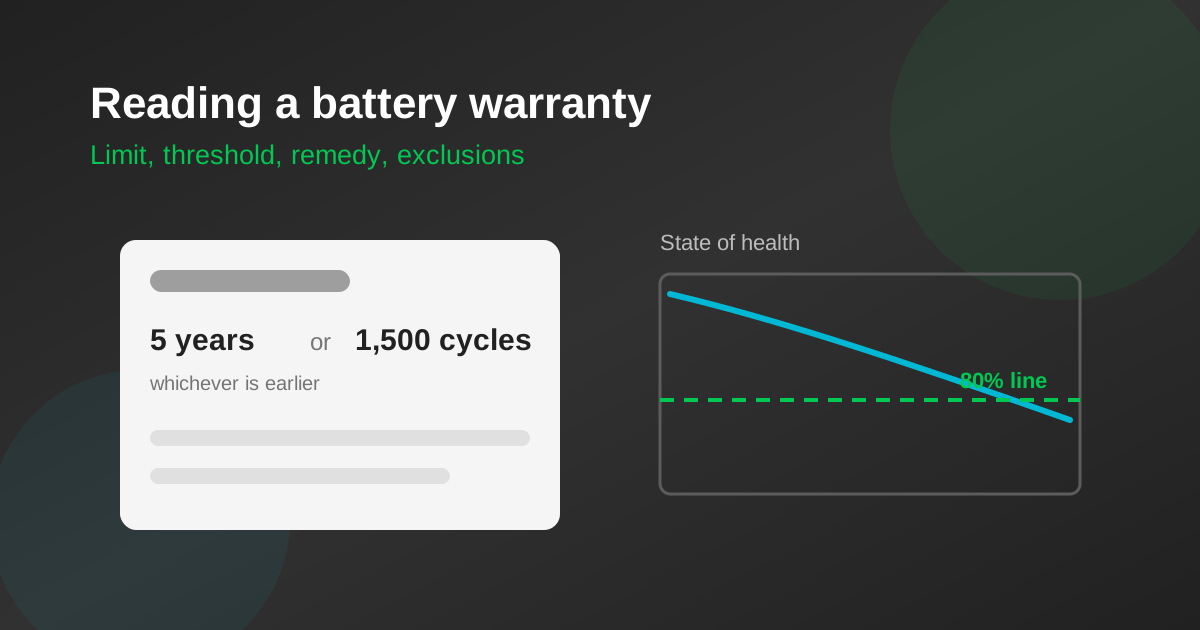
The original manufacturer’s warranty almost never survives a pack being opened or resold, so any cover will come from the refurbisher. Read it as you would a new battery’s warranty — our guide to reading a lithium battery warranty covers the limit, threshold and exclusions. A refurbished pack sold with a few months of written cover is common; one sold “as is” with nothing should be priced accordingly.
When a used pack is a fair deal, and when it is not
Compare price against the energy you will actually get. If a pack is at 80 per cent health and is likely to be retired somewhere around 70 per cent, you are buying the last part of its working life, not most of it. Fade also tends to speed up towards the end. A fair price therefore sits well below the share of capacity remaining — often well below half the price of a new pack, once the shorter warranty and the risk are counted.
The use matters as much as the price. An e-rickshaw battery works hard every day, draws high current on hills and loses income every day it is off the road. A used pack that fails in month four can cost a driver more than the saving. A light home backup job is gentler, and a tested, graded pack can serve it well — but a pack of unknown history installed indoors, near where a family sleeps, is a different kind of risk. For home use, the case for a tested pack with paperwork is stronger, not weaker.
A used pack is most likely to be a fair deal when it is lightly cycled, comes with a discharge test, carries some written warranty, and is going into a less demanding job than the one it came from.
A checklist before you pay
- •Ask what “refurbished” meant: cosmetic, BMS, swapped groups or regrouped from graded cells
- •Get a dated capacity test by discharge, with the current used
- •Read the BMS: cycle count, cell voltages, temperature history, faults
- •Check the voltage spread between cell groups after the pack has rested
- •Inspect for swelling, corrosion, water marks, heat damage and fresh paint
- •Get a GST invoice, the original serial number and a written warranty
- •Work out the price per unit of remaining usable capacity, not per pack
- •Match the pack to the job: a used pack suits light duty better than a working vehicle
Terms in this article
Frequently asked questions
What does “refurbished” mean for a lithium battery?+
It has no fixed meaning. It can mean a cleaned and repainted case with nothing changed inside, a replaced battery management system, a few weak cell groups swapped out, or a pack rebuilt from cells that were each tested and matched. Ask which was done and ask to see the test results.
How can I check the health of a used lithium battery?+
The reliable check is a capacity test: charge the pack fully, discharge it at a known current until the BMS cuts off, and compare the amp-hours delivered with the rating. The BMS cycle count and cell voltages, and the internal resistance of the cells, add detail. Voltage alone does not show health.
Is a second-hand lithium battery worth buying?+
It can be, when it is lightly cycled, has a dated discharge test, carries a written warranty and is going into a gentler job than before. It is a poor buy when its history is unknown, it shows swelling, corrosion or heat damage, or it is going into a working vehicle where a failure costs daily income.
Thinking about upgrading?
Talk to our team about the right pack for your vehicle, and about EMI options that keep the monthly outgo close to what you already spend.
Popular: Lithium e-rickshaw battery