A History of the Battery: From Volta’s Pile to the Lithium Cell
Two centuries of storage, from a stack of zinc and copper discs in 1800 to the LFP pack under an e-rickshaw — and why the battery, not the motor, has been the thing holding electrification back the entire time.
Published: 17 August 2026
History · 11 min read
A dead frog, and an argument that turned out to be wrong
In the 1780s the Italian anatomist Luigi Galvani noticed that a dissected frog’s leg twitched when touched with two different metals. He concluded he had found “animal electricity” — a life force stored in the tissue itself.
His countryman Alessandro Volta disagreed. He suspected the frog was incidental, and that the electricity was coming from the contact between the two dissimilar metals, with the moist tissue merely completing the circuit. To prove it, he built something with no biology in it at all.
1800: the voltaic pile
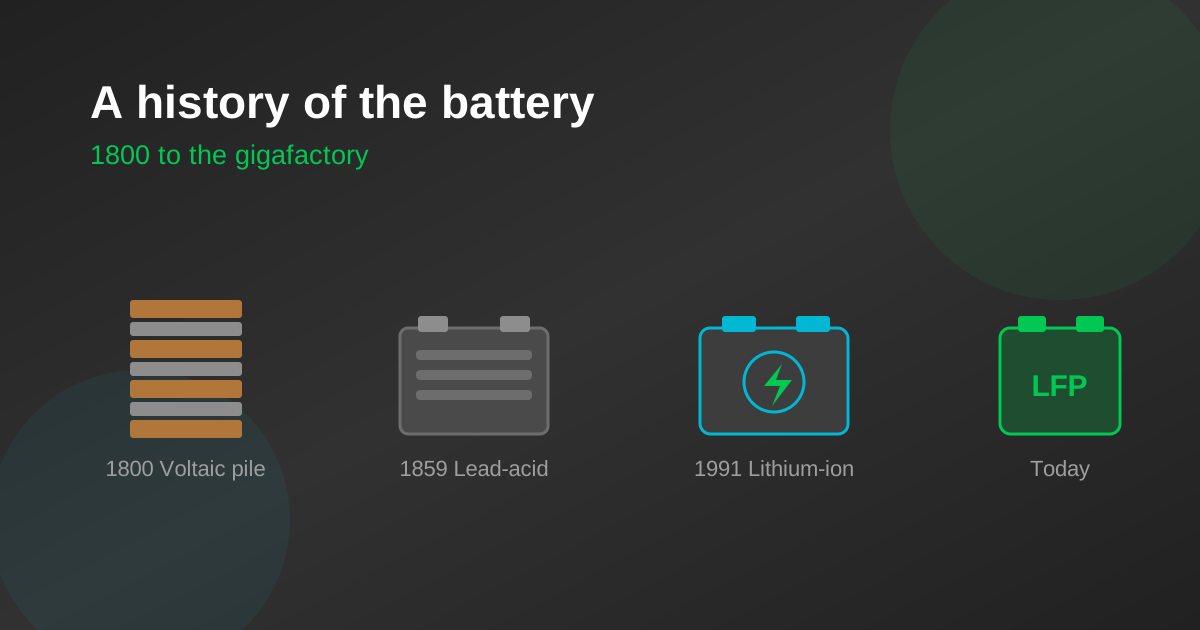
Volta stacked alternating discs of zinc and copper, separated by cardboard soaked in brine. Touch a wire to each end and current flowed — steadily, continuously, for as long as the chemistry lasted. Every previous source of electricity had produced a single spark from a static charge. This was the first source of a sustained current in human history.
It is difficult to overstate what that unlocked. Within months, other researchers were using voltaic piles to split water into hydrogen and oxygen. Within two decades the pile had been used to isolate sodium, potassium, calcium and magnesium as elements for the first time. An enormous amount of nineteenth-century chemistry exists because Volta gave chemists a controllable electric current to experiment with. The unit of electric potential carries his name for good reason.
1836–1866: making it practical
Volta’s pile had a serious flaw: it polarised. Hydrogen bubbles collected on the copper and the output collapsed within minutes. The nineteenth century is largely the story of fixing that.
- •The Daniell cell (1836) used two separate electrolytes divided by a porous barrier, giving a steady output for hours instead of minutes. It became the workhorse power source for the telegraph network.
- •The Grove and Bunsen cells improved voltage and current further through the 1840s, at the cost of handling aggressive acids.
- •The Leclanché cell (1866) used zinc, manganese dioxide and an ammonium chloride electrolyte. Immobilise that electrolyte into a paste and you have essentially the modern dry cell — the direct ancestor of the AA battery in a TV remote.
Every one of these was single-use. You built it, you drained it, you rebuilt it. Reversibility was the missing idea.
1859: the first rechargeable battery
Gaston Planté found that lead plates in sulphuric acid produced a cell that could be driven backwards by an external current, restoring the original chemistry and allowing the cell to be used again. The lead-acid battery was the first practical secondary — rechargeable — battery, and it is genuinely remarkable that it is still in mass production more than 165 years later.
Lead-acid survived because it does several things very well. It is cheap, it tolerates abuse, it delivers enormous current briefly (which is why it still starts almost every petrol and diesel engine), and its materials are easy to recycle. What it does badly is store energy for its weight, and survive being deeply discharged over and over — which is precisely the duty cycle an e-rickshaw imposes on it.
1899–1901: the nickel alternatives
Waldemar Jungner in Sweden patented the nickel-cadmium cell in 1899. Thomas Edison, looking for a battery to make electric cars viable, developed nickel-iron over the following years and commercialised it in 1901.
Edison’s battery was extraordinarily rugged — some original cells still hold charge today — but it was expensive, inefficient and slow to charge. Meanwhile the electric starter motor arrived in 1912, removing the hand crank that had been petrol’s biggest inconvenience, and cheap oil did the rest. The electric car essentially disappeared for eighty years, not because the motor was inadequate, but because the battery was.
This is the pattern that repeats through the whole history: the electric motor was solved in the nineteenth century and has been excellent ever since. Almost every time electrification has stalled, the binding constraint was storage.
1970s: the oil shock sends chemists back to the lab
Battery development was fairly quiet from roughly 1910 to 1970. The 1973 oil crisis changed the funding environment overnight, and among the people it put to work was M. Stanley Whittingham, then at Exxon.
Whittingham worked with lithium, which is attractive for an obvious reason: it is the lightest metal and gives up its outer electron readily, so it offers more energy per kilogram than anything heavier. He built a working cell in the 1970s using a titanium disulphide cathode and metallic lithium. It worked — and it was dangerous. Metallic lithium tends to grow needle-like dendrites during charging, which eventually pierce the separator, short the cell internally and cause a fire.
1980–1991: three ideas that became one product
The modern lithium-ion cell came from three separate contributions.
- •In 1980 John Goodenough, then at Oxford, showed that a cobalt oxide cathode could hold lithium ions and deliver substantially higher voltage than Whittingham’s design.
- •In 1985 Akira Yoshino at Asahi Kasei replaced the metallic lithium anode with a carbon material that lithium ions could slot into and out of. Because no metallic lithium was present, the dendrite problem largely went away.
- •In 1991 Sony put the combination into mass production for camcorders and portable electronics. That is the commercial birth of the lithium-ion battery.
Whittingham, Goodenough and Yoshino shared the 2019 Nobel Prize in Chemistry for it. Goodenough was 97 at the time, the oldest Nobel laureate in any category.
1996: the chemistry that ended up under Indian e-rickshaws
Cobalt oxide cathodes are energy-dense, which is exactly what a laptop wants. They are also expensive, dependent on a supply chain concentrated in a small number of countries, and thermally less forgiving when abused.
In 1996 Goodenough’s group at the University of Texas, with Akshaya Padhi and colleagues, published work on lithium iron phosphate — LFP. It stores less energy per kilogram than cobalt-based chemistries, but it uses no cobalt or nickel, tolerates heat far better, and lasts for substantially more charge cycles.
For a phone, that trade is unattractive. For a vehicle that sits in 45°C heat, gets charged every single night for years, and where purchase price decides whether a driver can buy it at all, the trade is close to ideal. LFP is why lithium became viable for e-rickshaws rather than just for premium cars, and it is the chemistry we build with — the reasoning is set out in our comparison of lithium against lead-acid.
2010s onwards: a manufacturing story, not a chemistry story
The last fifteen years of battery history have less to do with new chemistry than with learning to build the same chemistry at enormous scale and falling cost. Cell production moved from consumer-electronics volumes to vehicle and grid volumes, and unit costs fell by roughly an order of magnitude over the decade to 2020.
That shift is why grid-scale storage became a real business rather than a demonstration project, and why an electric three-wheeler in Bihar can now be financed on an instalment a driver can actually service. It is also why the industrial map matters so much — we cover where cell manufacturing concentrated, and why, in why China dominates battery cell manufacturing and how India is trying to catch up.
What two centuries of this actually tell you
Three things stand out when you look at the whole arc.
- •Progress has been slow and lumpy, not smooth. There are two clusters of intense activity — roughly 1800–1900 and 1970–2000 — separated by a long plateau. Anyone promising a step change in battery technology every eighteen months is not describing the historical record.
- •The winning chemistry is rarely the most energy-dense one. It is the one whose combination of cost, life, safety and supply chain fits the job. LFP beat cobalt chemistries for e-rickshaws on exactly those grounds.
- •Storage, not generation or motors, has been the binding constraint on electrification for most of the last 150 years. That is finally changing, and it is the reason the current transition is moving faster than the one Edison lost.
Frequently asked questions
Who invented the battery?+
Alessandro Volta, in 1800. His voltaic pile — alternating discs of zinc and copper separated by brine-soaked cardboard — was the first device to produce a sustained electric current rather than a single static spark. He built it to disprove Luigi Galvani’s theory that the electricity in a twitching frog’s leg came from the tissue itself.
When was the first rechargeable battery invented?+
In 1859, when Gaston Planté demonstrated that lead plates in sulphuric acid could be driven backwards by an external current and used again. Lead-acid was the first practical rechargeable battery and is still in mass production more than 165 years later, mainly because it is cheap, rugged and easy to recycle.
Who invented the lithium-ion battery?+
Three people share the credit and the 2019 Nobel Prize in Chemistry. Stanley Whittingham built the first working lithium cell in the 1970s. John Goodenough introduced the cobalt oxide cathode in 1980, raising the voltage substantially. Akira Yoshino replaced the dangerous metallic lithium anode with carbon in 1985. Sony commercialised the combination in 1991.
When was LFP battery chemistry invented?+
Lithium iron phosphate was published in 1996 by John Goodenough’s group at the University of Texas, with Akshaya Padhi and colleagues. It stores less energy per kilogram than cobalt-based chemistries but uses no cobalt or nickel, tolerates heat far better and lasts many more cycles — which is exactly the trade-off that suits an e-rickshaw.
Why did early electric cars fail?+
Not because of the motor. Electric motors were already excellent by 1900. Early electric cars failed because the available batteries — lead-acid and Edison’s nickel-iron — were heavy, expensive and slow to charge, while the 1912 electric starter removed petrol’s biggest inconvenience and oil stayed cheap. Storage has been the binding constraint on electrification for most of the last 150 years.
Thinking about upgrading?
Talk to our team about the right pack for your vehicle, and about EMI options that keep the monthly outgo close to what you already spend.
Get in touch