A History of Power Transmission: One Mile to One National Grid
Edison’s first power station could not send electricity further than about a mile. The story of how that limit was broken — through the transformer, the 1891 Frankfurt demonstration, HVDC, and India’s synchronisation into a single grid in 2013.
Published: 17 August 2026
History · 11 min read
The one-mile problem
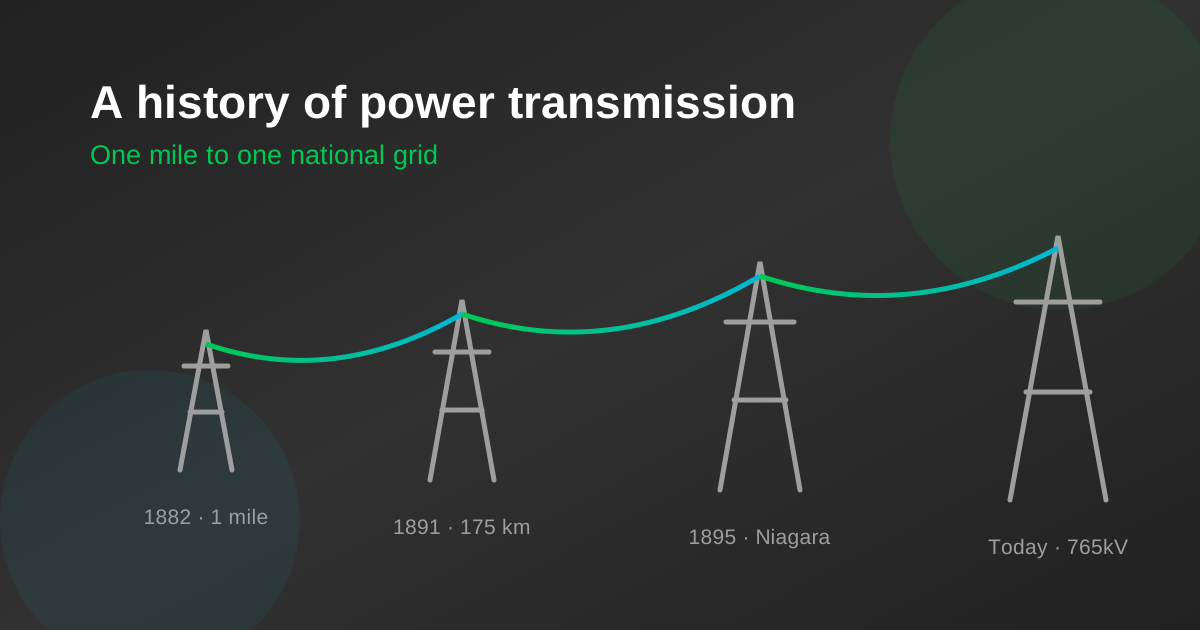
When Thomas Edison switched on the Pearl Street Station in Manhattan in September 1882, he created the world’s first commercial central power station. It served a few hundred customers with direct current at roughly 110 volts.
It also had a hard geographic limit. At that voltage, the current needed to deliver useful power was large, and the losses in copper conductors grow with the square of current. Beyond about a mile, you either lost most of your power as heat in the cable or spent more on copper than the electricity was worth.
Electrifying a country one square mile at a time, each with its own generating station, was never going to work. The history of transmission is the history of escaping that limit.
The transformer changes everything
The escape route follows from a single relationship. Power is voltage times current. To deliver a fixed amount of power at ten times the voltage requires one tenth the current — and since loss scales with current squared, the loss drops to one hundredth.
The problem in 1882 was that nobody could change DC voltage easily. Alternating current could be transformed with nothing more than two coils wound on an iron core — a device with no moving parts.
- •Lucien Gaulard and John Dixon Gibbs demonstrated an early transformer-based AC distribution system in the early 1880s.
- •In 1885 three engineers at Ganz Works in Budapest — Károly Zipernowsky, Ottó Bláthy and Miksa Déri — patented the closed-core transformer, essentially the modern design.
- •In 1886 William Stanley, working for George Westinghouse, demonstrated a practical AC system at Great Barrington, Massachusetts: step up for transmission, step back down for use.
Edison had enormous commercial exposure to DC and fought hard, in what became known as the War of Currents. He lost on the physics.
1891: the demonstration that settled the argument
The decisive event was not in America. In 1891, engineers transmitted three-phase alternating current roughly 175 kilometres from a hydroelectric plant at Lauffen am Neckar to the International Electrotechnical Exhibition in Frankfurt, where it lit a thousand lamps and drove a waterfall pump.
The efficiency was far higher than sceptics had predicted. Four years later, in 1895, the Niagara Falls project began transmitting hydroelectric power roughly 42 kilometres to Buffalo. The question of whether power could be generated far from where it was used had been answered definitively.
That answer is what makes a modern grid possible at all. It means a power station can be built where the coal, water, wind or sunlight is — rather than where the customers are. Every argument about renewable energy siting today rests on a principle established in 1891.
The twentieth century: climbing the voltage ladder
What followed was a century of steady escalation. Higher voltage meant longer distances and bigger blocks of power, and each step required real advances in insulators, transformers, switchgear and the physics of managing corona discharge on conductors carrying hundreds of kilovolts.
Transmission voltages rose from tens of kilovolts before the First World War, through 220kV and 400kV in the middle of the century, to 765kV and above in the largest modern systems — including India’s. Alongside it grew a second idea: rather than each utility running its own island, interconnect them, so a failure in one place can be covered by generation in another, and reserve capacity can be shared instead of duplicated.
1954: DC comes back
Having lost the original argument, direct current returned once power electronics made DC voltage conversion practical. The first commercial high-voltage DC link connected the Swedish mainland to the island of Gotland in 1954.
HVDC has real advantages in specific situations: very long overhead distances, undersea cables where AC capacitance becomes prohibitive, and connecting two AC systems that are not synchronised with each other. It costs more in converter stations at each end, so it only pays above a certain distance — but above that threshold it wins clearly. India now operates several HVDC links, and the technology is central to moving renewable power from resource-rich regions to demand centres.
India: from regional islands to one national grid
India’s grid did not start as a grid. It grew as separate regional systems — Northern, Western, Southern, Eastern and North Eastern — each operating independently, with power exchange between them limited.
Those regions were progressively synchronised over several decades, and the process completed on 31 December 2013 when the Southern Region was synchronised with the rest, creating a single synchronous national grid frequently described as One Nation, One Grid, One Frequency.
The practical consequence is that surplus generation in one part of the country can serve demand in another, several thousand kilometres away. That matters enormously for renewables: solar output in Rajasthan and wind output in Tamil Nadu peak at different times of day and different seasons, and a synchronised national grid lets them complement each other rather than each being stranded locally.
Where the difficulty has moved
For most of the last century, the hard problem was moving bulk power over distance. That problem is now largely solved. Three newer ones have replaced it.
- •Distribution, not transmission, is where most losses and most reliability problems now sit. High-voltage transmission in India is comparatively efficient; the losses that matter accumulate in the last few kilometres.
- •Falling inertia. Large spinning generators physically resist sudden frequency change, buying operators time. Solar and battery inverters have no such rotating mass, so as their share rises, frequency moves faster after a disturbance and the response must be quicker.
- •Timing rather than distance. The grid can now move power across the country, but not across the day. Solar peaks at midday and demand peaks after sunset — which is a storage problem, not a transmission one.
That last point is the reason grid-scale battery storage has become a serious industry rather than a pilot project. We walk through the economics in how grid-scale storage actually earns money, and the underlying grid mechanics in how power transmission works.
A hundred and forty years, one idea
Almost every development in this story is a variation on a single realisation from the 1880s: push the voltage up and the losses collapse. Transformers made that possible for AC, semiconductors later made it possible for DC, and everything else — the pylons, the substations, the national grid — is engineering built around that one relationship.
What has genuinely changed in the last fifteen years is the addition of storage. For 140 years the grid had to generate exactly what was being consumed, at every instant, with no buffer. That constraint is finally loosening, and it is the largest structural change to how electricity works since Frankfurt in 1891.
Frequently asked questions
Why could Edison’s first power station only serve about one mile?+
Because it distributed direct current at roughly 110 volts, and nobody could change DC voltage easily at the time. At low voltage the current needed to deliver useful power is large, and losses in a conductor grow with the square of current. Beyond about a mile you either lost most of the power as heat or spent more on copper than the electricity was worth.
What was the first long-distance power transmission?+
The landmark demonstration was in 1891, when three-phase alternating current was transmitted roughly 175 kilometres from Lauffen am Neckar to the International Electrotechnical Exhibition in Frankfurt, at far higher efficiency than sceptics expected. Four years later the Niagara Falls project began transmitting hydroelectric power about 42 kilometres to Buffalo.
Who won the war of currents?+
Alternating current, backed by George Westinghouse and Nikola Tesla, against Edison’s direct current. AC won because a transformer — two coils on an iron core, with no moving parts — could step voltage up for transmission and back down for use, which nobody could do with DC at the time. Direct current returned much later as HVDC, once power electronics made DC conversion practical.
When did India get a single national grid?+
India’s regional grids were progressively synchronised over several decades, and the process completed on 31 December 2013 when the Southern Region was synchronised with the rest, creating one synchronous national grid — often described as One Nation, One Grid, One Frequency. It allows surplus generation in one part of the country to serve demand thousands of kilometres away.
What is HVDC used for?+
High-voltage direct current suits three situations: very long overhead distances, undersea cables where AC capacitance becomes prohibitive, and connecting two AC systems that are not synchronised with each other. It costs more in converter stations at each end, so it only pays above a certain distance — but above that threshold it wins clearly. The first commercial link connected Sweden to Gotland in 1954.
Thinking about upgrading?
Talk to our team about the right pack for your vehicle, and about EMI options that keep the monthly outgo close to what you already spend.
Get in touch