Lithium-ion vs Lead-acid for an E-Rickshaw: How to Do the Three-Year Maths
A lead-acid set looks cheaper on the day you buy it. Here is the simple calculation that tells you what each option actually costs you per kilometre over three years.
Published: 14 July 2026
Buying guide · 6 min read
The sticker price is not the price
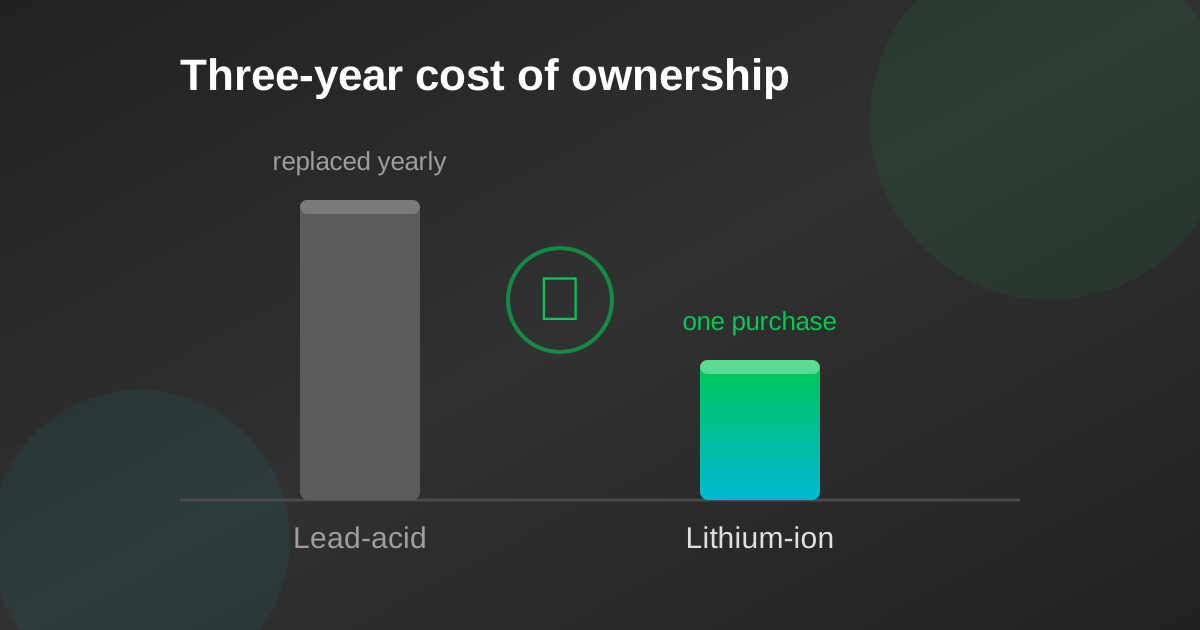
Ask any e-rickshaw driver in Indore, Kanpur or Gurugram what a battery costs and you will get one number: what the shop quoted. That number is the easiest thing to compare and the least useful. A battery is not a one-time purchase, it is a consumable that you buy again every time it dies.
The honest comparison is not price today. It is rupees per kilometre driven, over the whole life of the pack. Once you frame it that way, the arithmetic changes shape completely — and you can do it yourself on a phone calculator in about two minutes.
The one number that decides everything: cycle life
A cycle is one full charge and discharge. Cycle life is how many of those the pack survives before its usable capacity falls to roughly 80% of what it started with.
This is where the two chemistries part ways. A typical tubular lead-acid set used hard in commercial duty gives a few hundred cycles — which for a driver charging once a day usually means replacement inside a year to eighteen months. A well-built LFP (lithium-iron-phosphate) pack is generally specified in the low thousands of cycles. That is not a marginal improvement; it is a different order of magnitude.
The calculation, in four lines
Get a written quote for each option, then fill in these four lines for both. Use the numbers on the actual spec sheet, not the ones in the shop conversation.
- •Line 1 — Pack price. What you pay, including installation, GST, wiring and any charger you must buy with it.
- •Line 2 — Usable energy per charge. Roughly, the kilometres you actually get on a full charge with a loaded vehicle, not the showroom figure.
- •Line 3 — Cycle life. The rated cycles from the spec sheet, at the depth of discharge you will really use.
- •Line 4 — Lifetime kilometres. Multiply Line 2 by Line 3.
Now divide Line 1 by Line 4. That is your cost per kilometre for the battery alone. Do it for both options and the comparison becomes obvious — often in a direction that surprises people who were only looking at the quote.
Three costs the calculation still misses
- •Downtime. A day spent at the battery shop is a day of lost fares. Lead-acid replacement cycles put you in that queue more often, and each visit costs you an earning day, not just the part.
- •Weight and range fade. Lead-acid capacity drops noticeably in its final months, so the last stretch of its life is spent doing shorter runs. Those weak months are rarely counted in anyone’s comparison, but you feel them in daily income.
- •Charging losses. Energy that goes into the charger but not into the pack is money on your electricity bill that never turns into kilometres.
Where financing changes the answer
The reason many drivers stay on lead-acid is not that they think it is better. It is that the upfront cheque for lithium is larger, and the money has to come from somewhere this week.
This is exactly the problem EMI financing exists to solve. If the monthly instalment is below what you were already spending on replacement sets and lost earning days, the cheaper-per-kilometre option also becomes the easier one on your cash flow. Run that comparison honestly before deciding — monthly outgo against monthly outgo, not instalment against zero.
What to ask before you pay
- •The rated cycle life, and the depth of discharge and temperature it assumes
- •The warranty period, and specifically what is excluded
- •Whether the BMS is included and what protections it provides
- •Who services the pack locally, and what the turnaround time is
- •Whether the charger is matched to the pack or generic
A supplier who can answer all five in writing is telling you something about the product. One who cannot is telling you something too.
Thinking about upgrading?
Talk to our team about the right pack for your vehicle, and about EMI options that keep the monthly outgo close to what you already spend.
Get in touch