A History of Energy Finance: Who Paid for the Power
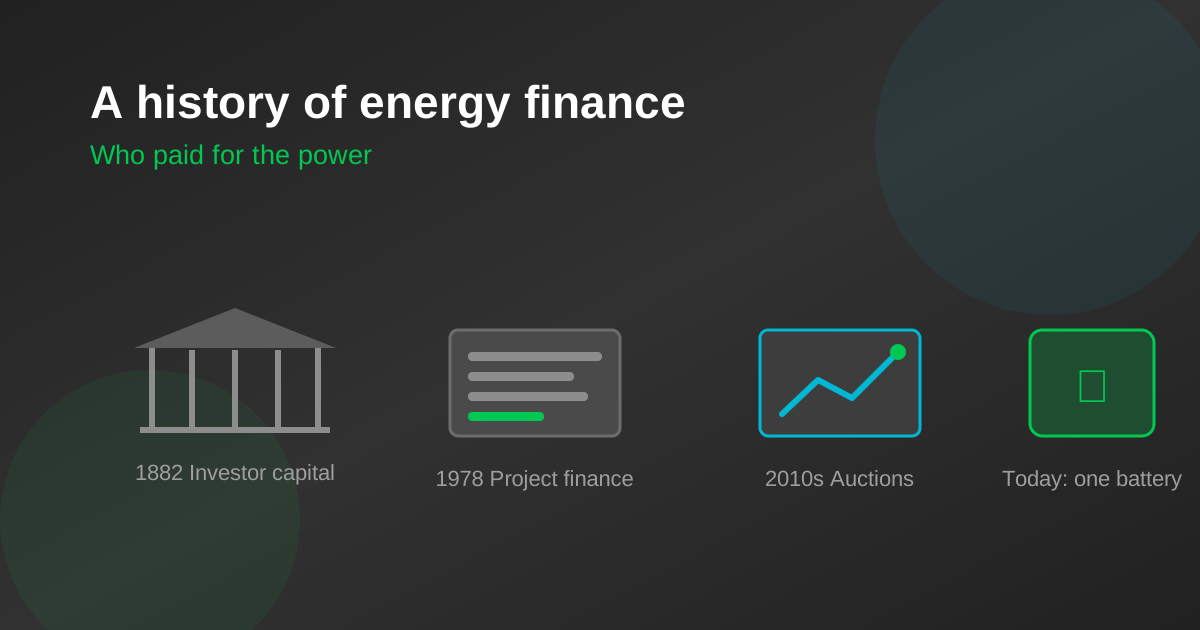
From J.P. Morgan funding Edison’s first power station to a driver financing a battery on EMI — 140 years of the same problem, which is who bears the risk of building something that only pays back over decades.
Published: 17 August 2026
History · 12 min read
Edison’s real problem was not the light bulb
By 1880 Thomas Edison had a working incandescent lamp. What he did not have was a business, because a lamp is worthless without a generating station, a distribution network, meters, wiring inside buildings, and customers willing to pay for something they had never used.
All of that had to be built before the first rupee of revenue arrived. Edison Electric Illuminating Company of New York was formed to raise that capital, with J.P. Morgan among the early backers, and Pearl Street Station opened in 1882.
That set the shape of the entire industry. Energy assets are capital-heavy, long-lived, and generate cash slowly over decades. Almost every development in energy finance since has been an answer to the same question: who bears the risk of building something that only pays back over twenty years?
The 1920s: selling the grid to the public
Samuel Insull, who began as Edison’s secretary and went on to build Commonwealth Edison in Chicago, understood something Edison did not: the constraint on electrification was financial, not technical.
Insull pioneered two ideas that shaped the industry for a century. The first was aggressive load-building — selling electricity to industry during the day, to homes in the evening, and to trams in between, so that expensive generating plant ran at a high utilisation rather than sitting idle. The second was raising capital by selling small-denomination shares and bonds directly to ordinary customers, turning consumers into investors.
He also assembled a pyramid of holding companies, each owning stakes in the next, which allowed a small amount of equity to control an enormous asset base. That structure worked while asset values rose and collapsed spectacularly when they did not. Insull’s empire failed in 1932.
1935: two laws that defined the next fifty years
The wreckage produced a regulatory settlement that lasted, in outline, until the 1980s.
- •The Public Utility Holding Company Act (1935) broke up the pyramid structures and constrained how utilities could be owned and financed. In exchange for accepting regulation, a utility received a protected service territory and a regulated return on its invested capital — low risk, modest but predictable returns, and therefore access to cheap long-term debt.
- •The Rural Electrification Administration (1935) attacked a different problem. Rural America was unelectrified not because the technology was missing but because no private utility could justify the capital against so few customers per kilometre of line. The answer was long-tenure, low-interest federal loans to locally-owned cooperatives.
The lesson of the rural electrification programme is one of the most durable in this entire history: the barrier to electrification is very often the cost of capital, not the cost of equipment. Change who lends, on what terms, and demand appears that looked absent the day before.
1978 onwards: breaking the monopoly
The regulated-monopoly model was stable but not especially efficient. In the United States, the Public Utility Regulatory Policies Act of 1978 obliged utilities to buy power from qualifying independent generators.
That single obligation created something that had not existed: a party who could build a power plant without owning a utility, because there was a guaranteed buyer for the output. The independent power producer was born, and with it the financing structure that still dominates large energy projects today.
Project finance: lending to a contract rather than a company
The structure is worth understanding because it is the ancestor of how almost every solar farm, wind farm and battery installation is funded now.
In conventional corporate lending, a bank lends to a company and can pursue that company’s whole balance sheet if the loan fails. In project finance, a separate entity is created that owns nothing but the project. The lenders are repaid from the project’s own cash flows and, in the event of failure, generally cannot pursue the sponsor beyond their investment in it.
This only works if the future cash flow is genuinely predictable, which is why the long-term power purchase agreement became the central document in energy finance. The contract, not the concrete, is what the lender is actually underwriting.
India: reform, then auctions
India’s power sector followed a broadly similar arc on its own timetable. State electricity boards had historically combined generation, transmission and distribution in a single entity. The Electricity Act, 2003 restructured that — unbundling those functions, largely removing licensing requirements for generation, and enabling open access — which made independent generation and private investment far more practical.
The Indian Renewable Energy Development Agency, established in 1987, had already been lending specifically against renewable projects, addressing exactly the cost-of-capital problem the rural cooperatives faced fifty years earlier.
The genuinely transformative mechanism arrived with the National Solar Mission from 2010: rather than governments setting a subsidised price and hoping it was right, developers bid competitively for contracts, and the lowest bid won. Solar tariffs fell dramatically over the following decade — driven partly by falling equipment costs, but substantially by falling risk premiums as lenders became comfortable with the asset class and the cost of capital came down.
The 2010s: labelling the capital
A parallel development was the emergence of instruments defined by what the money is used for rather than who is borrowing it. The European Investment Bank issued an early climate-linked bond in 2007 and the World Bank followed in 2008, establishing the green bond market.
The economic effect is debated — the pricing advantage over conventional debt is usually small — but the structural effect is real. It let a class of institutional investors with environmental mandates deploy capital into energy assets at scale, widening the pool of lenders competing to fund them.
Today: the smallest unit of energy finance
For 140 years, energy finance meant funding very large things: a generating station, a transmission line, a wind farm. The current transition has produced something genuinely new — the financeable energy asset has become small enough to belong to one person.
A driver buying a lithium battery for an e-rickshaw is doing something structurally identical to an independent power producer building a plant. There is a large upfront capital cost, a long asset life, and a predictable stream of savings — against diesel, against a lead-acid replacement cycle, against rental — that repays it over time. The instalment works precisely because the cash flow it is underwritten against is real.
The obstacle is the same one the American rural cooperatives faced in 1935, and it is not technology. It is that a driver without formal credit history struggles to access capital at a rate that makes the arithmetic work. That is a lending problem, and the framework governing it in India is the RBI’s Digital Lending Directions, under which the loan is made by a regulated lender and every rate and charge must be disclosed on a Key Fact Statement before you accept it.
What has not changed in 140 years
Strip out the institutions and the same three things appear at every stage of this story.
- •The asset is financed against its future cash flow, not its scrap value. That was true of Pearl Street, it is true of a solar auction, and it is true of a battery on EMI.
- •The cost of capital decides what gets built. Falling equipment prices matter, but risk premiums falling as lenders get comfortable with an asset class has repeatedly mattered more.
- •Someone has to bear the gap between spending and earning. Whether that is J.P. Morgan, a federal loan programme, a project finance syndicate or an NBFC underwriting a driver’s instalment, the structure differs but the function is identical.
If you are on the borrowing end of that today, the number that matters is the all-in APR rather than the headline interest rate — you can work yours out with our EMI calculator, and our guide to financing an e-rickshaw battery explains what to check before signing.
Frequently asked questions
How are large energy projects financed?+
Usually through project finance. A separate entity is created that owns nothing but the project, and lenders are repaid from that project’s own cash flows rather than the sponsor’s wider balance sheet. This only works when future revenue is predictable, which is why a long-term power purchase agreement is the central document — the lender is really underwriting the contract, not the concrete.
Why does the cost of capital matter so much in energy?+
Because energy assets are capital-heavy and pay back slowly over decades, so the interest rate dominates the total cost far more than in most industries. Rural America was unelectrified in the 1930s not because the technology was missing but because no private utility could justify the capital; long-tenure, low-interest loans to cooperatives changed that. The same logic applies to a driver financing a battery today.
What created the independent power producer?+
In the United States, the Public Utility Regulatory Policies Act of 1978 obliged utilities to buy power from qualifying independent generators. That guaranteed buyer meant someone could build a power plant without owning a utility, which created the independent power producer and the project finance structures that still dominate large energy projects today.
How did the Electricity Act 2003 change Indian power?+
It restructured a sector in which state electricity boards had combined generation, transmission and distribution in a single entity — unbundling those functions, largely removing licensing requirements for generation, and enabling open access. Together those changes made independent generation and private investment far more practical than they had been.
Why did solar tariffs in India fall so quickly?+
Partly because equipment costs fell, but substantially because of how the contracts were awarded. From 2010 the National Solar Mission used competitive bidding rather than administratively set prices, so developers bid against each other. As lenders became comfortable with solar as an asset class, risk premiums fell and the cost of capital came down — which for a capital-heavy asset moves the tariff more than equipment prices do.
Thinking about upgrading?
Talk to our team about the right pack for your vehicle, and about EMI options that keep the monthly outgo close to what you already spend.
Get in touch