Winter and Your E-Rickshaw Lithium Battery: Cold Mornings, Fog and Charging
Cold North Indian mornings cut lithium range for a while, and charging a frozen pack can damage it for good. Why it happens, how to park and charge in December and January, and how to tell cold from a fault.
Published: 12 November 2026
Battery care · 5 min read
Every December, the same complaint
Somewhere in the second or third week of December, drivers across Delhi-NCR, western Uttar Pradesh, Haryana and Bihar start saying the same thing: the battery is not giving what it gave in October. The first trip of the morning feels weak, the gauge falls faster than it should, and the last round of the evening becomes a question.
Most of the time nothing is broken. A lithium battery behaves differently when it is cold, and a North Indian winter — nights of a few degrees, dense morning fog, short days — brings that behaviour out more clearly than any other season. This article explains what is going on inside the pack, the one winter habit that can actually damage it, and how to tell a cold battery from a faulty one.
Why a cold battery gives less
A battery works by moving lithium through a liquid inside each cell. When that liquid is cold it becomes thicker and slower, a little like engine oil on a winter morning. The cells can still hold their charge, but they cannot hand it over as easily. Engineers call this higher internal resistance; a driver experiences it as a pack that feels tired.
Two things follow. First, the voltage dips harder whenever you pull away from a stop with a full load, so the vehicle feels sluggish and the gauge may jump down. Second, the battery management system (BMS) cuts power when the voltage falls to its safety limit, and on a cold pack it reaches that limit earlier, with energy still left inside.
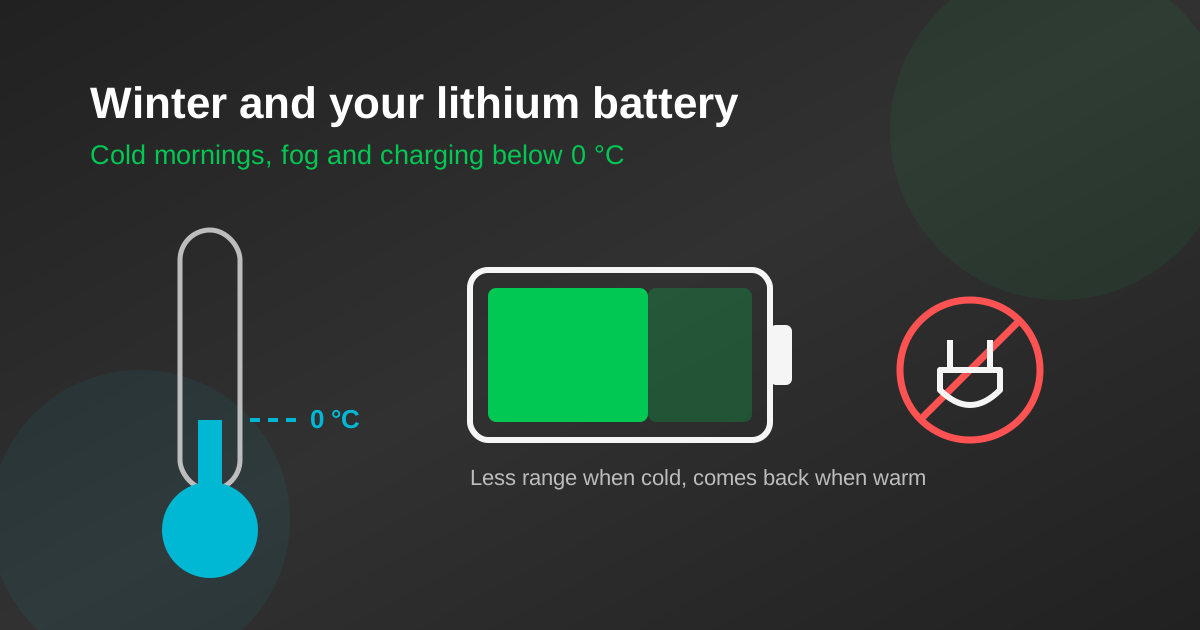
How much range goes missing depends on the pack, the load and how cold it is. As a rough guide for an LFP (lithium iron phosphate) pack, the kind most e-rickshaws use, a pack sitting at around 5–10 °C might give something like 5 to 15 per cent less than on a mild day, and a pack near freezing more than that. Lead-acid batteries lose range in the cold too, often more, so drivers who switched from lead-acid may notice it less than they expect.
The one winter mistake that does real damage
Driving on a cold battery is harmless. Charging a frozen one is not. When an LFP cell is charged below about 0 °C, the lithium cannot soak into the cell material fast enough and some of it settles on the surface as metal instead. This is called lithium plating. That lithium is lost for good, so the cell has permanently less capacity, and in bad cases the metal can grow in ways that weaken the cell from inside.
A good BMS knows this and refuses to charge when its temperature sensors read below a set limit, usually around 0 °C. Some also slow the charge when the pack is merely cool. That protection is why a well-built pack survives winter well — but it has a side effect that confuses many drivers. On a very cold night in an open yard, you may plug in, see the charger light come on, and find in the morning that the pack has barely charged. Nothing failed: the BMS waited for the pack to warm up, and it never did.
Most nights on the plains do not go below freezing. The danger is the cold-wave nights in late December and January, and open fields and highway dhabas in Punjab, Haryana and western UP, where it can drop to around zero. A pack parked in that air for six hours takes on that temperature.
Parking and charging habits for December and January
In summer the advice is to let a hot pack cool before charging. In winter it reverses: a pack is at its warmest just after the evening run, so that is the best time to plug in.
- •Charge soon after you finish. The pack is still warm from driving, so it takes the charge easily. Leaving it to stand for hours in a cold yard first and charging at 4 a.m. is the wrong way round.
- •Park under cover. A shed, a covered garage or the side of a building is several degrees warmer than an open plot and keeps dew and fog off the pack. Never wrap the pack in a blanket, sack or tarpaulin while it charges: that traps heat and moisture where you do not want them.
- •Go easy on the first trip. Pull away gently for the first ten or fifteen minutes. The current itself warms the pack, and hard starts on a cold pack are what trigger early cut-outs.
- •Keep a little more in reserve. Plan to come home with a larger cushion than in October, especially on fog days when trips take longer.
- •Do not heat the pack. No angithi, heater, fire or hot-air blower near the battery. Warmth from shelter and from driving is all it needs.
Fog, short days and the rest of the vehicle
Winter costs range in small ways that add up. Headlights and indicators stay on for longer in fog and in the early dark; on LED lights this is minor, on old halogen bulbs it is not. Tyre pressure falls as the air gets colder, so tyres that were right in October are soft in January and cost range on every kilometre. Slow-moving fog traffic also means more stopping and starting.
Fog brings moisture as well. Night-time dew settles on connectors and the charging port, and moisture plus dust is how terminals start to corrode. Wipe the charging plug dry before connecting it on a wet morning, and look for green or white powder on terminals more often than you would in summer.
Just cold, or a real fault?
The pattern tells you. A cold effect is worst in the early morning, better by afternoon, and roughly the same on every vehicle in a fleet that parks in the same place. A fault does not follow the thermometer.
- •Likely cold: range is short in the morning and recovers as the day warms up.
- •Likely cold: every vehicle parked in the same yard shows a similar drop.
- •Likely cold: the pack did not fill overnight on a freezing night but charges normally in the afternoon.
- •Likely a fault: range is short on a warm afternoon too, not only at dawn.
- •Likely a fault: one vehicle drops sharply while others on the same route do not.
- •Likely a fault: the vehicle cuts out with the gauge showing plenty of charge, again and again.
- •Likely a fault: charging ends much faster than before, or one part of the pack feels warmer than the rest.
- •Get it checked at once: swelling, a smell, smoke, or a pack that will not charge even when warm.
If the signs point to a fault, work through the cheaper causes first — tyres, brakes, connectors, the charger — using our range-drop checklist. A range drop that started in December and ends in February was the weather. One that stays into March was not; the summer heat that follows is the season that ages a pack for good.
Winter checklist
- •Charge soon after the evening run, while the pack is still warm.
- •Park and charge under cover, never in an open yard on a cold-wave night.
- •If the pack did not fill on a freezing night, let it warm and charge again — do not force it.
- •Never wrap, heat or cover the pack while charging.
- •Pull away gently for the first ten to fifteen minutes of the day.
- •Check tyre pressure weekly; cold air lowers it.
- •Wipe the charging plug and connectors dry on foggy mornings.
- •Note your daily kilometres so you can see whether the drop follows the weather.
- •If range is still short in March, get the pack tested.
Terms in this article
Frequently asked questions
Why does my e-rickshaw lithium battery give less range in winter?+
Cold makes the liquid inside each cell slower, so the pack cannot deliver its energy as easily and the BMS cuts power earlier under load. The energy is still there. Most of the lost range returns as the pack warms during the day, and all of it by the end of winter.
Is it safe to charge a lithium battery in the cold?+
Charging an LFP battery below about 0 °C can permanently damage the cells through lithium plating. A good BMS blocks charging below its low-temperature limit. In winter, charge soon after the evening run while the pack is still warm, and park under cover rather than in an open yard.
How do I know if a winter range drop is a fault?+
A cold effect is worst in the morning, improves by afternoon and affects every vehicle parked in the same place. If range is short on warm afternoons too, one vehicle drops while others do not, or the drop continues into March, have the battery and charger tested.
Thinking about upgrading?
Talk to our team about the right pack for your vehicle, and about EMI options that keep the monthly outgo close to what you already spend.
Popular: Lithium e-rickshaw battery