Sungrow’s Storage Margin Fell 13 Points in a Quarter. EVE Is Booked Through Q4.
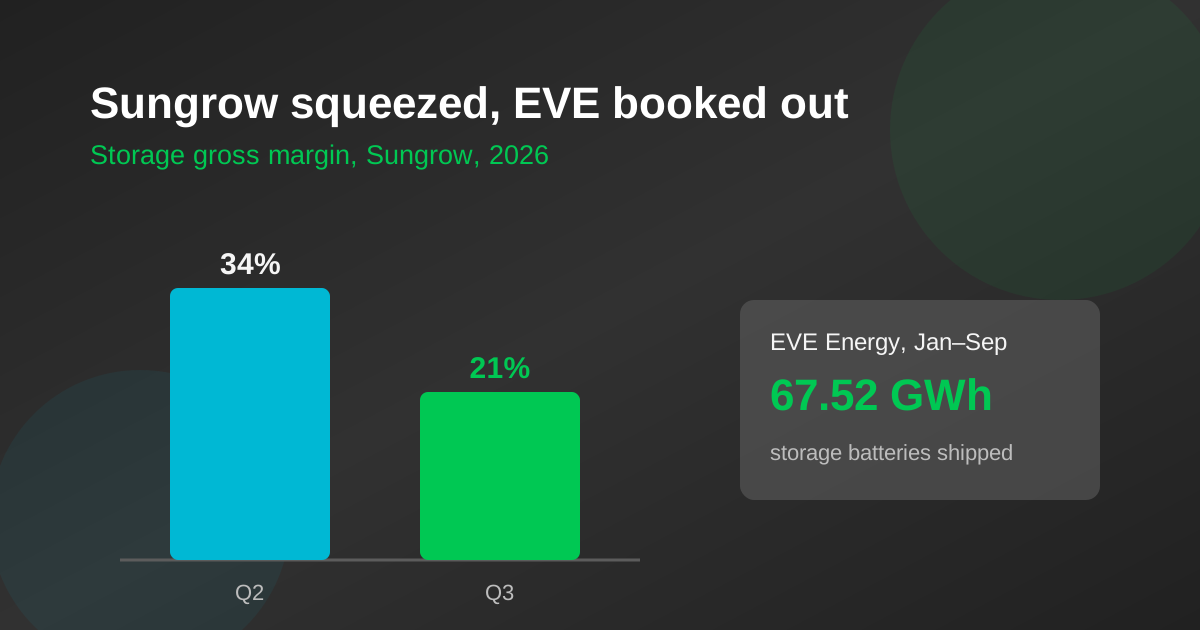
Sungrow’s third-quarter profit fell 68 per cent as its storage gross margin dropped from 34 to 21 per cent on costlier cells, a smaller export rebate and currency moves. Cell maker EVE shipped 67.5 GWh of storage batteries in nine months and says its fourth quarter is fully booked.
Published: 20 November 2026
Industry · 3 min read
What happened
Written 20 November 2026, on Bloomberg reporting of 13 November (via Energy Connects), a 10jqka (Tonghuashun) analysis of Sungrow’s third-quarter report published 7 November, and ESS News reporting of 27 October on EVE Energy’s third-quarter results.
Two of China’s biggest storage suppliers reported their third quarters this autumn, and they tell different stories. Sungrow, which builds complete storage systems, saw its profit squeezed. EVE Energy, which makes the cells, reports its fourth-quarter capacity is fully booked.
Bloomberg reports that Sungrow’s net income fell 68 per cent in the third quarter. 10jqka, working from the filing, puts net profit attributable to shareholders at RMB 1.341 billion, down 67.67 per cent year on year, and RMB 6.599 billion for the first nine months, down 44.46 per cent.
Sungrow: more volume, thinner margin
Sungrow shipped more storage, not less. 10jqka reports third-quarter storage shipments of 17 GWh, up 24 per cent on the second quarter, and 41 GWh for the nine months against 29 GWh a year earlier. But the gross margin on storage fell from 34 per cent in the second quarter to 21 per cent in the third, 13 points in a single quarter.
The reasons 10jqka gives:
- •Cell costs: lithium carbonate rose from about RMB 120,000 a tonne at the start of 2026 to about RMB 200,000 in May, and cells bought at those prices were booked when projects were accepted in the third quarter
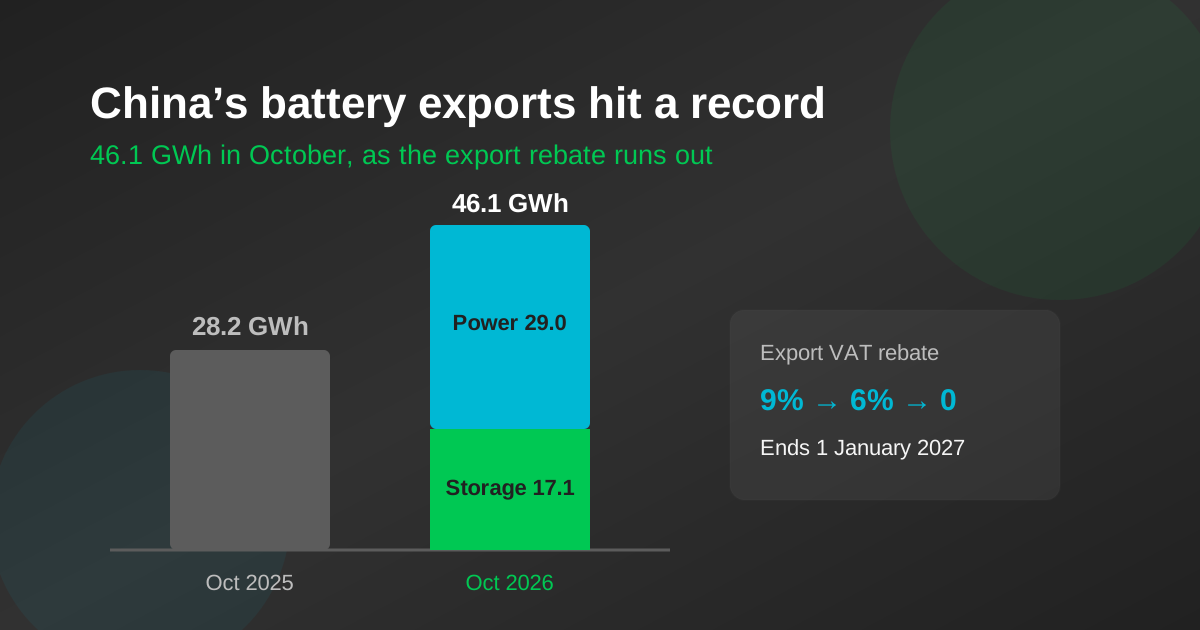
- •China’s export tax rebate was cut from 9 per cent to 6 per cent from April 2026
- •China’s consumption tax on batteries, for which 10jqka gives no figure
- •A weaker euro and dollar, worth one to two points of gross margin
- •Higher freight, and a mismatch in timing between signing orders, buying cells and recognising revenue
10jqka also reports inventory of RMB 40.97 billion at the end of September, up 50.33 per cent since the start of the year. Bloomberg reports Sungrow is turning to home and small commercial batteries for growth, with a 30 kW all-in-one product launched in Europe and Australia, while its rival Ningbo Deye grew profit 89 per cent in the same quarter.
A fixed-price storage contract signed before a cell price rise is a loss waiting to be booked. Sungrow’s quarter shows how long that lag can be: costs from the first half surfaced in the third.
EVE: booked out
ESS News reports that EVE shipped 67.52 GWh of storage batteries in the first nine months, up 39.46 per cent, slightly more than its 66.17 GWh of EV batteries. Nine-month net profit was RMB 5.24 billion, up 86.11 per cent. At an investor briefing on 23 October, EVE said its fourth-quarter production capacity was fully booked, and its first-quarter 2027 delivery schedules were not yet set.
EVE’s storage line is built on large 628 Ah LFP cells, with a 702 Ah cell and a 6.9 MWh container in sampling. In September a subsidiary signed a framework with Fluence for up to 206 GWh over 2027 to 2031. Its first-half storage battery gross margin was 12.51 per cent, ESS News reports: thin, but on a business whose capacity is spoken for.
What it means for this business
Wingzman buys cells and builds packs and storage systems in India, so it sits closer to Sungrow’s side of this split than EVE’s. The lessons are practical:
- •When cell makers are booked a quarter ahead, integrators carry the price risk between quote and delivery
- •Short quote validity and cost pass-through clauses are a response to exactly this, not a negotiating tactic
- •Large-format cells such as EVE’s 628 Ah are where leading cell makers are putting their storage capacity, which matters when choosing a container design today
For the cell side, see why cell quotes now expire in 14 days; for the cost hit from China’s currency, see the strong yuan and an Indian cell buyer. What the inverter and conversion stage in a Sungrow system does is explained under power conversion system in our glossary.
Sources
Reporting this piece draws on. Figures were correct as published; scheme terms and commodity prices move.
- Sungrow Turns to Home Batteries for Growth After Profit SqueezeBloomberg (via Energy Connects) · 13 November 2026
- 光储巨头阳光电源第三季度净利下滑67.67%,储能单季毛利率暴跌13个百分点10jqka (Tonghuashun) · 7 November 2026
- EVE Energy ships 67.52 GWh of storage batteries in first nine months of 2026ESS News · 27 October 2026
Terms in this article
Frequently asked questions
Why did Sungrow’s profit fall in the third quarter of 2026?+
Bloomberg reports a 68 per cent fall in net income. A 10jqka analysis of the filing attributes it mainly to a drop in storage gross margin from 34 to 21 per cent, citing cells bought when lithium was dearer in the first half, an export tax rebate cut from 9 to 6 per cent from April, the battery consumption tax, currency moves and freight.
How is EVE Energy doing in storage?+
ESS News reports EVE shipped 67.52 GWh of storage batteries in the first nine months of 2026, up 39.46 per cent, and said at an investor briefing that its fourth-quarter capacity was fully booked. Its storage line is built on 628 Ah LFP cells.
What does this mean for storage buyers in India?+
When cell makers are booked ahead, system builders carry the price risk between quote and delivery. That is why short quote validity and cost pass-through clauses have become common in storage contracts.
Want this applied to your own numbers?
Every solution page carries a calculator that shows its own arithmetic — storage savings, lithium against lead-acid, and home pack sizing.