Battery Cell Quotes Now Expire in 14 Days. That Is the Story.
Offer validity has collapsed from about three months to a fortnight since January. Lithium peaked in May and turned down, the 587 Ah cell transition is pulling costs the other way, and cells are under 40 per cent of a turnkey system anyway.
Published: 24 August 2026
Industry · 7 min read
Where things stand
Written 24 August 2026. Cell pricing moves week to week; figures below are as reported through mid-August 2026.
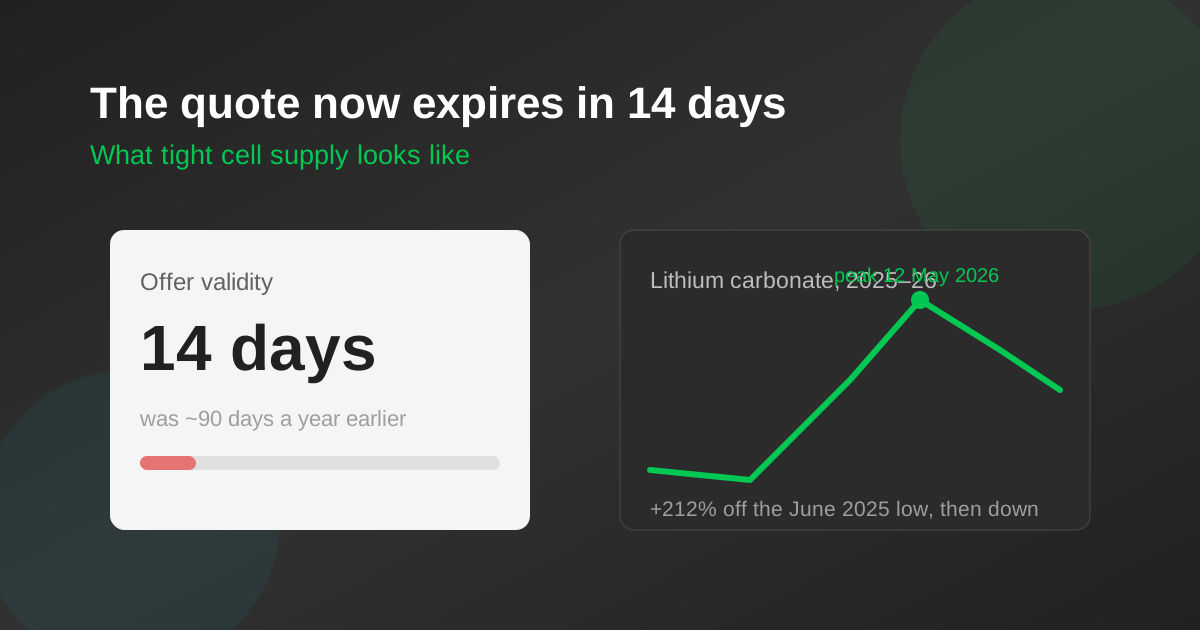
The most useful indicator of what is happening in battery storage procurement this year is not a price. It is the expiry date on the quotation. Reporting from the storage market notes that cell offer validity periods have collapsed since January 2026, in some cases to as little as fourteen days, against roughly three months a year earlier.
A supplier who will only hold a price for a fortnight is telling you something specific: that their own input costs are moving faster than their sales cycle, and that they expect to be able to sell the same cells to somebody else if you hesitate. Both halves of that statement matter more to a project developer than the headline number on the quote.
What moved
The commodity leg is the visible part. Lithium carbonate ran to a year-to-date peak of around $24.50 to $25.80 per kilogram on 12 May 2026 — up roughly 212 per cent from the June 2025 low near $7.50 to $8.60 — before turning downward. Forecasts covered in the trade press expect further softening through 2027 as delayed production finally arrives.
The demand leg is the larger part. Storage has stopped being a marginal buyer of cells. Grid-scale procurement is now competing directly with automotive demand for the same LFP production lines, and unlike a carmaker, a storage developer does not have a multi-year supply agreement negotiated three product cycles in advance.
Short validity windows are a scheduling problem before they are a price problem. A tender that takes six weeks to evaluate cannot be bid on a quote that expires in two, so bidders either pad the number or carry the risk. Both outcomes end up in the tariff.
The 587 Ah transition is the offsetting force
Pulling in the other direction is a format change. The industry is moving from the legacy 280 to 320 Ah prismatic LFP cells toward much larger formats around 587 Ah, and analysis from Intertek’s CEA group suggests this could drive BESS costs down through 2027 even if cell prices per kilowatt-hour do not fall.
The mechanism is worth understanding, because it is the same argument that has driven almost every cost reduction in this industry. A bigger cell puts more energy into the same container, which means fewer cells, fewer welds, fewer sensing points, fewer module assemblies and fewer racks for the same megawatt-hour. The saving is in everything around the cell rather than in the cell itself.
That distinction matters because, for European utility-scale builds, cells have been reported at under 40 per cent of turnkey system cost. The majority of what a storage project costs is non-cell hardware, power conversion, civils, grid connection and engineering — none of which cares what lithium did last month.
What this means if you are buying
- •Ask what the quote is indexed to. A fixed price with a fourteen-day window and a fixed price valid for ninety days are different products, and the second one has a risk premium inside it that you are paying for whether or not you notice.
- •Separate the cell line from everything else. If cells are under half the system cost, a 10 per cent cell move is a 4 to 5 per cent system move. Renegotiating the balance-of-plant scope is often worth more than chasing the commodity.
- •Treat the cell format as a specification decision, not a supplier detail. A system built around larger-format cells has a different spares position, a different failure granularity and a different second-source story over a fifteen-year life.
- •Do not build the business case on a lithium forecast. Prices have moved 212 per cent up and then down again inside eighteen months. If the project only works at one end of that range, it does not work.
For Indian buyers specifically, the currency and freight legs usually move a landed quotation more than the metal does — the arithmetic is worked through in our note on what actually sits inside a pack price, and the site-level version is in the BESS savings calculator.
Sources
Reporting this piece draws on. Figures were correct as published; scheme terms and commodity prices move.
- Lithium price volatility creates BESS cost uncertainty with hedging in infancy: ESS 2026Fastmarkets
- Intertek CEA says 587Ah cells could drive down BESS costs through 2027ESS News · 14 July 2026
- Energy storage moves toward next-gen lithium cells as price volatility drives interest in alternativespv magazine · 13 August 2026
- BESS prices set to increase in short-term, but technology will 'continue to move goal posts' long-termEnergy-Storage.News
Frequently asked questions
Why are battery cell quotations only valid for two weeks?+
Because supply is tight and input costs are moving faster than the sales cycle. Reporting from the storage market notes offer validity periods shortening since January 2026 to as little as fourteen days, against roughly three months a year earlier. A short window tells you the supplier expects to resell the same cells if you hesitate, which is a scheduling problem for any tender that takes six weeks to evaluate.
Did lithium prices peak in 2026?+
Lithium carbonate reached a year-to-date peak around $24.50 to $25.80 per kilogram on 12 May 2026, up roughly 212 per cent from the June 2025 low near $7.50 to $8.60, and has since turned downward. Forecasts covered in the trade press expect further softening through 2027 as delayed production comes online.
What are 587 Ah cells and why do they lower cost?+
They are a larger prismatic LFP format replacing legacy 280 to 320 Ah cells. More energy in the same container means fewer cells, welds, sensing points, module assemblies and racks for the same megawatt-hour, so the saving comes from everything around the cell rather than from the cell price itself. Intertek CEA has suggested this could drive BESS costs down through 2027 even without cell price falls.
How much of a battery storage system is actually the cells?+
Less than most buyers assume. For European utility-scale builds cells have been reported at under 40 per cent of turnkey system cost, with non-cell hardware, power conversion, civils, grid connection and engineering making up the rest. That means a 10 per cent cell price move is roughly a 4 to 5 per cent system move, and renegotiating balance-of-plant scope is often worth more than chasing the commodity.
Want this applied to your own numbers?
Every solution page carries a calculator that shows its own arithmetic — storage savings, lithium against lead-acid, and home pack sizing.
Get in touch