Saudi Arabia Signs 8 GWh of Battery Storage; a Chinese Supplier Takes Three-Quarters
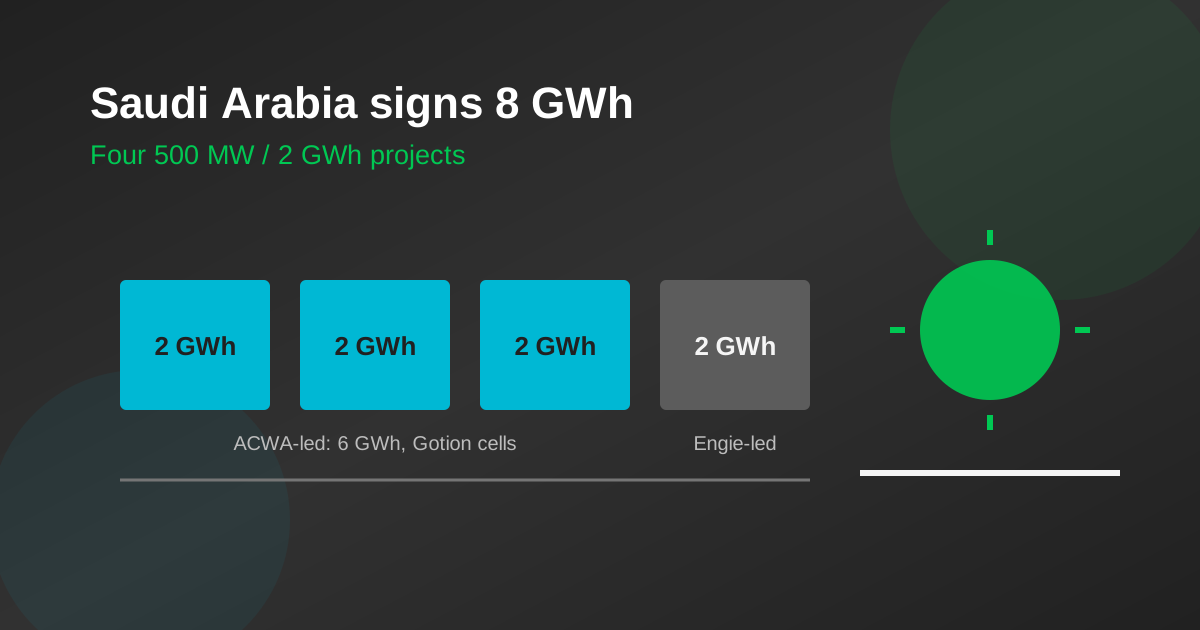
Saudi Arabia’s power procurer signed four 500 MW / 2 GWh storage contracts worth $1.16 billion. Gotion High-Tech will supply the three ACWA-led projects, 6 GWh, as a 12 GWh second round goes to bid.
Published: 11 October 2026
Grid storage · 3 min read
Four contracts, 8 GWh
Written 11 October 2026, on the Saudi Power Procurement Company’s awards as reported by MEED (21 August) and ESS News (24 August), and on Gotion High-Tech’s supply contracts as reported by Battery-News (16 September) and Zawya (28 September).
Saudi Arabia has signed its first utility-scale battery storage contracts under an independent-provider model. MEED reports that the Saudi Power Procurement Company (SPPC) signed four storage service agreements for 2,000 MW of four-hour storage, 8,000 MWh in total, with investment of more than SR4.35 billion ($1.16 billion). ESS News reports the agreements run 15 years and that each project is 500 MW / 2,000 MWh on a build-own-operate basis.
- •Al Muwyah and Haden (Makkah region) and Al Kahafa (Hail region): a consortium of Saudi Energy, ACWA Power and Al Sharif Contracting
- •Al Khushaybi (Qassim region): a consortium of Engie and Haji Abdullah Alireza & Co
- •Winning consortia hold 100 per cent of the project companies, with SPPC as principal buyer (ESS News)
Where the batteries come from
A month later, the supplier became clear. Zawya reported on 28 September that Gotion High-Tech, the Chinese battery maker, has contracts for the three ACWA-led projects: 1.5 GW / 6 GWh, or 75 per cent of the first group. Battery-News had reported the order on 16 September, quoting the company as saying the projects “have now entered the construction phase.”
Gotion describes this as the first large-scale international deployment of its utility-scale system. It claims a 25-year design life against a 15–20 year industry average, and operation from −30°C to 55°C. Those are the company’s figures, not independent tests. Zawya also reports the company puts its Middle East and North Africa storage portfolio at about 9 GWh.
A desert duty cycle. These are four-hour systems designed, in Battery-News’s description, to store daytime solar surplus and return it at peak demand, in some of the hottest operating conditions anywhere. The 55°C rating matters more here than the headline gigawatt-hours.
Bigger rounds behind it
This is the first of several groups. MEED reports that SPPC issued requests for proposals in July for a second group of six 500 MW projects, 3 GW / 12 GWh in total, in Qassim, Makkah, Madinah and the Eastern Province, with bids due in October. Up to 27 firms prequalified. ESS News puts the national target at 48 GWh of battery storage by 2030.
The bidder list is international. ESS News names Masdar, EDF, TotalEnergies and China Longyuan Power among the prequalified firms, and MEED lists Masdar, ACWA, EDF, Kepco, Engie’s International Power and Marubeni as likely bidders. MEED ties the programme to the kingdom’s goal of roughly 50 per cent renewable electricity by 2030. Storage is what lets that much daytime solar serve demand after sunset.
What it means for this business
Saudi Arabia and India are buying storage the same way: long-term contracts awarded by a state buyer, largely with Chinese cells inside. The structures differ in detail. India’s tenders typically pay a fixed rupee tariff per MW per month, as in Maharashtra’s recent 4 GWh auction.
- •Large Gulf orders compete for the same cell supply as Indian projects. A 6 GWh order is a share of a manufacturer’s output that is not available to anyone else that year
- •Heat is a shared design problem. Indian summers are not Saudi summers, but derating, cooling and warranty terms at high ambient temperature matter in both
- •Supplier claims of 25-year life are worth asking about, and worth asking to see in a warranty
On the supply side, see our coverage of BESS cell supply tightness and our explainer on lithium batteries in Indian summer heat.
Sources
Reporting this piece draws on. Figures were correct as published; scheme terms and commodity prices move.
- Saudi Arabia signs $1.16bn bess agreementsMEED · 21 August 2026
- Saudi Arabia awards $1.16 billion for 8 GWh of battery storage; ACWA Power, Engie win bigESS News · 24 August 2026
- Gotion High-Tech to Supply 6 GWh of Battery Storage in Saudi ArabiaBattery-News · 16 September 2026
- China’s Gotion High-Tech wins 6GWh battery storage contracts in Saudi ArabiaZawya · 28 September 2026
Frequently asked questions
What did Saudi Arabia sign?+
The Saudi Power Procurement Company signed four 15-year storage service agreements for 500 MW / 2,000 MWh projects, 2 GW / 8 GWh in total, with investment of more than $1.16 billion. Three went to a Saudi Energy, ACWA Power and Al Sharif consortium and one to Engie with Haji Abdullah Alireza & Co.
Who is supplying the batteries?+
Gotion High-Tech has contracts for the three ACWA-led projects, 1.5 GW / 6 GWh or 75 per cent of the first group, as reported by Zawya and Battery-News in September 2026. The company claims a 25-year design life; that is its own figure, not an independent test.
Is there more to come?+
Yes. MEED reports a second group of six 500 MW projects, 3 GW / 12 GWh, was issued for bids in July with an October deadline, and up to 27 firms prequalified. ESS News puts Saudi Arabia’s target at 48 GWh of battery storage by 2030.
Is storage right for your site?
Send us a month of electricity bills and your load profile, and we will tell you what a battery would save — including when it would not pay.