Maharashtra Drafts a Storage Mandate for Rooftop Solar Above 100 kW
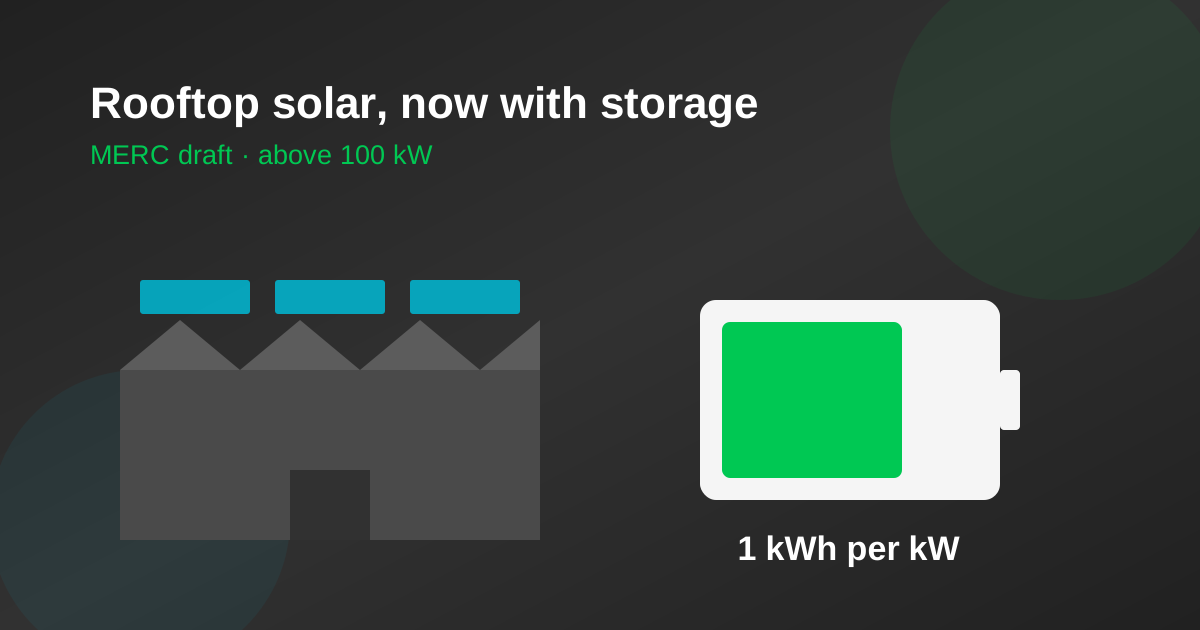
Draft MERC rules would require 1 kWh of batteries per kW of new rooftop solar above 100 kW, rising to 2 kWh after 2030, and a second draft sets up standalone storage as a business with relief on grid charges.
Published: 30 September 2026
Policy · 4 min read
What has been proposed
Written 30 September 2026, on coverage by Energetica India and Saur Energy of draft regulations the Maharashtra Electricity Regulatory Commission released on 22–23 September 2026. We have not been able to read the drafts themselves; figures are as reported.
The Maharashtra Electricity Regulatory Commission (MERC) has published two drafts that bear directly on battery storage. The first revises the rules for rooftop renewable energy and would require new grid-interactive and behind-the-meter rooftop systems above 100 kW to include an energy storage system. The second sets out a framework for standalone storage as a business in its own right.
The rooftop storage requirement
As reported by Energetica India, the minimum storage is equivalent to 50 per cent of the installed renewable capacity with two hours of storage, or 25 per cent with four hours. Both work out to the same energy: 1 kWh of storage for every kW of rooftop solar. That ratio applies through 2030 and then rises to 2 kWh per kW.
In practice, a factory putting 500 kW of solar on its roof would need about 500 kWh of batteries under the first phase and about 1 MWh after 2030. The draft also proposes that rooftop capacity on any transformer or feeder should not exceed 70 per cent of its rated capacity, which is a hosting limit rather than a storage rule, but it points the same way: a concern about how much midday solar the local network can absorb.
Why the ratio is stated in kWh per kW. The two options, half the solar capacity for two hours or a quarter for four, store the same energy. The regulator is fixing how much energy moves off the midday peak, and leaving the building owner to choose between a faster, shorter battery and a slower, longer one.
Storage as a standalone business
The second draft, reported by Saur Energy, sets a minimum size of 5 MW for storage connected to the transmission network and 1 MW for storage connected to distribution, each with at least two hours of duration. Power drawn to charge the storage would be exempt from certain transmission, distribution demand, wheeling and surcharge-related charges. Without that exemption, a battery is charged grid fees on energy it only holds and hands back.
Saur Energy gives 12 October 2026 as the deadline for comments on this draft, with counter-submissions by 15 October. We have not seen a confirmed deadline for the rooftop draft.
What it means for this business
This is the most direct policy driver for commercial and industrial storage we have seen from a state regulator. Utility-scale tenders create demand for large developers. A rooftop mandate creates demand at the factory gate, among exactly the customers that C&I battery storage is sold to.
- •Applies to new rooftop systems above 100 kW, so mid-sized factories, warehouses and commercial buildings
- •Sizing is set in energy terms: 1 kWh per kW of solar to 2030, 2 kWh per kW after
- •A mandated battery still has to earn its keep: peak shaving and demand-charge savings are what make it pay
- •Both are drafts, and the final figures can change after consultation
A battery that is installed to meet a rule but run only to meet that rule is a cost. Run against the site’s demand charges, the same battery can pay for itself. Our guide to peak shaving and demand charges explains how.
Sources
Reporting this piece draws on. Figures were correct as published; scheme terms and commodity prices move.
- MERC Proposes New Rooftop Renewable Energy RulesEnergetica India · 23 September 2026
- MERC Proposes New Rules To Convert Energy Storage to A Standalone BusinessSaur Energy · 23 September 2026
Terms in this article
Frequently asked questions
Which rooftop solar systems would need batteries under the MERC draft?+
New grid-interactive and behind-the-meter rooftop systems above 100 kW, as reported by Energetica India. The proposal is a draft and can change after consultation.
How much storage would be required?+
Storage equivalent to 50 per cent of the rooftop capacity for two hours, or 25 per cent for four hours. Both equal 1 kWh per kW of solar, which applies through 2030 before rising to 2 kWh per kW.
What does the standalone storage draft change?+
It sets minimum sizes of 5 MW for transmission-connected and 1 MW for distribution-connected storage, with at least two hours of duration, and would exempt power drawn for storage from certain transmission, distribution demand, wheeling and surcharge-related charges. Saur Energy reports comments are due by 12 October 2026.
Want this applied to your own numbers?
Every solution page carries a calculator that shows its own arithmetic — storage savings, lithium against lead-acid, and home pack sizing.