Lithium Carbonate Fell 17% in Three Weeks. Storage Cells Fell 2%.
InfoLink’s lithium carbonate average fell from RMB 109,000 to RMB 90,000 a tonne between 14 October and 4 November as a big Chinese mine moved towards restart. Storage cell prices slipped only 2 to 3 per cent, and most system prices did not move.
Published: 12 November 2026
Industry · 3 min read
What happened
Written 12 November 2026, on InfoLink Consulting’s weekly storage price reports of 14, 21 and 28 October and 4 November, and Shanghai Metals Market (SMM) reports of 30 October and 11 November. All prices are Chinese domestic spot prices.
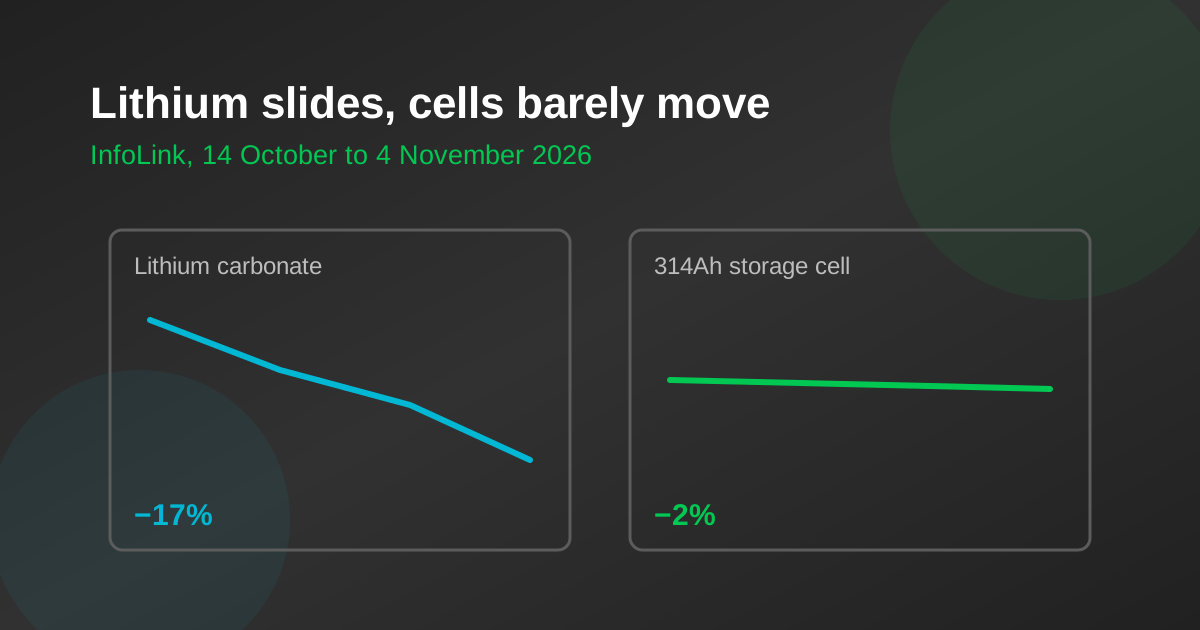
Lithium carbonate kept falling through October. InfoLink put battery-grade lithium carbonate at an average of RMB 109,000 a tonne on 14 October, down 9.2 per cent on the week. It fell again in each of the next three reports, to RMB 102,000, RMB 97,000 and, on 4 November, RMB 90,000, down 7.2 per cent on the week. SMM’s daily assessment on 11 November averaged RMB 90,450 a tonne, down another RMB 800 on the day.
Over the same three weeks to 4 November, the storage cells made from it barely moved.
Raw material down, cells down a little
InfoLink’s average prices for Chinese LFP storage cells, per watt-hour:
- •100Ah cells: RMB 0.420 on 14 October, RMB 0.415 on 21 October, RMB 0.413 on 28 October and RMB 0.408 on 4 November
- •280Ah and 314Ah cells: RMB 0.360, RMB 0.358, RMB 0.355 and RMB 0.353 on the same dates
- •Two-hour DC-side storage systems: an average of RMB 0.49 throughout, with a 1 per cent weekly fall recorded on 4 November
- •AC-side systems of one, two and four hours: flat at RMB 0.84, RMB 0.58 and RMB 0.53
By InfoLink’s numbers, lithium carbonate fell about 17 per cent between 14 October and 4 November. The 100Ah cell fell about 3 per cent, the 314Ah cell about 2 per cent, and most system prices not at all.
InfoLink’s explanation is consistent from week to week. Cheaper lithium lowers LFP cathode costs and some makers have trimmed quotes, but steady deliveries to utility-scale projects support the larger 280Ah and 314Ah formats. The 100Ah cell has fallen further because of weak residential storage demand, inventory and a narrowing premium as demand shifts to larger cells. On systems, InfoLink said on 14 October that integrators were holding prices on the strength of order backlogs and waiting to see whether low material prices last.
Why lithium is falling
InfoLink attributes the fall largely to expected supply. On 30 October, SMM reported that the Yichun environment bureau had approved in principle the environmental impact assessment for the CATL-affiliated Jianxiawo lithium mine in Jiangxi, with mining capacity of 30 million tonnes of ore a year. SMM notes that operations may formally begin only after the mine’s environmental facilities pass acceptance and it obtains a discharge permit.
InfoLink also points to high ore arrivals from Australia, Zimbabwe and elsewhere, rising port inventories, October cell output that fell short of plans, and buyers cautious about orders into early 2027. On 21 October it added that changes to export tax rebates were pulling some overseas storage orders forward into the fourth quarter of 2026. SMM said on 11 November that it expects spot lithium prices to keep pulling back.
What it means for this business
The 100Ah format InfoLink tracks is the one closest to e-rickshaw, two- and three-wheeler and home backup packs, so its price is the most relevant line here. For Indian buyers of cells and packs, the October numbers suggest:
- •Falls in lithium reach the cell slowly and only in part; a large move in carbonate has so far meant a small one in cells
- •These are Chinese domestic prices; a landed price in India also depends on freight, duty, the rupee and the yuan
- •The utility-scale formats are holding up better than the smaller cells, because big projects are still taking delivery
- •None of this is a forecast, and a mine restart can slip; we would not plan purchases on lithium falling further
For the September side of this story, see lithium fell almost 10 per cent in a week, and storage cells did not; for how the price agencies differ, see why lithium price assessments disagree. For what goes into a pack price, see our e-rickshaw battery page.
Sources
Reporting this piece draws on. Figures were correct as published; scheme terms and commodity prices move.
- Lithium salt price declines persist; cell prices move lower and system prices hold steadyInfoLink Consulting · 14 October 2026
- Lithium salt prices continue to decline; cell prices edge lower and ESS prices hold steadyInfoLink Consulting · 21 October 2026
- Lithium salt prices weaken amid fluctuations; cell prices dip; ESS prices steady for nowInfoLink Consulting · 28 October 2026
- Lithium salt prices decline further as quotes soften across the energy storage supply-chainInfoLink Consulting · 4 November 2026
- [SMM Flash] CATL-Affiliated Jianxiawo Lithium Mining Project Receives EIA ApprovalShanghai Metals Market (SMM) · 30 October 2026
- [SMM Lithium Carbonate Daily Review] On November 11, spot lithium carbonate continued to decline, while futures opened lower, rose, and closed higher on reduced positions.Shanghai Metals Market (SMM) · 11 November 2026
Terms in this article
Frequently asked questions
How far did lithium carbonate fall in October 2026?+
InfoLink’s battery-grade lithium carbonate average fell from RMB 109,000 a tonne on 14 October to RMB 90,000 on 4 November, about 17 per cent. SMM’s daily assessment averaged RMB 90,450 on 11 November.
Why did LFP cell prices fall so much less?+
InfoLink says steady deliveries to utility-scale projects supported 280Ah and 314Ah cells, which slipped from RMB 0.360 to RMB 0.353 per Wh. The 100Ah cell fell further, from RMB 0.420 to RMB 0.408, on weak residential storage demand and inventory. Most system prices held flat.
Why is lithium falling?+
InfoLink cites expected supply, including CATL’s Jianxiawo mine in Jiangxi, whose environmental impact assessment SMM reported approved in principle on 30 October, along with high ore imports, rising port inventories and weaker October cell output. The mine still needs its environmental facilities accepted before it can operate.
Want this applied to your own numbers?
Every solution page carries a calculator that shows its own arithmetic — storage savings, lithium against lead-acid, and home pack sizing.