Two Lithium Assessments, Same Month, 25 Per Cent Apart
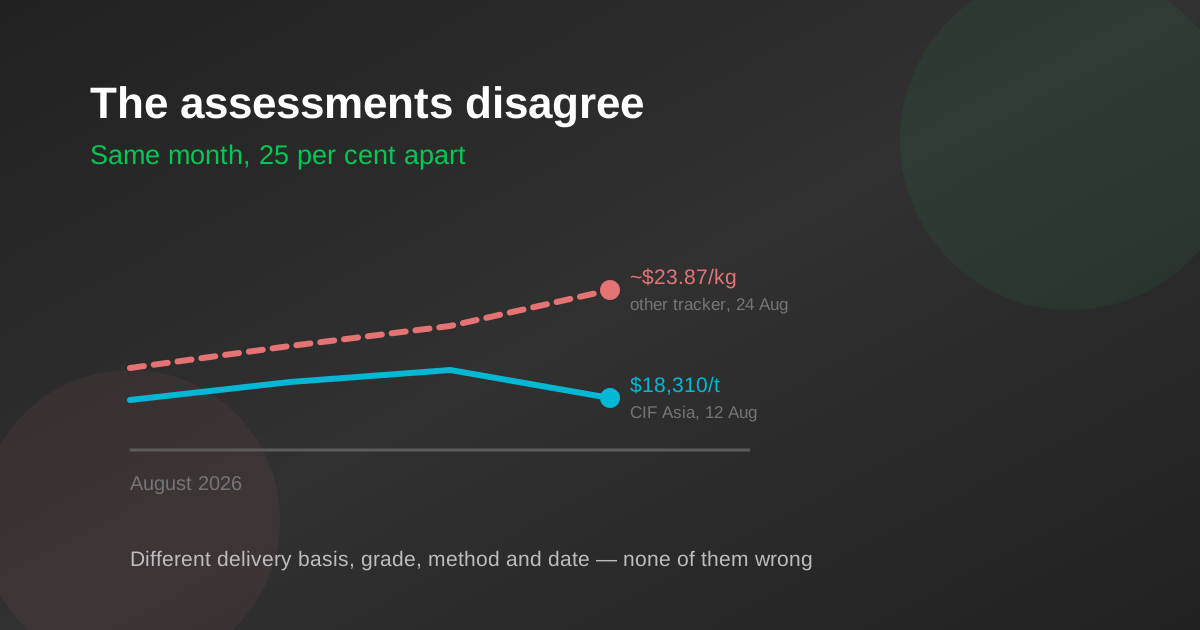
Benchmark had battery-grade carbonate at $18,310/t CIF Asia and falling. Another tracker had it near $23.87/kg and rising. Both are defensible, neither is a substitute for the other, and mixing them will manufacture a trend that does not exist.
Published: 27 August 2026
Industry · 7 min read
Where things stand
Written 27 August 2026. Lithium prices move daily — re-verify before relying on any figure here, and cite the assessment basis explicitly when you do.
We covered the rally itself earlier this month: lithium carbonate has roughly doubled off its mid-2025 low, and the arithmetic of what that adds to a pack is there rather than here.
This is about a different problem, which surfaced while checking those numbers. Published assessments for the same month disagree by more than 25 per cent, and they disagree about direction as well as level.
What the assessments say
Benchmark Mineral Intelligence assessed battery-grade lithium carbonate at $18,310 per tonne CIF Asia on 12 August 2026, down almost 5 per cent week on week, with spodumene concentrate at $2,038 per tonne FOB Australia, down more than 2 per cent. Benchmark attributed the weakness to bearish sentiment on 2027 oversupply, alongside building finished cell inventory and storage cell production outpacing installations.
Other trackers published materially higher figures for the same period, with one reporting a 5.4 per cent single-session rise on 24 August to around $23.87 per kilogram globally, citing energy storage demand and constrained supply.
That is a spread of more than 25 per cent between published assessments in the same month, pointing in opposite directions on momentum.
Why the divergence exists, and why it is not sloppiness
Assessments differ on several axes at once, and each difference is legitimate on its own terms.
- •Delivery basis. CIF Asia is a landed price including freight and insurance; a Chinese domestic ex-works price is neither. They are different goods at different points in a chain.
- •Grade. “Battery grade” covers a range of specifications, and the premium between them widens when the market is tight.
- •Methodology. Some assessments weight confirmed transactions; others incorporate indicative offers. In a thin market those diverge sharply.
- •Date within the month. A commodity moving several per cent a week does not have a monthly price, and any two assessments taken a fortnight apart are measuring different days.
- •Currency and unit. Chinese domestic prices quoted in yuan per tonne convert to numbers that look nothing like a CIF Asia dollar figure, before any of the above is considered.
None of these is wrong. They are measuring different things, and none of them is a proxy for the others.
The direction is not in dispute
Battery-grade carbonate traded around $8 per kilogram in May 2025. Every source has it well above that now. Fastmarkets has been reported as expecting elevated prices through 2027 before easing, arguing the market needs several years of stronger pricing to fund the next wave of greenfield mine development.
So the disagreement is about level and momentum, not about whether the rally happened. That matters, because level and momentum are exactly what a procurement decision turns on.
What it means downstream
Raw materials account for the majority of cell cost, and LFP uses lithium carbonate specifically rather than hydroxide — so a carbonate rally hits LFP cells directly, which in the Indian three-wheeler and storage markets means most cells.
Reporting through 2026 describes manufacturers absorbing raw material increases rather than passing them through, which compresses margins and defers rather than removes the price effect.
For anyone quoting battery prices forward, the practical implication is about quotation validity rather than price level. Cell suppliers have been shortening the period a quote stays good for — a price held for 90 days in 2024 may be held for 30 now, and in the storage market as little as fourteen days.
If you track this yourself
Name the assessment you are using, and stick to one basis. Mixing a CIF Asia dollar assessment one month with a Chinese domestic yuan price the next will manufacture a trend that does not exist — and it will do so in the direction of whichever source you happened to read most recently.
The same discipline applies to any commodity series, including the one behind our own commodity prices page. A figure without a stated basis is not a price; it is a number that resembles one.
Sources
Reporting this piece draws on. Figures were correct as published; scheme terms and commodity prices move.
- Lithium Prices — Lithium Carbonate & Hydroxide Price DataBenchmark Mineral Intelligence · 12 August 2026
- Lithium Price Watch: What the Forward Curve Is Telling Buyers Right NowBenchmark Source
- Battery raw materials monthly market update 2026Fastmarkets
- Lithium — price, chart and historical dataTrading Economics
Frequently asked questions
How far apart are the published lithium assessments?+
More than 25 per cent, and they disagree on direction too. Benchmark Mineral Intelligence assessed battery-grade lithium carbonate at $18,310 per tonne CIF Asia on 12 August 2026, down almost 5 per cent week on week, with spodumene at $2,038 per tonne FOB Australia. Other trackers published materially higher figures for the same period, with one reporting a 5.4 per cent single-session rise on 24 August to around $23.87 per kilogram.
Why do the assessments differ so much?+
Five reasons, all legitimate. Delivery basis — CIF Asia is a landed price including freight and insurance, a Chinese domestic ex-works price is not. Grade, since “battery grade” covers a range and the premium widens when the market is tight. Methodology, since some assessments weight confirmed transactions and others incorporate indicative offers. Date within the month, because a commodity moving several per cent a week does not have a monthly price. And currency and unit conversion. None of them is wrong; they measure different things.
Is the direction of the lithium market in dispute?+
No. Battery-grade carbonate traded around $8 per kilogram in May 2025 and every source has it well above that now. Fastmarkets has been reported as expecting elevated prices through 2027 before easing, on the argument that the market needs several years of stronger pricing to fund the next wave of greenfield mine development. The disagreement is about level and momentum — which is unfortunately what a procurement decision turns on.
What does this mean for anyone buying cells?+
The practical effect is on quotation validity rather than price level. Cell suppliers have been shortening the period a quote stays good for — a price held for 90 days in 2024 may be held for 30 now, and in the storage market as little as fourteen days. Raw materials are the majority of cell cost, and LFP uses carbonate specifically rather than hydroxide, so a carbonate rally hits LFP cells directly.
How should you track lithium prices without misleading yourself?+
Name the assessment you are using and stick to one basis. Mixing a CIF Asia dollar assessment one month with a Chinese domestic yuan price the next will manufacture a trend that does not exist, in the direction of whichever source you read most recently. The same discipline applies to any commodity series: a figure without a stated basis is not a price, it is a number that resembles one.
Want this applied to your own numbers?
Every solution page carries a calculator that shows its own arithmetic — storage savings, lithium against lead-acid, and home pack sizing.
Get in touch