Korea’s Biggest Storage Auction Scores Bidders on Where Their Materials Come From
South Korea is buying 1,180 MW of six-hour storage, more than double either earlier round, with half the score on non-price factors including domestic materials. LG Energy Solution, SK On and Samsung SDI are each pivoting to LFP to compete.
Published: 11 October 2026
Grid storage · 3 min read
What happened
Written 11 October 2026, on reporting by Financial News (Seoul) on 23 September and Korea JoongAng Daily on 30 September. Bidding was still open at the time of writing; no award has been made.
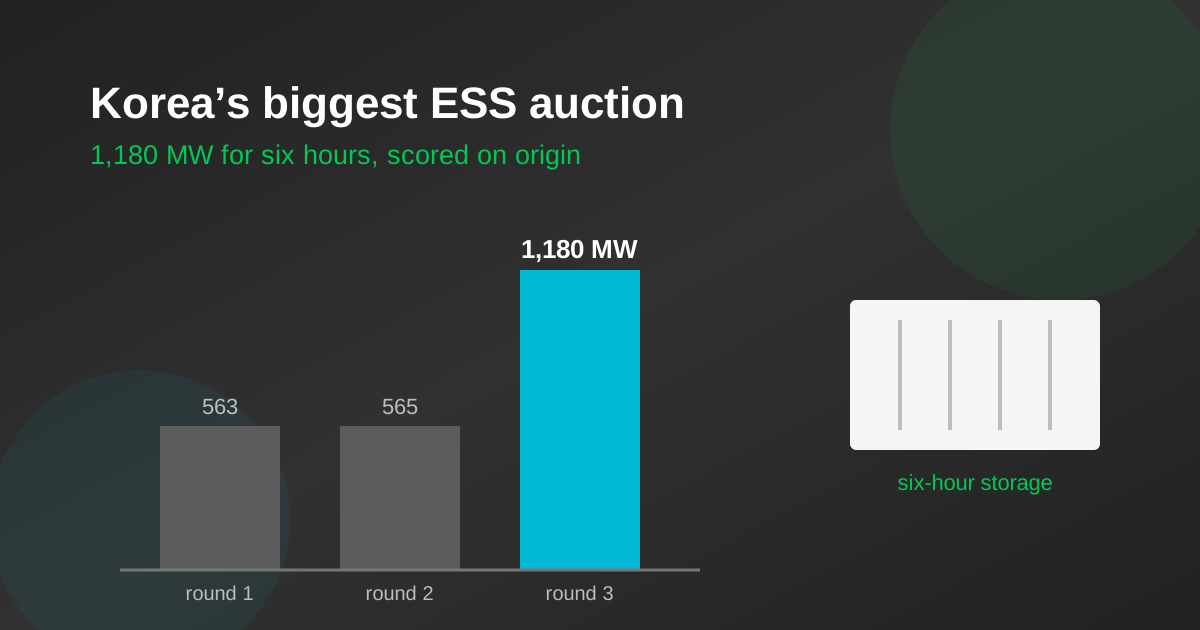
South Korea has opened the third round of its central contract market for energy storage, and it is the largest so far. Financial News reports that the Ministry of Climate, Energy and Environment and the Korea Power Exchange are seeking 1,180 MW: 1,100 MW on the mainland and 80 MW on Jeju. That is more than double each of the first two rounds, which Financial News puts at 563 MW and 565 MW.
Korea JoongAng Daily reports that the systems must sustain their full output for six hours, taking the round past 7 GWh — more than the first two combined. It puts the procurement at roughly 2 trillion won (US$1.47 billion), with bids open until 11 November, operators to be selected in November, and facilities due online by February 2029.
Price is only half the score
Both papers report a 50:50 split between price and non-price factors. According to JoongAng Daily, 25 of the non-price points turn on domestic manufacturing, supply-chain localisation and job creation. Financial News reports that bidders prove domestic contribution with certificates of origin for the cathode, anode, separator and electrolyte, alongside their cell and packaging capacity.
The scoring rewards where the materials come from, not just where the cell is assembled. It is aimed at a supply chain in which, JoongAng Daily notes, Korean makers have relied on China for LFP materials, including cathode.
Three makers, three LFP pivots
Lithium iron phosphate (LFP) has become the dominant storage chemistry, and Korea’s three cell makers, built around nickel-based EV cells, are each moving towards it:
- •LG Energy Solution won the smallest share of the first two rounds (14 per cent of round two, per both papers). JoongAng Daily reports it proposed sourcing some LFP cells from its Nanjing plant last time; this time it plans to make the entire supply in Ochang and, in its words, “for the first time, all four core materials used in our LFP batteries will come from Korean suppliers”
- •SK On took 284 MW, or 50.3 per cent, of round two. It is converting 3 GWh of its 7 GWh Seosan plant to LFP storage lines, with pilot production at year-end, and has signed LFP cathode supply deals with L&F (about 160 billion won) and Posco Future M (about 1.07 trillion won), JoongAng Daily reports
- •Samsung SDI, which JoongAng Daily says won about 76 per cent of round one, bid nickel-cobalt-aluminium cells from Ulsan in both earlier rounds. It has not decided between that chemistry and LFP this time, and is converting some Ulsan lines to LFP
Abroad, Financial News describes LG Energy Solution as the only non-Chinese company mass producing LFP storage cells, with production in Nanjing since 2024 and now also in Michigan, and an order backlog of more than 100 GWh.
What it means for this business
The Korean tender does not touch the Indian market directly. What it shows is a second country besides China building LFP storage cells and their materials at scale, with public procurement used to pull the supply chain home.
- •More non-Chinese LFP capacity is, over time, more choice for Indian buyers of grid and commercial and industrial storage; how much of it will be offered for export is not yet clear
- •Scoring on material origin rather than cell origin is a model India’s own storage and cell policies could be measured against
- •Six-hour duration and safety scoring point to where utility specifications are heading, beyond the two- and four-hour systems common today
- •None of this changes near-term cell prices for an Indian buyer; those still follow Chinese supply
For the Indian side of the cell gap, see India’s BESS cell manufacturing gap and how LFP rose with China’s battery strategy; for factory storage, see our battery storage page.
Sources
Reporting this piece draws on. Figures were correct as published; scheme terms and commodity prices move.
- Domestic sourcing becomes key battleground in Korea’s biggest ESS projectKorea JoongAng Daily · 30 September 2026
- 'Largest Ever' ESS Bidding Begins... LG Ensol Aims for Revenge on Home GroundFinancial News · 23 September 2026
Terms in this article
Frequently asked questions
What is Korea’s third ESS central contract market round?+
A government auction for 1,180 MW of battery storage, 1,100 MW on the mainland and 80 MW on Jeju, that must sustain full output for six hours. Korea JoongAng Daily puts it at over 7 GWh and roughly 2 trillion won, with bids open until 11 November and facilities due online by February 2029.
How are bids scored?+
Price and non-price factors are weighted 50:50. Korea JoongAng Daily reports that 25 points turn on domestic manufacturing, supply-chain localisation and job creation, and Financial News reports that bidders prove domestic contribution with certificates of origin for cathode, anode, separator and electrolyte.
Who won the earlier rounds?+
Korea JoongAng Daily reports that Samsung SDI won about 76 per cent of round one. In round two, SK On took 284 MW (50.3 per cent), Samsung SDI 35.7 per cent and LG Energy Solution 14 per cent, according to both Korea JoongAng Daily and Financial News.
Is storage right for your site?
Send us a month of electricity bills and your load profile, and we will tell you what a battery would save — including when it would not pay.