How LFP Went From Also-Ran to Default
The industry agreed that energy density was the metric that mattered. One set of manufacturers optimised something else entirely, then re-engineered packs until the original metric mattered less.
Published: 15 August 2026
Industry · 7 min read
A chemistry that was written off
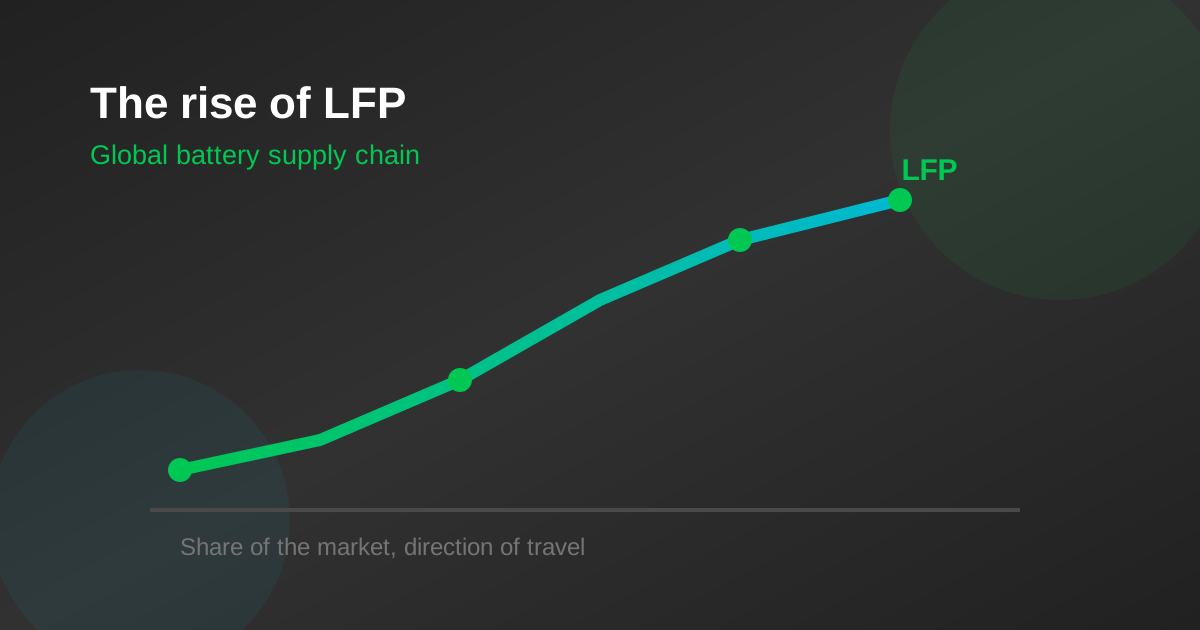
For much of the 2010s, lithium iron phosphate was treated as the budget option. It stored less energy per kilogram than nickel-based chemistries, so it lost on the specification that the industry had decided mattered most: range per kilo.
Western and Korean manufacturers largely moved up the nickel ladder in pursuit of energy density. Chinese manufacturers kept developing LFP. That divergence turned out to be one of the most consequential strategic calls in the industry.
Why LFP won more ground than expected
- •No cobalt, no nickel. It removes exposure to the two most price-volatile and most ethically fraught inputs in the chain. That is a cost advantage and a supply-risk advantage at once.
- •Longer cycle life. For commercial duty and for stationary storage, cycles matter far more than weight. LFP wins that comparison decisively.
- •Better thermal stability. Safer behaviour under abuse, which matters more as fleets scale and as regulators pay attention.
- •Pack-level engineering closed the gap. Cell-to-pack designs removed module structure and recovered much of the volumetric penalty, so the density disadvantage at cell level shrank at pack level — where it actually matters.
The last point is the one outsiders missed. The industry compared cells. The advantage was engineered at the pack.
The patent timing
Key foundational patents covering LFP expired in the early 2020s. Before that, manufacturing LFP outside China involved licensing complications that discouraged investment. Afterwards, the barrier fell away — but by then Chinese producers had a decade of process experience, existing lines, and an established cathode supply chain.
Legal freedom to operate arrived long after the practical ability to compete had been lost. That gap is the lesson.
What it means for stationary storage
For grid and commercial storage, weight and volume are close to irrelevant. Cycle life, safety and cost per kWh are everything. LFP is therefore not merely competitive in that application — it is the obvious answer, which is why it dominates new stationary deployment.
Our piece on grid-scale storage covers why that application has different priorities from vehicles.
What it means for Indian buyers
For e-rickshaws, commercial three-wheelers and commuter two-wheelers in Indian ambient temperatures, the LFP trade-off is close to ideal: the weight penalty is tolerable, and the cycle life and thermal stability are exactly what hard daily duty in heat requires.
That is why it dominates this segment, and why our chemistry comparison points most commuter and commercial buyers towards it.
The caveat remains what it always was: chemistry is necessary, not sufficient. A poorly built LFP pack with a weak BMS is worse than a well-built NMC one. Ask for the specification, not the acronym.
Frequently asked questions
Why did LFP become so popular?+
It removes cobalt and nickel, so it avoids the most price-volatile and ethically fraught inputs; it delivers longer cycle life, which matters more than weight for commercial and stationary use; it is more thermally stable; and cell-to-pack engineering recovered much of its volumetric disadvantage at the pack level, where it actually counts.
Is LFP better than NMC?+
For commuter and commercial vehicles in hot climates, and for stationary storage, generally yes — cycle life and thermal stability matter more there than energy per kilogram. For performance vehicles and tight packaging where weight dominates, NMC still has the edge. Neither is universally better; the application decides.
Why was LFP not used more widely earlier?+
Partly because the industry optimised for energy density, where LFP lost, and partly because key foundational patents restricted manufacturing outside China until they expired in the early 2020s. By the time that barrier fell, incumbents had a decade of process experience and an established cathode supply chain.
Thinking about upgrading?
Talk to our team about the right pack for your vehicle, and about EMI options that keep the monthly outgo close to what you already spend.
Get in touch