Europe’s Storage Industry Asks for Tougher Cyber Checks on the Battery’s Control Layer
Energy Storage Europe wants battery management, power conversion and energy management systems classed as critical products under the Cyber Resilience Act, with third-party assessment.
Published: 11 October 2026
Policy · 3 min read
The industry asks for stricter rules on itself
Written 11 October 2026, on Energy Storage Europe’s September 2026 policy paper “Cybersecurity in Battery Energy Storage Systems”, and on the EU’s restriction of funding for high-risk inverter suppliers as reported by Euronews and pv magazine (4 May 2026).
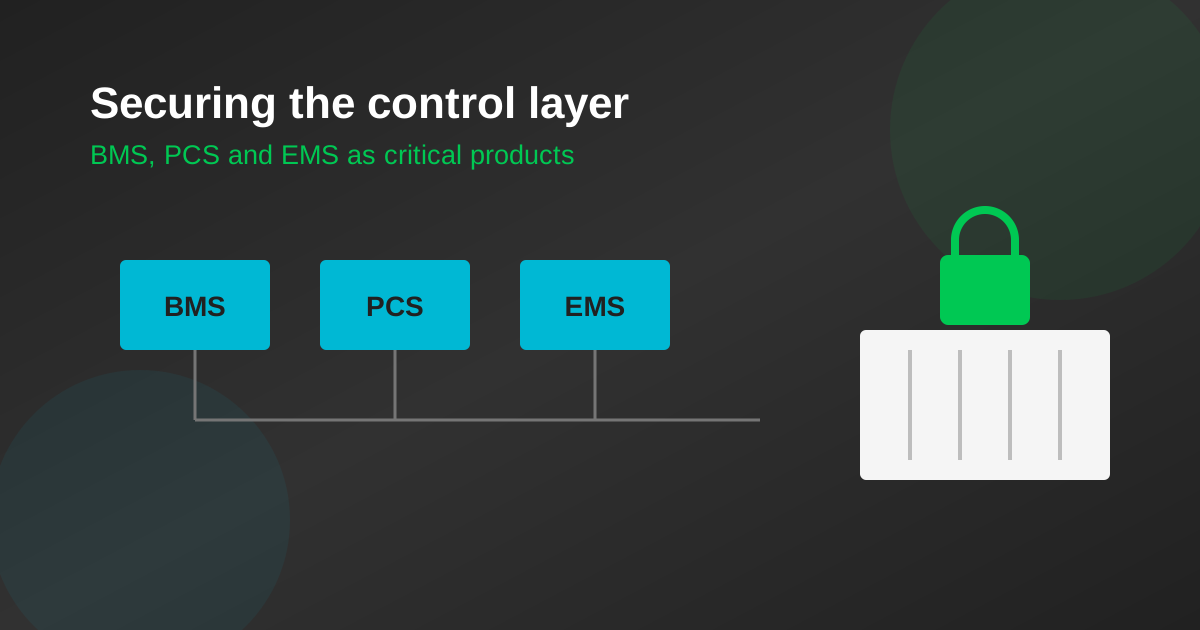
It is unusual for a trade body to ask for tougher certification of its own products. In a policy paper published in September, Energy Storage Europe, the EU storage industry association, does exactly that. It wants the three control systems inside a battery installation, the battery management system (BMS), the power conversion system (PCS) and the energy management system (EMS), reclassified as “Critical” products under the EU’s Cyber Resilience Act. That would move them to third-party conformity assessment rather than self-declaration.
The reasoning is about scale and role. The paper puts battery storage deployment at 50 GW today and projects 200 GW by 2030. Batteries now “regulate the grid in real time”, providing frequency response, balancing, black start and grid-forming services.
Not more vulnerable, but faster to fail
The paper does not claim that batteries are especially weak. It says they are not inherently more vulnerable than other grid-connected equipment, but that “control-layer failures can escalate rapidly to grid-stability events.” A battery can swing from full import to full export in seconds; a compromised controller can do the same.
The rest of its asks are about making the existing rules workable:
- •Harmonise connectivity requirements for distribution-level storage across the Single Market, ending country-specific configurations
- •Publish joint guidance on NIS2 and the Network Code on Cybersecurity, so operators are not audited twice for the same thing
- •Close accountability gaps for legacy assets, outsourced operations, project-company structures and manufacturers with no EU legal entity
- •Allow transition periods of at least one year, reflecting asset lives of 15 to 20 years
The supplier question underneath
The paper lands in a debate about where equipment comes from. In May, Euronews and pv magazine reported that the European Commission would restrict EU funding, including through the European Investment Bank, for projects using inverters from “high-risk” suppliers in China, Russia, Iran and North Korea. pv magazine reported that battery storage power conversion systems are covered, standalone and co-located.
Euronews put Chinese manufacturers at an estimated 80 per cent of the global inverter market. It reported that projects at an advanced stage by 1 November 2026 would be assessed under the old framework, with new contracts fully subject to the restrictions from April 2027.
Where the industry draws the line. Energy Storage Europe asks that “non-technical risk” in the proposed Cybersecurity Act 2.0 be defined by ownership, jurisdiction and state-compelled access, “not supplier location alone”, and that technical mitigations earn credit. In other words: test the product and the control over it, rather than ban by passport.
What it means for this business
India’s storage fleet is far smaller and its rules different, and nothing here binds an Indian project. But the paper is a useful checklist for anyone buying a connected battery system, at any scale.
- •Ask who can reach the controller remotely, from where, and under whose authority. The BMS, PCS and EMS are the attack surface, not the cells
- •Ask what happens to remote access and software updates if the supplier exits the market or has no local entity
- •For a C&I system that only shaves peaks behind the meter, the grid-level risk is smaller, but the same controls decide whether the system keeps the factory running
Cyber is one layer of a wider safety picture. For the physical side, see our coverage of India’s BESS safety rules from April 2027 and of the 2026 edition of NFPA 855, and our commercial storage page.
Sources
Reporting this piece draws on. Figures were correct as published; scheme terms and commodity prices move.
- Cybersecurity in Battery Energy Storage SystemsEnergy Storage Europe · September 2026
- EU moves to ban high-risk inverters from China over cybersecurity threatsEuronews · 4 May 2026
- EU funding ban on high-risk inverters, including Chinese suppliers, extends to BESSpv magazine · 4 May 2026
Terms in this article
Frequently asked questions
What is Energy Storage Europe asking for?+
In a September 2026 policy paper, the trade body asks for battery management, power conversion and energy management systems to be reclassified as Critical products under the EU Cyber Resilience Act, which would require third-party conformity assessment. It also wants harmonised connectivity rules and joint NIS2 and network-code guidance.
Are batteries more vulnerable to cyber attack than other grid equipment?+
The paper says they are not inherently more vulnerable, but that control-layer failures can escalate rapidly to grid-stability events. It puts battery storage at 50 GW today, projected to reach 200 GW by 2030.
Does the EU restrict Chinese inverters in battery storage projects?+
For EU-funded projects, yes. Euronews and pv magazine reported in May 2026 that the Commission is restricting EU funding for projects using inverters from high-risk suppliers in China, Russia, Iran and North Korea, and that battery storage power conversion systems are covered.
Want this applied to your own numbers?
Every solution page carries a calculator that shows its own arithmetic — storage savings, lithium against lead-acid, and home pack sizing.