NFPA 855’s 2026 Edition Removes the Exemptions
Hazard mitigation analysis is now required for every installation, explosion control must meet NFPA 69, and a new clause demands backup power for the safety systems themselves. It has no legal force in India and Indian projects will comply anyway.
Published: 24 August 2026
Grid storage · 8 min read
Where things stand
Written 24 August 2026, on the 2026 edition of NFPA 855 as released and summarised by the NFPA and by engineering commentators.
The National Fire Protection Association has released the 2026 edition of NFPA 855, the standard for the installation of stationary energy storage systems. It is the most consequential revision the document has had, and the direction of travel is consistent throughout: fewer exemptions, more testing, and an assumption that the safety system itself can fail.
NFPA 855 is a United States standard and has no direct legal force in India. It matters here anyway, because it is what international insurers, lenders, EPC contractors and multinational site owners reach for when nothing local is specific enough, and because Indian practice has generally followed it with a lag.
What changed
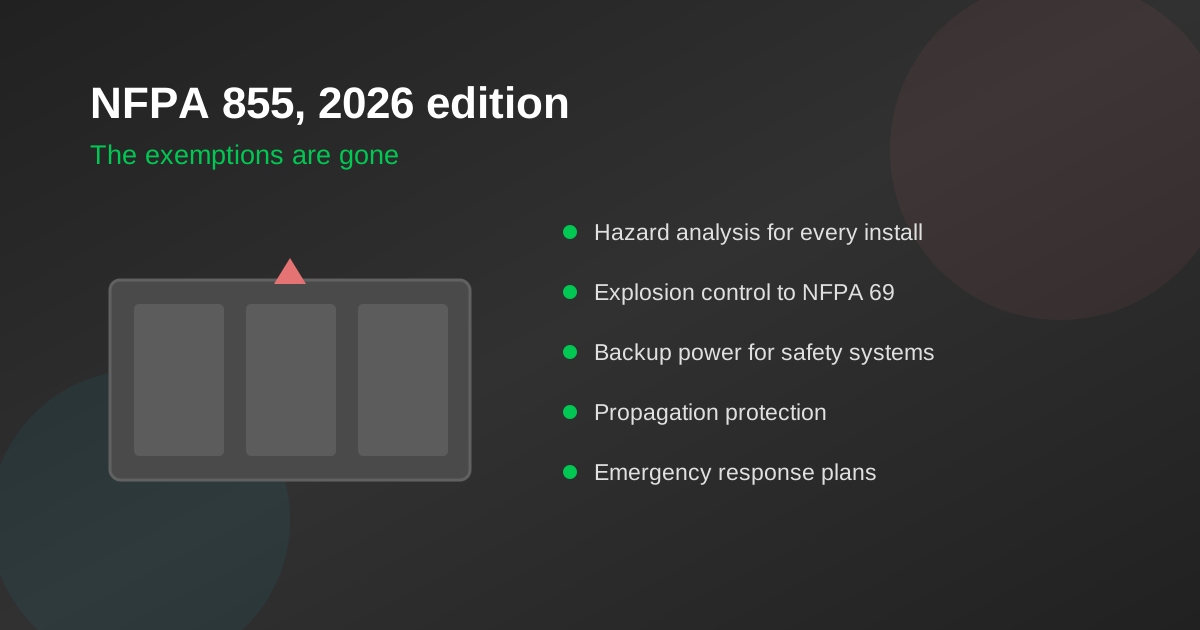
- •Hazard Mitigation Analysis is now required for all installations. Previous editions carved out exemptions for systems meeting certain test criteria; the 2026 edition removes them. If you are installing storage, you are doing an HMA.
- •Explosion control becomes explicit. Installations are required to incorporate explosion control and prevention designed to NFPA 69, or a performance-based alternative justified by installation-level fire and explosion testing. Deflagration venting as an afterthought is no longer the default answer.
- •Critical safety systems need their own power. A new Section 4.10 requires reliable backup for safety-critical functions through emergency or stored emergency power supply systems built to NFPA 110 or NFPA 111 — so detection, suppression and ventilation cannot silently stop working during the grid outage that a battery site exists to ride through.
- •Thermal runaway propagation protection is addressed directly, with recommendations for systems intended to stop a single-cell event becoming a module or rack event.
- •Emergency response planning is now a project requirement rather than a document produced afterwards, which puts the local fire service into the design conversation.
- •The scope widens beyond lithium. Iron-air, nickel-hydrogen, zinc-bromide, hybrid supercapacitor and lithium-metal chemistries are brought in, as are EV charging installations that integrate storage.
- •Fire detection, suppression and separation distance requirements are tightened, and large-scale fire testing provisions are expanded.
The theme underneath the changes
Read the revision as a whole and one assumption runs through it: the standard has stopped treating a battery installation as a piece of electrical equipment that might catch fire, and started treating it as a process hazard.
That is a meaningful shift. Electrical safety asks whether a component is rated correctly and protected. Process safety asks what happens when the protection fails, what the consequence envelope looks like, who responds, whether they can, and whether the systems they depend on are still powered when they arrive. The move to mandatory hazard analysis, explosion control, backup power for safety systems and pre-agreed emergency response is exactly the vocabulary of the second discipline.
The most quietly demanding clause is the backup power requirement. It closes a failure mode that has embarrassed real projects: a site loses grid supply, the safety and monitoring layer loses power with it, and the one system nobody wanted blind is blind at the worst moment.
What it means for Indian projects
Nobody in India is obliged to comply. Several categories of project will end up complying anyway.
- •Anything with international insurance or overseas lenders. Underwriters converge on the most recent recognised standard, and once the 2026 edition is the reference, a design justified against an older one requires an argument.
- •Utility-scale storage procured competitively. Large tenders import fire, protection and testing requirements into contract schedules, and those schedules are usually written from international standards.
- •Commercial and industrial sites owned by multinationals, where group HSE policy typically names an external standard rather than a local one.
- •Anyone specifying a system that has to still be defensible in a decade. Standards ratchet in one direction, and retrofitting explosion control into a commissioned site is considerably more expensive than designing it in.
The practical takeaway for a buyer is to ask which edition a proposal is written against and to be sceptical of a bid that is silent on hazard analysis, propagation testing and emergency response. Our explainer on BESS fire safety standards covers what the underlying tests actually demonstrate and where the gaps between certificate and installed reality usually sit.
Sources
Reporting this piece draws on. Figures were correct as published; scheme terms and commodity prices move.
- National Fire Protection Association releases NFPA 855 ESS safety standard, 2026 editionEnergy-Storage.News
- NFPA 855 (2026 Edition) — What’s New for Battery Energy Storage SystemsEngineering Fire Protection
- NFPA 855 Expands Safety Guidelines for Battery Energy Storage SystemsExponent
- Battery Energy Storage System Safety — policy resourceSolar Energy Industries Association · April 2026
Frequently asked questions
What changed in the 2026 edition of NFPA 855?+
The main changes are that hazard mitigation analysis is now required for all installations with previous exemptions removed; explosion control and prevention must be designed to NFPA 69 or a performance-based alternative backed by installation-level fire and explosion testing; a new Section 4.10 requires backup power for critical safety systems via emergency or stored emergency power supplies built to NFPA 110 or NFPA 111; thermal runaway propagation protection and project emergency response plans are addressed directly; and the scope widens to non-lithium chemistries such as iron-air, nickel-hydrogen, zinc-bromide and lithium metal, plus EV charging installations that integrate storage.
Does NFPA 855 apply in India?+
It has no direct legal force here. It matters anyway because international insurers, overseas lenders, EPC contractors and multinational site owners reach for it when nothing local is specific enough, and because large competitive tenders import fire, protection and testing requirements into contract schedules that are usually drafted from international standards.
Why does the standard now require backup power for safety systems?+
To close a real failure mode: a site loses grid supply, and the detection, suppression and ventilation controls lose power along with it, leaving the safety layer blind precisely during the outage a battery site exists to ride through. Section 4.10 requires those functions to have reliable emergency or stored emergency power built to NFPA 110 or NFPA 111.
What should a buyer ask a BESS supplier about safety?+
Which edition of the standard the design is written against, whether a hazard mitigation analysis has been done for this specific installation rather than the product generally, what large-scale propagation testing the enclosure has passed, how explosion control is achieved and justified, whether safety-critical systems have their own power supply, and whether an emergency response plan has been agreed with the local fire service. A bid silent on those points is quoting a different product.
Want this applied to your own numbers?
Every solution page carries a calculator that shows its own arithmetic — storage savings, lithium against lead-acid, and home pack sizing.
Get in touch