China Awarded 53.6 GWh of Storage in October as Four-Hour Bids Rose 17%
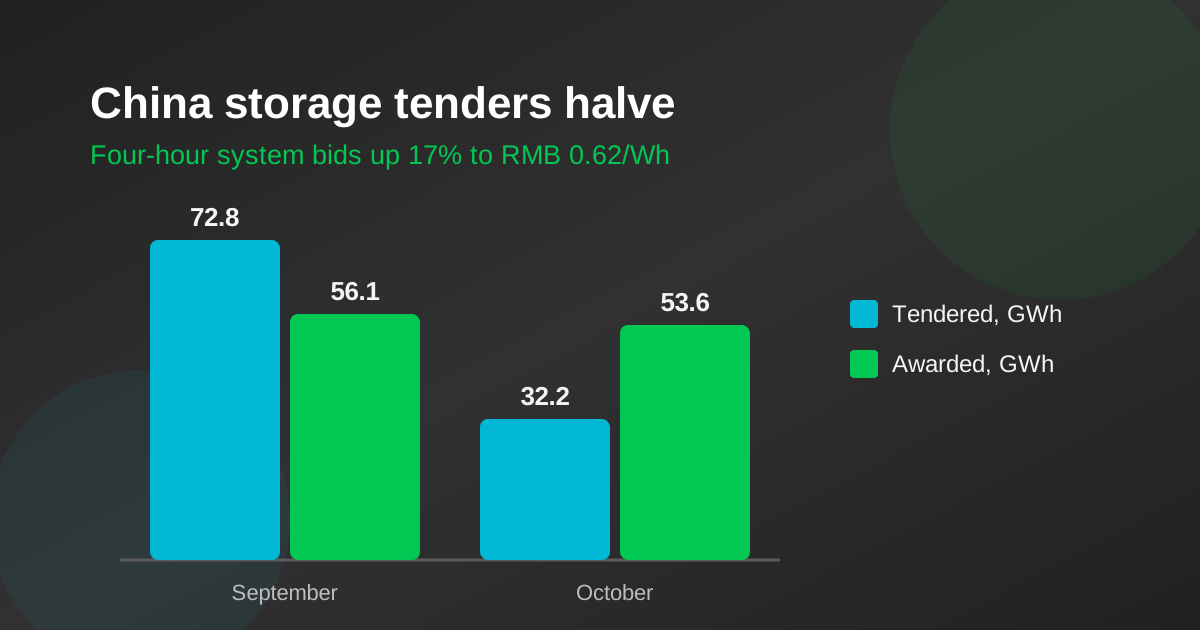
Chinese buyers awarded 53.6 GWh of storage contracts in October, TrendForce data show, and the average four-hour system bid rose 17 per cent to RMB 0.62 per Wh even as lithium fell. New tenders more than halved.
Published: 20 November 2026
Grid storage · 3 min read
What happened
Written 20 November 2026, on TrendForce’s monthly tender tallies published by EnergyTrend on 9 November (October) and 16 October (September), and SMM’s report of 16 October on CNNC’s storage procurement, with InfoLink’s lithium price update of 28 October.
Chinese buyers awarded 15.6 GW and 53.6 GWh of energy storage contracts in October, according to TrendForce data published by EnergyTrend. That is down 7 per cent in energy terms on September. Turnkey (EPC) projects made up more than 80 per cent of it, led by a single 6 GWh project in Inner Mongolia and a 4 GWh project in Ningxia.
The price of four-hour storage systems moved the other way. The weighted average winning bid for a four-hour system was RMB 0.62 per Wh, up 17 per cent on September, within a range of RMB 0.51 to 0.83.
Prices by product
TrendForce’s October weighted averages, with the change on September:
- •Four-hour storage system: RMB 0.62/Wh, up 17 per cent
- •Two-hour storage system: RMB 0.58/Wh, down 2 per cent
- •Four-hour EPC project: RMB 0.88/Wh, up 12 per cent
- •Two-hour EPC project: RMB 1.00/Wh, down 2 per cent
A month earlier the picture was the reverse. TrendForce put September’s four-hour system average at RMB 0.53/Wh, down 12 per cent, and the two-hour average at RMB 0.60/Wh, down 21 per cent. These are weighted averages over a handful of system awards each month, so a single large contract can move them a long way. Two months make a wobble, not a trend.
One large award gives a firmer reading. SMM reports that China National Nuclear Corporation named five winners on 14 October for its 2.98 GWh LFP storage procurement for 2026–2028: Sungrow, CATL, Zhongtian Energy Storage, CRRC Zhuzhou Institute and Kehua. Bids from the 33 bidders ranged from RMB 0.4995 to 0.5329 per Wh, for two- and four-hour systems.
New tenders halved
The pipeline behind those awards thinned sharply. New tenders in October were 11.2 GW and 32.2 GWh, down 55 per cent in energy terms on September, when TrendForce counted 72.84 GWh. EnergyTrend puts the fall in system tenders down mainly to a lack of large centralised or framework procurements. Ningxia led new EPC tenders with 6 GWh; Inner Mongolia, Xinjiang and Shanxi each topped 2.5 GWh.
Independent storage, the kind that earns from the grid rather than sitting beside a solar or wind farm, was 67 per cent of October’s tendered capacity. Commercial and industrial storage was about 1 per cent.
Lithium carbonate fell through October, on InfoLink’s figures; four-hour system bids rose. Chinese system prices are being set by contract mix and project demand, not by the raw material alone.
What it means for this business
Wingzman sells commercial storage and LiFePO4 packs in India, built mostly on imported Chinese cells. Chinese domestic bid prices are, in practice, the floor under export quotes, so they are worth watching even though Indian buyers never pay them directly:
- •Chinese four-hour system bids have stopped falling for now, despite cheaper lithium, so a lower lithium price is not on its own a reason to expect cheaper containers
- •Independent grid storage dominates Chinese tenders; commercial and industrial storage is a small, separate market there, as it is in India
- •A halving of new tenders in one month is worth watching: if it persists, Chinese makers may push harder for export orders in 2027
For how system prices differ by market, see turnkey storage prices across markets; for the lithium side of the story, see lithium carbonate’s fall and the lag in storage cells. Why duration matters to a price per Wh is covered in sizing a storage plant by power, energy and duration.
Sources
Reporting this piece draws on. Figures were correct as published; scheme terms and commodity prices move.
- Energy Storage Projects Awarded in October Total 53.6 GWh; Average Price for 4-Hour Systems RisesEnergyTrend (TrendForce) · 9 November 2026
- Storage Tenders Hit 72.84 GWh in September; EPC Awarded Volume Hits New High for the YearEnergyTrend (TrendForce) · 16 October 2026
- Energy storage: Sungrow, CATL among five winners of CNNC 2.98GWh storage procurementShanghai Metals Market (SMM) · 16 October 2026
- Lithium salt prices weaken amid fluctuations; cell prices dip; ESS prices steady for nowInfoLink Consulting · 28 October 2026
Terms in this article
Frequently asked questions
What did four-hour storage systems sell for in China in October 2026?+
TrendForce data published by EnergyTrend put the weighted average winning bid for four-hour storage systems at RMB 0.62 per Wh in October, up 17 per cent on September, within a range of RMB 0.51 to 0.83. Two-hour systems averaged RMB 0.58 per Wh.
Why did new tenders fall?+
New tenders were 32.2 GWh in October, down 55 per cent on September’s 72.84 GWh. EnergyTrend attributes the fall in system tenders mainly to a lack of large centralised or framework procurements in the month.
Do Chinese bid prices affect what Indian buyers pay?+
Not directly, since Indian buyers pay export prices. But Chinese domestic bids are in practice the floor under export quotes, and October showed system prices can rise even while lithium carbonate falls.
Is storage right for your site?
Send us a month of electricity bills and your load profile, and we will tell you what a battery would save — including when it would not pay.