Turnkey Storage Fell 31 Per Cent to $117/kWh. In America It Is $219.
BloombergNEF and Ember agree on the global average within seven per cent. They also show a three-fold spread between China, Europe and the United States on identical technology — and the gap is not the battery.
Published: 26 August 2026
Industry · 8 min read
Where things stand
Written 26 August 2026. The survey figures below are full-year 2025 assessments published at the end of that year. They describe where prices landed, not where a quotation you receive this month will land — see the last section.
BloombergNEF’s annual cost survey put the global average price of a turnkey battery energy storage system at US$117 per kWh in 2025, a fall of about 31 per cent in a single year. Ember, working the problem separately, assessed a complete grid-connected system at roughly US$125 per kWh as of October 2025 for four-hour-plus utility-scale projects in markets outside China and the United States.
Two houses, two methods, answers within seven per cent of each other. That agreement is worth more than either number on its own.
The average hides the story
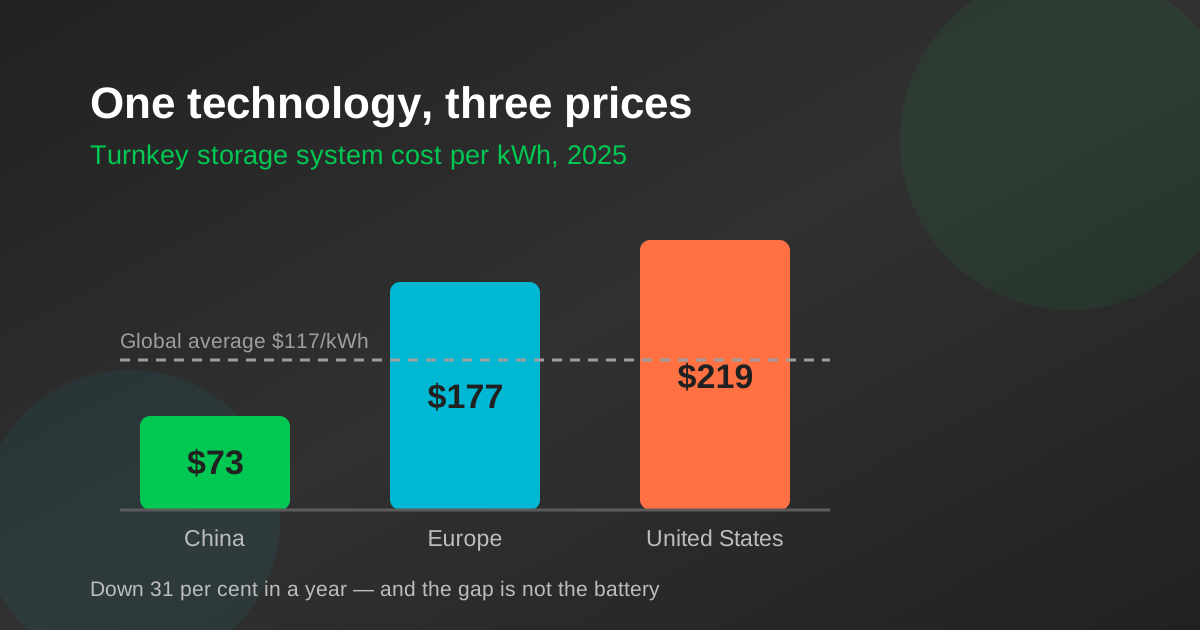
Underneath the US$117 global average sit three very different markets. BNEF put turnkey system prices at about US$73 per kWh in China, US$177 per kWh in Europe and US$219 per kWh in the United States.
That is a three-fold spread on the same technology, in the same year, largely from the same cell suppliers. Whatever explains it, it is not the battery.
Ember’s breakdown says what it is. Of their US$125 per kWh, roughly US$75 is core equipment shipped from China — the enclosure, the power conversion system, the energy management system — and roughly US$50 is installation and grid connection. The equipment half is a globally traded good and prices much the same everywhere. The other half is local labour, local civils, local permitting, local grid queues and local tariffs, and that is where the markets diverge.
A battery system is not one purchase. It is a traded commodity bolted to a local construction project, and the local half is what separates a US$73 market from a US$219 one. It is also the half a buyer can actually negotiate.
Where India sits
India buys the equipment half at close to the low end of that range and then adds freight, customs duty, and — on grid-scale tenders — a domestic content requirement. It does not add American or European labour rates. So the landed number should sit well below the US and European figures and above the Chinese one, which broadly matches what Indian tenders have been clearing at.
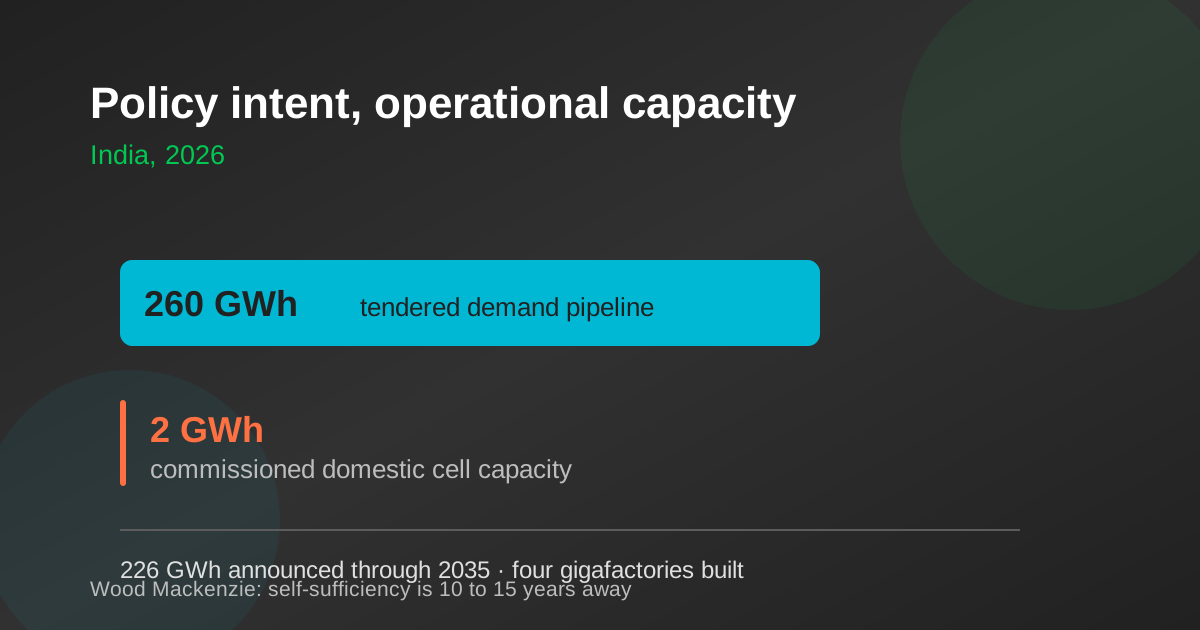
The domestic content requirement is the part worth watching, because it is a deliberate decision to pay more now for capacity later. Wood Mackenzie has put the cost of taking a 100 MW two-hour project from the current 20 per cent domestic content to 100 per cent at roughly 30 per cent on total capital cost. That is the price of the industrial policy, and it is covered in our note on the gap between India’s tender pipeline and its cell capacity.
Why this does not contradict the price rises
We wrote two days ago that cell quotations have shortened to fourteen days and that near-term system prices are expected to rise. Both things are true, and holding them together is the whole skill of reading this market.
- •Different periods. The survey figures are full-year 2025. The tightness is 2026. A steep fall followed by a modest rise is an ordinary shape for a commodity-linked product, and it is not a contradiction.
- •Different layers. Cells are under 40 per cent of a turnkey system in reported European builds. Cell prices can rise while system prices fall, if the non-cell half is falling faster — which is exactly what larger cell formats and better integration have been doing.
- •Averages lag. An annual average is made of contracts signed months earlier. It tells you what the market cleared at, not what it is offering today.
What a buyer should take from it
- •Ask which of the two halves a quotation is competing on. A supplier who is cheap on equipment and vague on installation, civils and connection has not quoted the expensive half.
- •Do not benchmark an Indian quotation against a headline global average. The average is an artefact of mixing a US$73 market with a US$219 one, and it describes nobody.
- •Treat a survey number as a sanity check, not a target. If a bid is far below the band for your market, the difference is in scope, warranty or cell grade, and it is worth finding out which before signing.
- •For behind-the-meter systems the local half is proportionally larger, not smaller. A factory rooftop or a basement plant room is a construction project with a battery in it.
None of this changes the direction of travel. Storage has become dramatically cheaper and is still getting cheaper in the places that have learned to build it. The lesson from the spread is simply that the learning is local, and that a country importing the hardware still has to do its own half of the work.
Sources
Reporting this piece draws on. Figures were correct as published; scheme terms and commodity prices move.
- Battery storage system prices continue to fall sharply, BNEF and Ember reports findEnergy-Storage.News
- Energy Storage Systems Cost Survey 2025BloombergNEF
- How cheap is battery storage?Ember · December 2025
- India's battery storage self-sufficiency remains over a decade awayWood Mackenzie · 20 August 2026
Frequently asked questions
How much does a battery storage system cost per kWh in 2026?+
BloombergNEF put the global average turnkey system price at about US$117 per kWh for 2025, down roughly 31 per cent in a year, and Ember independently assessed a complete grid-connected four-hour system at about US$125 per kWh as of October 2025 outside China and the United States. Both are full-year 2025 assessments, so treat them as a sanity check on a 2026 quotation rather than a current offer price.
Why does the same battery system cost three times more in America than in China?+
Because roughly 40 per cent of the cost is not the battery. Ember splits a US$125 per kWh system into about US$75 of core equipment shipped from China — enclosure, power conversion system, energy management system — and about US$50 of installation and grid connection. The equipment half is a traded good and prices similarly everywhere. The other half is local labour, civils, permitting, grid queues and tariffs, and that is where a US$73 per kWh market and a US$219 per kWh market diverge.
Where does India sit on that range?+
Between the two, and closer to the low end. India buys the equipment half near Chinese prices and adds freight and customs, but not American or European labour rates. It then adds a domestic content requirement on grid-scale tenders, which is a deliberate decision to pay more now in exchange for domestic capacity later.
Storage prices fell 31 per cent, so why are suppliers quoting increases?+
The survey figures are full-year 2025 and the tightness is 2026 — different periods. They are also different layers: cells are under 40 per cent of a turnkey system, so cell prices can rise while system prices fall if larger formats and better integration are pulling the other 60 per cent down faster. An annual average is built from contracts signed months earlier and always lags what is being offered today.
Want this applied to your own numbers?
Every solution page carries a calculator that shows its own arithmetic — storage savings, lithium against lead-acid, and home pack sizing.
Get in touch