Two in Three New Cars Sold in China Are Electric. Fewer Cars Are Being Sold.
New energy vehicles took a record 67.5 per cent of China’s car retail sales in October, and 74.9 per cent in early November. The share rose because petrol car sales roughly halved; electric sales themselves fell for a tenth straight month.
Published: 20 November 2026
Mobility · 3 min read
What happened
Written 20 November 2026, on China Passenger Car Association (CPCA) data for October as reported by CnEVPost on 9 and 10 November and Yicai Global on 11 November, China Association of Automobile Manufacturers (CAAM) data reported by CnEVPost on 11 November, and CPCA’s figures for 1–8 November, reported by CnEVPost on 11 November.
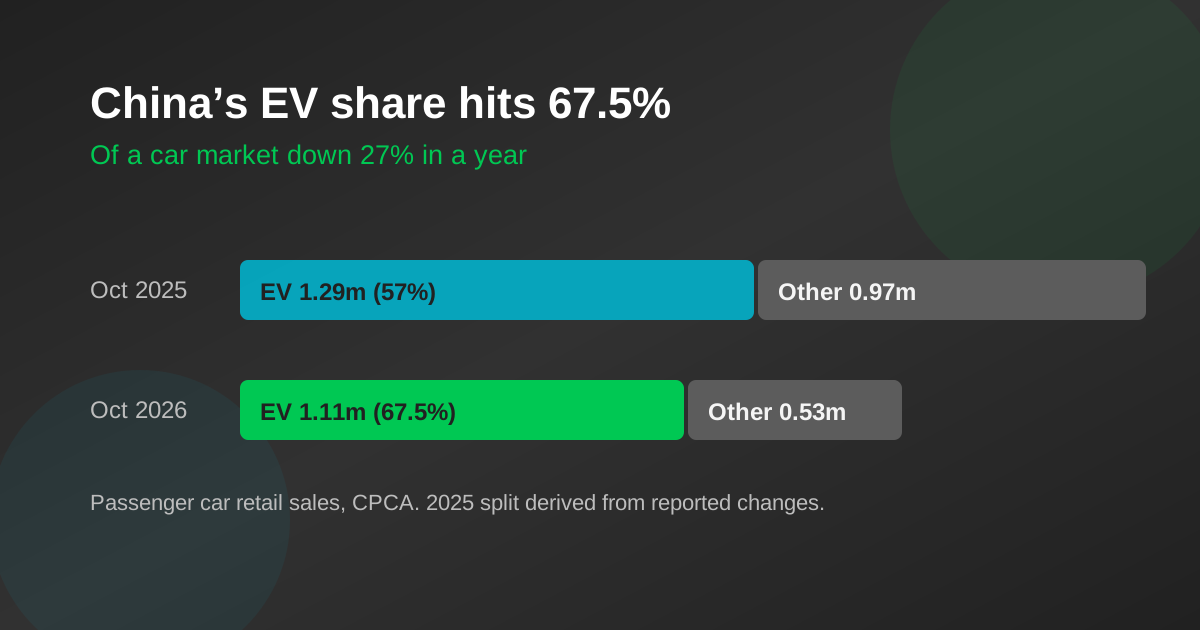
New energy vehicles — battery-electric cars and plug-in and range-extended hybrids — took a record 67.5 per cent of China’s passenger car retail sales in October, according to the CPCA, up from 67.0 per cent in September and 57.2 per cent a year earlier. In the first eight days of November the share reached 74.9 per cent.
That is not because more electric cars were sold. CnEVPost reports that NEV retail sales were 1.109 million in October, down 13.7 per cent on a year earlier and the tenth straight month of year-on-year decline. The whole passenger car market fell faster: 1.643 million retail sales, down 27.1 per cent. Yicai Global, also citing the CPCA, reports that petrol car sales fell 45 per cent.
A bigger share of a smaller market
Our arithmetic from the CPCA figures: about 534,000 cars without a plug were sold at retail in October, against roughly 970,000 a year earlier. The NEV share rose because the rest of the market roughly halved, not because electric sales grew.
Within the electric total, the mix also moved, on CnEVPost’s numbers:
- •Battery-electric cars: 770,000, down 5.3 per cent year on year
- •Plug-in hybrids: 226,000, down 37.2 per cent
- •Range-extended hybrids: 114,000, up 1 per cent, helped by Xiaomi and Leapmotor
- •BYD remained the largest seller at 250,301, but that was down 15.4 per cent; Geely, second, fell 19.8 per cent
The CAAM count, which includes exports, tells the same story from the other side. Total NEV sales were a record 1.94 million, up 13.1 per cent, but domestic NEV sales were 1.334 million, down 8.6 per cent. The growth was abroad, which is the subject of a separate item.
Why the market is weak
The CPCA gives several reasons. It says “persistently high oil prices continued to accelerate the shift from gasoline vehicles to EVs,” which explains the share. It says tighter subsidy eligibility weighed on first-time buyers, leaving the smallest A00 and A-segment cars sluggish, and that trade-in subsidy funding remains available but its “marginal impact is diminishing.” Yicai reports the association also blamed “increasing industry costs and a strong consumer wait-and-see attitude.”
The early November figures were softer on volume, if not on share: CnEVPost reports NEV retail of 219,000 for 1–8 November, down 7 per cent year on year, with the whole market down 21 per cent. The CPCA expects a modest November recovery from two extra working days, colder weather and migrant workers returning home.
Electric cars now outsell everything else in China by two to one. But China’s domestic car market is more than a quarter smaller than it was a year ago, and electric sales have fallen with it for ten months running.
What it means for this business
Wingzman builds LFP packs for e-rickshaws, two- and three-wheelers and storage from cells that are mostly made in China. A shrinking Chinese car market matters to that in two limited ways:
- •Chinese carmakers and their battery suppliers built capacity for a home market that is now buying fewer cars; that output is increasingly going abroad, as the export figures show
- •The CPCA names high oil prices as the driver of the switch; the same prices are pushing Indian fleet operators toward electric three-wheelers
- •None of this sets Indian cell prices directly: those follow lithium, Chinese tax changes and the exchange rate
On the oil link, see how oil above $100 reaches an Indian battery. For the wider picture, see where global EV sales are growing in 2026 and why China dominates battery cells.
Sources
Reporting this piece draws on. Figures were correct as published; scheme terms and commodity prices move.
- China October NEV retail sales fall 13.7% as penetration hits record 67.5%, CPCA data showsCnEVPost · 9 November 2026
- China NEV market share in October: BYD leads with 22.4%, Tesla drops out of top 10CnEVPost · 10 November 2026
- China's Car Sales Fall for 13th Straight Month in October; NEV Adoption Hits New HighYicai Global · 11 November 2026
- China NEV sales rise 13.1% to record 1.94 million in October, CAAM data showsCnEVPost · 11 November 2026
- China NEV retail sales fall 7% in first 8 days of November as penetration reaches 74.9%CnEVPost · 11 November 2026
Terms in this article
Frequently asked questions
What share of China’s car sales were electric in October 2026?+
A record 67.5 per cent of passenger car retail sales were new energy vehicles, according to the China Passenger Car Association, up from 57.2 per cent a year earlier. In the first eight days of November the share was 74.9 per cent.
Are electric car sales in China still growing?+
Not at home. NEV retail sales were 1.109 million in October, down 13.7 per cent year on year and the tenth straight monthly decline. The share rose because the whole market fell 27.1 per cent and petrol car sales fell about 45 per cent. Total NEV sales including exports were a record 1.94 million on CAAM data.
Why is China’s car market shrinking?+
The CPCA cites tighter subsidy eligibility for first-time buyers, a diminishing effect from trade-in subsidies, rising industry costs and a wait-and-see attitude among consumers. It says high oil prices are speeding the switch from petrol to electric.
Thinking about upgrading?
Talk to our team about the right pack for your vehicle, and about EMI options that keep the monthly outgo close to what you already spend.
Popular: Lithium e-rickshaw battery