The Fastest-Growing EV Market in 2026 Is Called “Rest of World”
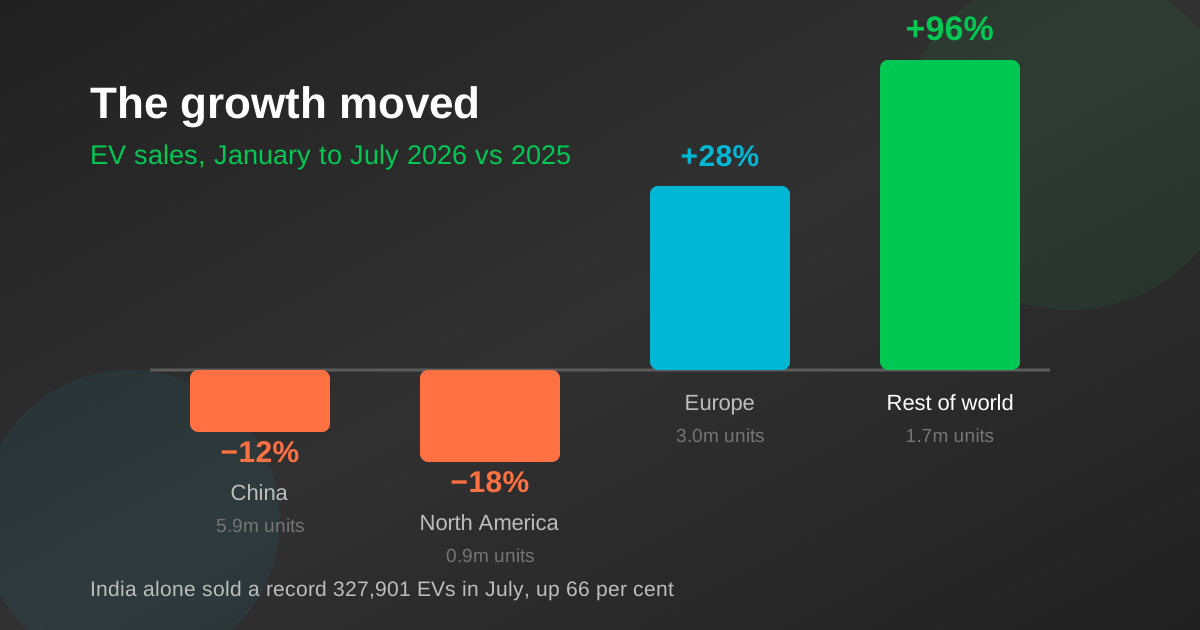
Global EV sales are up 4 per cent this year, which is the average of China down 12, North America down 18, Europe up 28 and everyone else up 96. India registered a record 327,901 EVs in July alone.
Published: 26 August 2026
Mobility · 8 min read
Where things stand
Written 26 August 2026. Monthly sales trackers revise, and different houses draw the boundary between battery-electric and plug-in hybrid differently. Read the direction, not the third significant figure.
Global electric vehicle sales reached about 1.85 million in July 2026, up 9 per cent on the same month last year, taking the year to date to roughly 11.5 million units — about 4 per cent ahead of 2025.
Four per cent sounds like a market going flat. It is not. It is the average of four regions moving violently in opposite directions.
The four markets
- •China: 5.9 million units, down 12 per cent. Still by a wide margin the largest EV market on earth, and still around 64 per cent of its own domestic car sales — but no longer the source of growth.
- •North America: 0.9 million units, down 18 per cent. July alone was down 27 per cent. This is what happens to a market when the purchase incentives underneath it are withdrawn.
- •Europe: 3.0 million units, up 28 per cent. France up 81 per cent year on year with EVs at 37 per cent of its car market, Germany up 46 per cent, the United Kingdom up 43 per cent.
- •Rest of world: 1.7 million units, up 96 per cent. The smallest of the four blocks, growing faster than the other three combined, and now larger than North America.
For the first time, the market that used to be the rounding error is the market that is growing. “Rest of world” nearly doubled in a year and overtook North America, and India is a large part of the reason.
What India contributed
India registered a record 327,901 electric vehicles in July 2026, up about 66 per cent year on year, having crossed 12 per cent EV penetration for the first time in June. Full-year FY2026 came in around 2.45 million units, roughly 25 per cent up, with all four segments growing double digits.
The composition matters more than the total. Electric took 65.1 per cent of three-wheeler registrations in July — not a transition under way, a transition largely finished. Nothing comparable has happened in any four-wheeler market anywhere.
This is the point we keep returning to: India is not a small version of the Chinese or European EV market. It is a different market that happens to use the same cells, and it got there through three-wheelers and two-wheelers earning their keep, not through subsidised cars.
Reading these numbers honestly
- •Growth rates on small bases flatter. Rest-of-world at +96 per cent is 1.7 million units; China at −12 per cent is 5.9 million. A percentage cannot tell you which one moved more cells.
- •Registrations are not deliveries and neither is production. Indian monthly figures are usually VAHAN registrations, which miss states outside the portal and lag on paperwork.
- •Segment mixes are not comparable across countries. An Indian EV is most often a two- or three-wheeler with a 2 to 12 kWh pack; a European one is a car with 50 to 80 kWh. Unit counts and GWh demand tell completely different stories.
- •A policy-driven fall is not the same as a demand-driven one. North America did not lose interest in electric cars; it lost a tax credit. Those recover differently.
What it changes here
Two practical consequences for anyone buying batteries in India.
First, cell demand is not softening just because China and North America are down. The growth blocks are Europe and rest-of-world, and both import their cells. Anyone waiting for a demand slump to deliver cheap packs is reading the wrong line of the table — which is consistent with what we found on cell supply tightness.
Second, India is now big enough to be worth designing for rather than adapting to. A market adding a third of a million vehicles a month, most of them commercial three-wheelers running long daily duty cycles in high ambient temperatures, is a specification in its own right. We have written on what that means for packs working in Indian heat.
Sources
Reporting this piece draws on. Figures were correct as published; scheme terms and commodity prices move.
- Global EV sales hit 1.85 million in July 2026 as Europe surges and China recoversElectric Cars Report · 13 August 2026
- India electric three-wheelers cross 65% as July EV record tops 327,000 unitsTech Times · 7 August 2026
- EV sales in India surpass 2.45 million units in FY2026, all 4 segments register double-digit growthAutocar Professional
- Electric Vehicle Outlook 2026: global EV sales set for another record-breaking year, but growth in some major markets slowsBloombergNEF
Frequently asked questions
Are global EV sales slowing down in 2026?+
Only in aggregate, and the aggregate is misleading. Sales through July 2026 were about 11.5 million units, roughly 4 per cent ahead of 2025. That average is made of China at 5.9 million and down 12 per cent, North America at 0.9 million and down 18 per cent, Europe at 3.0 million and up 28 per cent, and rest-of-world at 1.7 million and up 96 per cent. Four regions moving in opposite directions, not one market going flat.
Why did EV sales fall in North America?+
Because the purchase incentives underneath them were withdrawn. July alone was down 27 per cent year on year. That is a policy-driven fall rather than a collapse in consumer interest, and the two recover on very different timescales.
How is India doing on EV sales?+
India registered a record 327,901 electric vehicles in July 2026, up about 66 per cent year on year, having crossed 12 per cent EV penetration for the first time in June. FY2026 came in around 2.45 million units, roughly 25 per cent up, with all four segments growing double digits.
Which Indian vehicle segment has actually gone electric?+
Three-wheelers. Electric took 65.1 per cent of three-wheeler registrations in July 2026 — not a transition under way but one largely finished. No four-wheeler market anywhere has done anything comparable. It happened because the vehicles earn their keep on running cost, not because of a subsidised purchase decision.
Does a weaker Chinese EV market mean cheaper batteries?+
Not on this evidence. The blocks that are growing — Europe and rest-of-world — both import their cells, so cell demand is not softening. Anyone waiting for a demand slump to deliver cheap packs is reading the wrong line of the table.
Want this applied to your own numbers?
Every solution page carries a calculator that shows its own arithmetic — storage savings, lithium against lead-acid, and home pack sizing.
Get in touch