China Extends Its Battery Export-Control Pause by Two Months, Not a Year
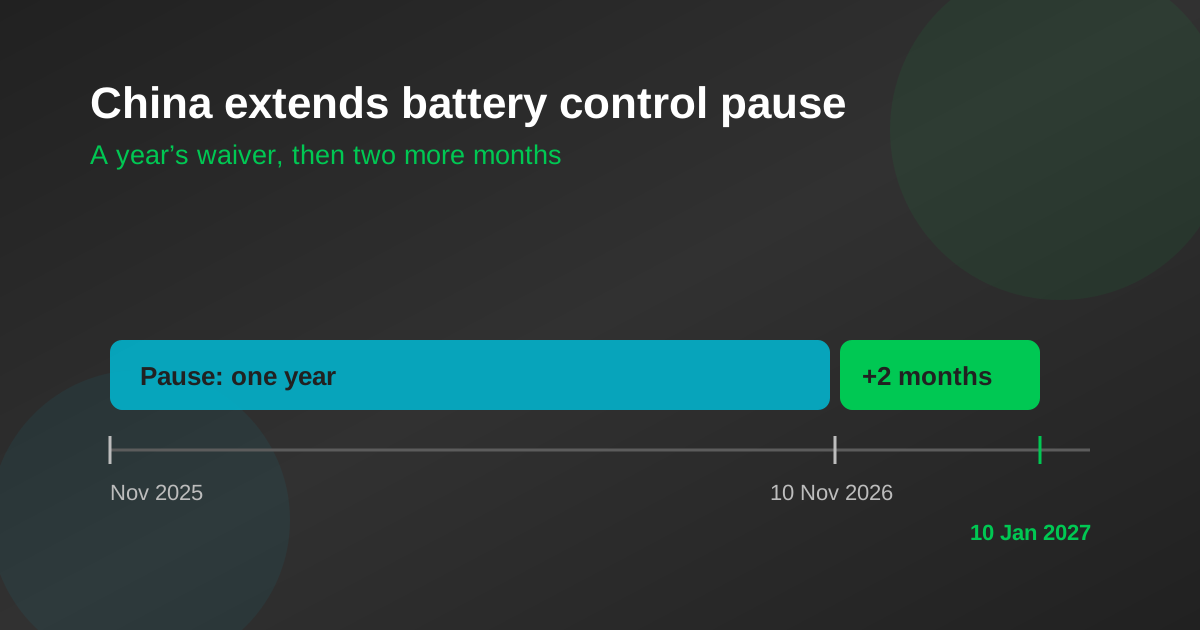
China’s pause on its controls over high-end lithium batteries, cathode, graphite anode and rare earths was due to end on 10 November. Beijing extended it to 10 January 2027, two months rather than another year, as trade talks with Washington continue.
Published: 12 November 2026
Policy · 3 min read
What happened
Written 12 November 2026, on Reuters reporting of 9 November, Benchmark Mineral Intelligence and The National on 9–10 November, and SMM’s October 2025 summary of the controls themselves.
China’s one-year pause on its October 2025 export controls for lithium batteries, battery materials and rare earths was due to run out on 10 November 2026. It did not lapse. Reuters reports that the Ministry of Commerce announced on Monday 9 November a two-month extension of the waivers, to 10 January 2027, in a brief statement that “gave no other details.”
Benchmark Mineral Intelligence reports that the extension covers rare earths, lithium-ion batteries and graphite anode materials, that the notice was published one day before the original suspension expired, and that no reason was given for the length of the extension.
What the controls would cover
The battery measures are Announcement No. 58 of 2025. SMM’s summary at the time lists what would need an export licence if the pause ended:
- •Lithium-ion cells and packs with an energy density of at least 300 Wh/kg, a level SMM described as far above ordinary power batteries
- •LFP cathode material with a compaction density of at least 2.5 g/cm³ and a capacity of at least 156 mAh/g
- •Nickel-based cathode precursors and lithium-rich manganese cathode material
- •Artificial graphite anode material and blends of artificial and natural graphite
- •Cell-making equipment such as winding, stacking, electrolyte filling and formation systems, and cathode and anode production equipment
SMM also noted that “control does not equate to prohibition”: the measures set up licensing rather than a ban, and in SMM’s reading were aimed mainly at slowing the overseas localisation of the battery supply chain.
Two months, not twelve
The pause was part of the trade truce agreed between China and the United States after the Xi–Trump summit in South Korea in late 2025. Reuters reports that the extension came alongside a wider suspension of Chinese trade countermeasures and tariffs as Beijing negotiates a lasting agreement with Washington. The National reports that China’s finance ministry will suspend a 24 per cent tariff on US goods for two months while keeping a 10 per cent levy, and that Trump and Xi are expected to meet at the APEC summit in Shenzhen.
The first pause ran for a year. This one runs for two months. The controls are still written and could be switched back on in January if the talks go badly.
What it means for this business
Wingzman assembles LiFePO4 packs for e-rickshaws, two- and three-wheelers and storage. For a pack assembler the extension changes nothing on the ground for now, and there are limits to how much the controls would bite even if they came back:
- •Mainstream LFP cells sit well below the 300 Wh/kg cell threshold, so finished LFP cells for mobility or storage were not the main target
- •The exposure is further up the chain: high-density LFP cathode, graphite anode and cell-making equipment are what India’s own cell plants need to import
- •A licence regime, if revived, would add paperwork and delay for those plants rather than an outright stop, on SMM’s reading
- •The short extension means 10 January 2027 is the next date to watch; we will report what happens then
For why so much of the chain runs through China, see the refining chokepoint in the battery supply chain and India’s BESS cell manufacturing gap. For the chemistry itself, see LFP battery in our glossary.
Sources
Reporting this piece draws on. Figures were correct as published; scheme terms and commodity prices move.
- China extends suspension of new rare earth controls until JanuaryReuters (via Investing.com) · 9 November 2026
- China extends pause on rare earth and battery export controls until 2027Benchmark Mineral Intelligence · 10 November 2026
- China extends pause on rare earth export curbs for two monthsThe National · 9 November 2026
- [SMM Analysis] China Implements Export Controls on Lithium Batteries and Key Materials Covering High End Batteries and Artificial Graphite AnodesShanghai Metals Market (SMM) · 9 October 2025
Terms in this article
Frequently asked questions
Did China’s battery export controls come back on 10 November 2026?+
No. Reuters reports that China’s Ministry of Commerce announced on 9 November a two-month extension of the waivers, so the pause now runs to 10 January 2027. Benchmark Mineral Intelligence reports that it covers rare earths, lithium-ion batteries and graphite anode materials.
What would the battery controls cover?+
According to SMM’s summary of Announcement No. 58 of 2025: lithium-ion cells and packs of at least 300 Wh/kg, LFP cathode with compaction density of at least 2.5 g/cm³ and capacity of at least 156 mAh/g, nickel-based precursors, artificial graphite anode, and cell, cathode and anode production equipment. Exports of these would need a licence.
Does this affect LFP battery packs sold in India?+
Not directly for now, since the controls remain paused. Mainstream LFP cells sit well below the 300 Wh/kg threshold; the larger exposure is for Indian cell makers importing high-density cathode, graphite anode and cell-making equipment, if the controls are revived after 10 January 2027.
Want this applied to your own numbers?
Every solution page carries a calculator that shows its own arithmetic — storage savings, lithium against lead-acid, and home pack sizing.