The Real Battery Chokepoint Is Not Cells — It Is Refining
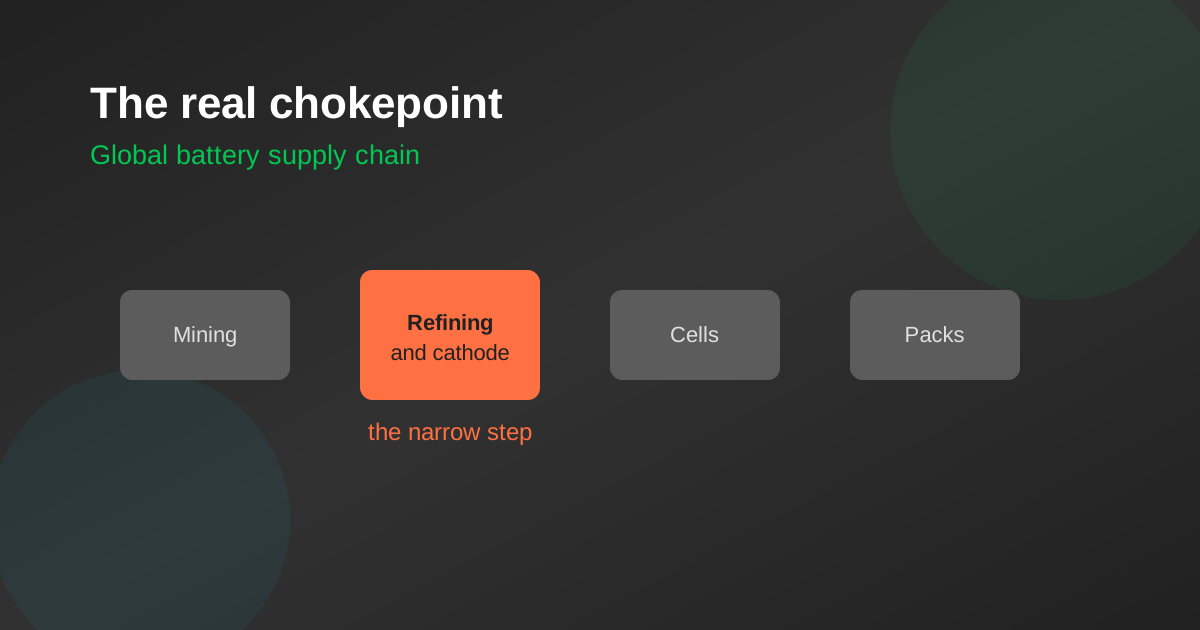
Mining is globally distributed and gigafactories can be built in three years. The step between them is concentrated far more heavily than either, and it is where the leverage actually sits.
Published: 15 August 2026
Industry · 8 min read
Everyone watches the wrong step
Public debate about battery supply chains concentrates on two ends: where the lithium is mined, and where the cells are assembled. Both are visible, both make good photographs, and neither is where the leverage sits.
The chokepoint is the middle — turning mined ore into battery-grade chemicals, and those chemicals into cathode and anode materials. That step is concentrated far more heavily than either mining or cell assembly.
Mining is distributed. Refining is not.
Lithium is mined in Australia, Chile, Argentina and increasingly Africa. Cobalt comes overwhelmingly from the Democratic Republic of Congo. Nickel is concentrated in Indonesia. Graphite is mined in several countries.
Yet a large majority of all of it is refined in China, regardless of where it came out of the ground. Australian spodumene is routinely shipped to China for conversion. The country that holds the mine frequently does not hold the step that makes the material usable.
For anode graphite in particular, the concentration is close to total. Synthetic and spherical graphite processing is one of the narrowest points in the entire chain.
Why refining stayed concentrated
- •It is chemically demanding and low margin. Battery-grade purity is exacting, the process is unglamorous, and returns are thin. Firms elsewhere chose not to compete for it.
- •It is environmentally heavy. Refining and graphite processing carry meaningful pollution burdens, and permitting is slow or effectively impossible in many jurisdictions.
- •It rewards clustering. Refineries, cathode plants and cell factories located near each other cut logistics and quality-loop time. Once a cluster exists it is very hard to replicate elsewhere piecemeal.
- •Deliberate policy. This position was built over two decades with sustained state support, not acquired accidentally.
Why it matters more than cell capacity
Cell factories can be built in three to four years given capital and will, and several countries are doing exactly that. A refinery and cathode plant chain takes comparable time, requires environmental approvals that are far harder to obtain, and needs process knowledge that is not on the open market.
The consequence is uncomfortable: a country can build gigafactories, announce independence, and remain fully dependent, because those factories still import cathode and anode. Cell capacity without midstream capacity is assembly, not sovereignty.
What is being attempted elsewhere
- •Direct support for refining and cathode capacity, rather than only for cell plants
- •Local content rules that count midstream value rather than final assembly
- •Long-term offtake agreements between miners and non-Chinese refiners, to make new plants financeable
- •Recycling as a domestic source of refined material — attractive in principle, but constrained for years by how few packs have reached end of life
None of these is fast. All of them take the better part of a decade to change the picture materially.
What it means if you buy batteries in India
Two practical implications. First, price volatility in your packs may originate several steps upstream and have nothing to do with your supplier’s margins. Second, when a vendor says a battery is Indian, it is worth asking precisely which step happened here — pack assembly, cell manufacture, or cathode production. The answer is usually the first, and that is not a criticism, but it should be stated honestly rather than implied away.
Our spec sheet guide covers what to ask a supplier about cell origin and grade.
Frequently asked questions
Where is the real bottleneck in the battery supply chain?+
The midstream — refining ore into battery-grade chemicals and converting those into cathode and anode materials. Mining is distributed across many countries and cell assembly can be built anywhere with capital, but refining is heavily concentrated, and for anode graphite the concentration is close to total.
Why did refining stay concentrated in one country?+
It is chemically demanding, low margin and environmentally heavy, so firms elsewhere chose not to compete for it and permitting is slow or impossible in many jurisdictions. It also rewards clustering near cathode and cell plants, and it was built deliberately with sustained state support over two decades.
Can building gigafactories make a country self-sufficient in batteries?+
Not on its own. A cell plant that imports cathode and anode is assembly rather than independence. Genuine self-sufficiency requires the midstream too, which takes longer, is harder to permit and requires process knowledge that is not freely available on the open market.
Thinking about upgrading?
Talk to our team about the right pack for your vehicle, and about EMI options that keep the monthly outgo close to what you already spend.
Get in touch