Beyond Lithium: Long-Duration Energy Storage Options Explained
Pumped hydro, flow batteries, sodium-ion, iron-air, compressed air and thermal storage compared on duration, efficiency and maturity, and where each fits against two-to-four-hour LFP.
Published: 11 October 2026
Grid storage · 5 min read
What lithium is good at, and where it stops
Lithium iron phosphate batteries have become the default for grid and commercial storage because they are very good at one job: storing a few hours of energy and returning it efficiently, many thousands of times. Two to four hours of duration covers the evening peak after a solar day, which is exactly the problem most grids now have.
The economics change as duration grows. A lithium system’s cost scales almost linearly with energy: twice the hours means roughly twice the cells. For eight, twelve or twenty-four hours, or for storing energy across days and seasons, that gets expensive quickly. Technologies whose energy is cheap to add — a bigger reservoir, a bigger tank, a bigger cavern — start to look attractive.
That is the territory called long-duration energy storage. Here are the main contenders, what each is good for, and how mature each is.
Pumped hydro: the incumbent
Pumped storage hydro moves water between two reservoirs at different heights: pump it up when energy is cheap, release it through turbines when energy is needed. It is the oldest form of grid storage and still holds the large majority of stored energy capacity worldwide.
- •Round-trip efficiency typically around 70 to 80 per cent
- •Durations of six to ten hours or more are routine, set by reservoir size
- •Asset life measured in many decades, far longer than any battery
- •Needs specific geography, long construction periods and environmental clearances
India has substantial pumped storage potential, much of it in hilly states and at existing reservoirs that can be paired with a new lower or upper pond. It is a natural long-duration partner for a solar-heavy grid, but it is a utility-scale, multi-year proposition, not something a factory can buy.
Flow batteries
A flow battery stores energy in liquid electrolytes held in external tanks and pumped through a cell stack. The stack sets the power; the tanks set the energy. To add hours, you add electrolyte and tank volume, not more stacks. The best-established chemistry uses vanadium in both electrolytes.
- •Round-trip efficiency typically around 65 to 75 per cent, below lithium
- •Very long cycle life with little capacity fade, and the electrolyte retains value at end of life
- •Non-flammable aqueous electrolyte, which simplifies fire risk
- •Bulky, with pumps and plumbing to maintain, and exposed to vanadium price swings
Flow batteries are commercially deployed but at a far smaller scale than lithium. They make most sense for sites that need four to ten hours, cycle daily, and value long life over compactness.
Sodium-ion, iron-air and other chemistries
Sodium-ion is not really a long-duration technology; it is a cheaper-materials cousin of lithium-ion, with similar durations and somewhat lower energy density. Its appeal is that sodium is abundant and the supply chain avoids lithium, and it tolerates cold well. It competes with LFP in the two-to-four-hour segment rather than replacing pumped hydro. We covered its commercial arrival in sodium-ion’s move from pilot to production.
Iron-air batteries store energy by rusting and un-rusting iron. The materials are extremely cheap, which makes durations of a hundred hours conceivable, aimed at multi-day gaps in wind or solar. The cost is low efficiency — well under lithium, roughly half of what goes in comes back in many designs — and the technology is at an early commercial stage.
Compressed air and thermal storage
- •Compressed air. Air is compressed into an underground cavern or vessel and later expanded through a turbine. Older plants burned gas during expansion; newer adiabatic designs store the heat of compression to avoid that. Efficiency varies widely by design, and suitable caverns are a geographic constraint.
- •Thermal storage. Energy is stored as heat in molten salt, crushed rock, sand or blocks of carbon. It is cheap to store and very effective when the end use is heat. Converting heat back to electricity is inefficient, so the strongest cases are industrial process heat and concentrated solar plants.
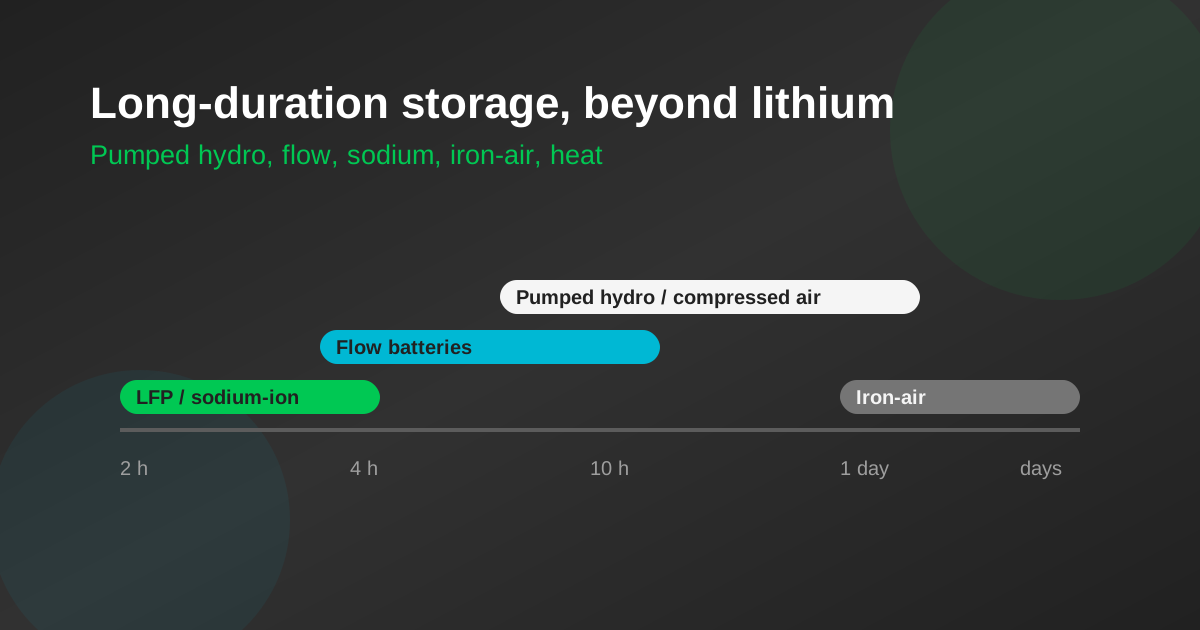
The useful distinction is not old versus new, but what the storage is for. Daily shifting of a few hours favours lithium or sodium-ion. Overnight-plus shifting at utility scale favours pumped hydro or flow. Multi-day firming is where iron-air and compressed air are aiming. Heat that will be used as heat is where thermal storage wins.
Where each fits against two-to-four-hour LFP
- •Two to four hours, daily cycling: LFP, with sodium-ion as an emerging alternative
- •Four to ten hours: flow batteries and pumped hydro compete with longer-duration LFP
- •Ten hours and beyond: pumped hydro and compressed air, where geography allows
- •Multi-day and seasonal: iron-air and other early-stage technologies, plus hydrogen in principle
- •Process heat: thermal storage, often charged directly from solar or cheap grid hours
In practice, grids will use several of these at once. Lithium is likely to remain the default for the daily peak for some time, with long-duration technologies added as the share of solar and wind rises. Our explainers on grid-scale battery storage in India and sizing a plant by power, energy and duration go deeper on the lithium side.
What this means for a buyer
For a factory or commercial building, the practical choice today is still almost always lithium iron phosphate. The problems a site battery solves — evening peaks, demand spikes, short outages, storing midday solar — sit squarely in the two-to-four-hour range, and the alternatives are either utility-scale, early-stage or built for heat.
The exception is a site with a large process-heat load, where thermal storage may beat a battery outright. For everyone else, long-duration storage matters indirectly: as more of it reaches the grid, it will shape the tariff signals that a site battery responds to. That is a reason to keep the economic case for a site battery grounded in your own bills, not in assumptions about the grid a decade out.
Terms in this article
Frequently asked questions
What is long-duration energy storage?+
Storage designed to deliver energy for longer than the two to four hours typical of lithium batteries, from around eight hours to several days. It includes pumped hydro, flow batteries, compressed air, thermal storage and newer chemistries such as iron-air, whose energy capacity is cheap to add.
Is pumped hydro better than batteries?+
They suit different jobs. Pumped hydro offers long durations and a life of many decades, but needs suitable geography and years to build. Lithium batteries are faster to deploy and more efficient for daily shifting of a few hours. Grids with a large share of solar and wind generally use both.
Should a factory consider a flow battery instead of lithium?+
Rarely, for now. Most site needs — evening peaks, demand spikes, short outages and storing midday solar — fall within two to four hours, where lithium iron phosphate is cheaper and more compact. A flow battery may suit a site that needs many hours of daily discharge and values very long life over footprint.
Is storage right for your site?
Send us a month of electricity bills and your load profile, and we will tell you what a battery would save — including when it would not pay.