Grid-Forming vs Grid-Following Inverters: What Batteries Do for a Weak Grid
Most inverters follow the grid. Grid-forming inverters set its voltage and frequency themselves, which is why batteries are becoming the stabilising anchor of renewable-heavy networks.
Published: 11 October 2026
Grid storage · 5 min read
The grid used to hold itself up
For a century, the stability of an alternating-current grid came almost for free. Coal, gas, hydro and nuclear stations turn large synchronous generators, spinning in lockstep with the grid frequency. Their rotating mass resists any change in speed, and their physics makes them push back instantly against a dip in voltage. Nobody had to program that behaviour; it came with the steel.
Solar panels, wind turbines and batteries have no such machine. They connect through power electronics — inverters — and an inverter does exactly what its control software tells it to. As more of the generation on a grid comes through inverters, the question of what that software should do stops being a detail and becomes the central question of grid stability. For the wider picture of how power moves across a network, see how power transmission works.
Grid-following: listen, then inject
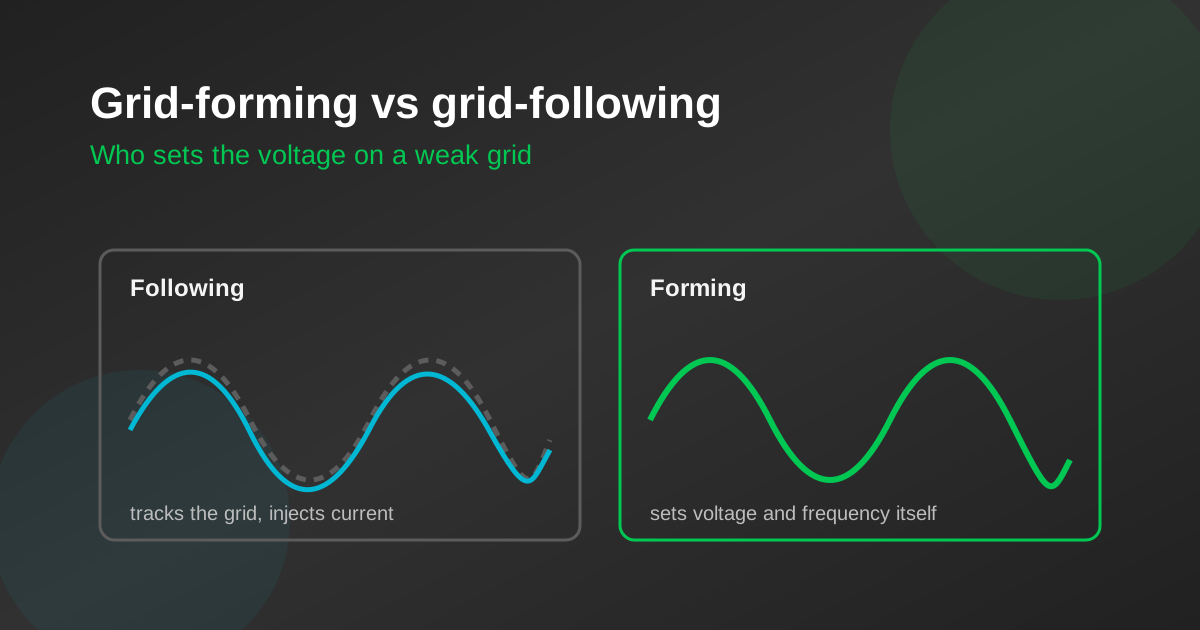
Almost every inverter installed to date is grid-following. It measures the voltage at its terminals, locks on to its phase and frequency with a control loop known as a phase-locked loop, and then injects a current in step with it. In effect it behaves as a controlled current source: it assumes someone else is setting the voltage and frequency, and it follows.
This works well on a strong grid, where plenty of synchronous machines hold the voltage steady. It struggles on a weak one. If the voltage the inverter is trying to follow is itself being pushed around by the inverter’s own output — which happens at the end of a long line with little else connected — the control loops can interact and oscillate. And a grid-following inverter cannot run at all if the grid disappears, because there is nothing left to follow.
Grid-forming: set the voltage, let current follow
A grid-forming inverter inverts that logic. It behaves as a voltage source: it generates its own voltage waveform at a set magnitude and frequency, and lets the current be whatever the network draws. When the load suddenly increases, the inverter responds immediately, from the physics of the circuit rather than after measuring the change and deciding what to do.
Many grid-forming designs deliberately mimic a synchronous machine in software, with a virtual rotor whose speed changes slowly in response to power imbalance. That is what gives the inverter its stabilising character.
- •Inertia-like response. It resists sudden changes in frequency in the first instants after a disturbance, before slower controls act.
- •Voltage support. It holds voltage up during disturbances rather than chasing it down.
- •Weak-grid operation. It remains stable where the connection is electrically distant and grid-following inverters would oscillate.
- •Islanding and black start. It can energise a dead network section and hold it up, so other plants can resynchronise.
Synthetic inertia, and why the battery matters
Grid-following inverters can be programmed to help with frequency too, by measuring the rate of change of frequency and injecting power in response. This is often called synthetic inertia or fast frequency response, and it is valuable. But it is reactive: it has to detect the event first, so it arrives after a short delay. Grid-forming response is inherent and arrives at once.
Either way, the inverter needs energy behind it to deliver the response. A solar inverter running at full output has no headroom to push more power when frequency falls. A battery does, provided its control system keeps some state of charge and power capacity in reserve. That is why grid-forming capability is most naturally delivered by battery storage, and why grid-forming batteries are becoming the stabilising anchor of high-renewable networks.
The limit is fault current. A synchronous generator can briefly deliver several times its rated current into a fault, which is what protection relays rely on to detect it. Inverters are limited by their semiconductors to little more than rated current. Grid-forming control helps, but protection schemes on inverter-dominated grids still have to be designed with this in mind.
Why grid codes are moving
Grid codes — the technical rules a plant must meet to connect — were written for a world of synchronous machines and grid-following renewables riding on top of them. As the share of inverter-based generation grows, system operators need new sources of the stability that the old plants supplied as a by-product. Several operators, notably in Australia and Great Britain, have already written specifications for grid-forming capability, and the direction elsewhere is similar.
The cost of grid-forming is modest but real: inverters may need some extra current rating, the battery must hold reserve headroom, and the control design and testing are more involved. Those costs are small compared with the alternatives, which include building synchronous condensers or curtailing renewables to keep enough conventional plant online.
Why this matters for Indian renewable zones
India’s best solar and wind resources are often a long way from its largest loads. Large renewable parks in western Rajasthan, the Kutch region of Gujarat and the Deccan plateau connect through long high-voltage lines to a network whose synchronous plant sits elsewhere. Electrically, these are classic weak-grid locations: many inverters, little local stiffness, long distances to the machines that hold the voltage.
That is exactly where grid-following plants run into stability limits, and where grid-forming storage adds the most value. A battery at a renewable hub can steady local voltage, damp oscillations, and allow more renewable capacity to connect to the same transmission before stability rather than thermal capacity becomes the constraint. Our explainers on grid-scale storage in India and site selection and grid connection cover the wider context.
What a buyer should ask
For a utility-scale plant, grid-forming capability is increasingly worth specifying even where it is not yet mandatory, because retrofitting it later may require new inverter firmware, new studies and new connection approvals. Ask whether the PCS supports grid-forming mode, whether it has been demonstrated at scale, how much reserve headroom it needs, and how its behaviour has been modelled for your connection point.
For a factory or commercial site, the question is narrower. Grid-forming capability is what lets a battery keep a site running when the grid drops, as an island, rather than simply switching off with it. If backup matters to your operation, ask whether the system can island seamlessly, which loads it can carry, and how it resynchronises when the grid returns.
Terms in this article
Frequently asked questions
What is a grid-following inverter?+
A grid-following inverter measures the grid voltage, locks on to its phase and frequency, and injects current in step with it. It relies on the grid being strong enough to set a stable reference, and it cannot operate if the grid disappears. Almost all solar, wind and battery inverters installed to date work this way.
What is a grid-forming inverter?+
A grid-forming inverter behaves as a voltage source, setting its own voltage and frequency and letting current follow the load. It responds to disturbances instantly rather than after measuring them, can operate on weak grids, and can energise a dead network for black start or islanded operation.
Why do grid-forming inverters need batteries?+
Stabilising the grid means delivering extra power the moment frequency or voltage dips. A solar inverter already at full output has no headroom to do that. A battery does, provided its control system keeps some energy and power in reserve, which is why grid-forming capability is most often delivered by storage.
Is storage right for your site?
Send us a month of electricity bills and your load profile, and we will tell you what a battery would save — including when it would not pay.